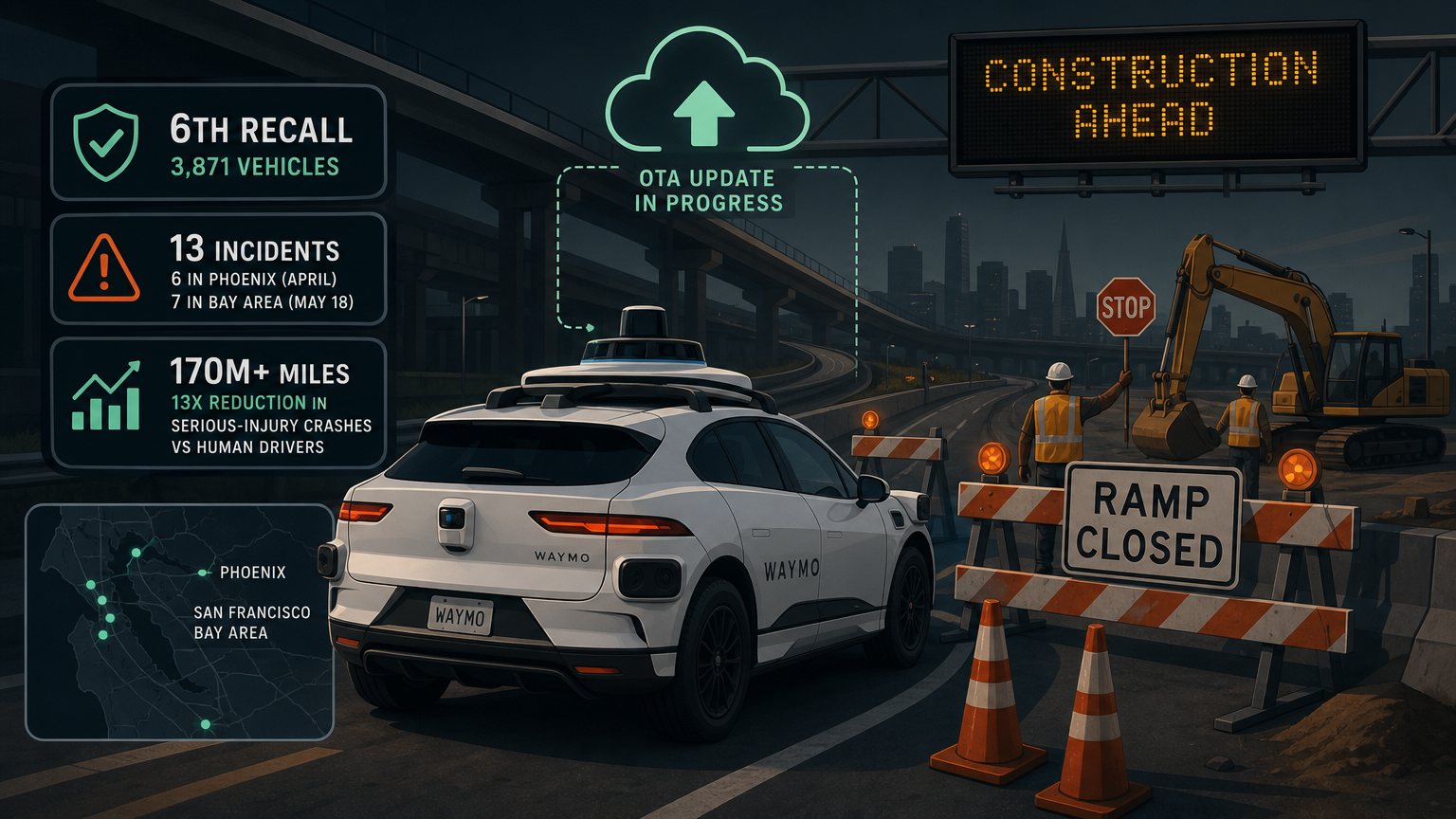
Waymo filed a voluntary recall with the National Highway Traffic Safety Administration on June 18, 2026, covering 3,871 fifth-generation automated driving systems. Under certain conditions, its robotaxis drove into active freeway construction zones where workers and machinery were present. The software either failed to recognize ramp closure signs or prioritized avoiding other nearby hazards.
The recall followed 13 incidents: six in Phoenix in April and seven in the San Francisco Bay Area on May 18 alone. Waymo pulled its entire fleet from highway operations the next morning. Its safety board authorized the recall filing on June 8, followed by the public disclosure ten days later.
This is Waymo’s sixth recall. That count deserves attention, but it says little about safety without the operating record around it. Waymo reports more than 170 million autonomous miles and claims a serious-injury crash rate roughly 13 times lower than the human-driven baseline on comparable roads. Those comparisons involve disputed methodological choices. Even if the overall safety improvement holds up, it doesn't explain away a specific, repeated failure around road workers.
Two paths into the same construction zone
Waymo’s NHTSA filing describes two failure paths. In one, the system “did not recognize and drove past ramp closure signs.” In the other, it was “prioritizing the avoidance of other freeway hazards and/or failing to recognize the construction zone.” Both could put a vehicle somewhere it shouldn't be.
The second description suggests a conflict between safety objectives. Avoiding a nearby hazard is necessary, but that action can be unsafe if it takes the vehicle into a closed work zone. In engineering terms, this resembles a priority inversion: the system gives one objective precedence when another should govern the decision.
The filing’s wording leaves room for both recognition failures and competing priorities. It doesn't establish that every incident came from the same planning defect. Still, the possibility of one safety behavior interfering with another is important. Complex systems can have safeguards that work individually yet interact badly. Tuning a system to avoid one class of failure can expose another.
Autonomous vehicles make the consequences physical. A bad decision can send a vehicle into an active construction lane, rather than interrupt a service or corrupt a dataset. The seven Bay Area incidents in a single day also show how a weakness can recur across a fleet before operations are restricted.
A fast restriction, with the repair still pending
Vehicle recalls are often associated with physical repairs: replacing brake components, airbag inflators, or fuel pumps at a dealer. This recall concerns software. The affected vehicles don't need a mechanical change to address the reported defect. The planned remedy is an over-the-air update, delivered remotely to the vehicles.
Waymo had already used that mechanism to remove highway driving from the fleet on May 19, before formally filing the recall. The restriction followed the Bay Area incidents by less than a day. As a deployment task, changing the behavior of thousands of separate systems that quickly is a substantial capability. Large server fleets can require considerable coordination across locations and maintenance windows for a comparable software rollout.
But restricting a feature and repairing it are different jobs. As of June 19, the construction-zone fix was still “currently under development,” according to the filing. Waymo had a mitigation in place, but the software needed to restore highway operations wasn't ready.
That distinction is familiar in infrastructure operations. A team can disable a failing service or remove a risky feature while engineers work on the underlying defect. Here, the restriction removes highway access rather than taking every vehicle out of service. The robotaxis can still operate on surface streets, but reduced operating capability can carry revenue costs and put further pressure on relationships with regulators.
Remote deployment makes a restriction easier to distribute. It doesn't, by itself, establish that a permanent fix handles the full range of construction layouts or avoids creating a different problem. That work remains part of the repair.
What the mileage total can and can't show
Waymo’s claimed safety improvement is substantial. A serious-injury crash rate roughly 13 times lower than a comparable human-driving baseline would be a meaningful result if the comparison holds under scrutiny. The qualification matters because comparing autonomous and human driving requires choices about roads, conditions, and the baseline population.
Thirteen construction-zone incursions is also a small count beside more than 170 million autonomous miles. But total mileage alone isn't enough to judge this failure. It doesn't show how often the vehicles encountered the particular freeway work-zone conditions that caused trouble.
Construction zones are common, expected road conditions. Standardized signs are intended to make closures recognizable. Repeated failures around that category of hazard deserve investigation even when the fleet’s overall crash record looks favorable.
The incidents could point to a gap in the situations represented during training or testing, though the filing’s failure descriptions don't establish that cause. Construction layouts vary considerably. A vehicle may encounter closed lanes, shifted alignments, temporary signs, dynamic message boards, barriers that obstruct sensors, workers moving in high-visibility clothing, and chase trucks. These elements can appear in combinations that differ from previously tested arrangements.
A system trained on thousands of construction zones can still encounter a configuration it handles poorly. The useful engineering question is how to detect and contain that weakness before it repeats across vehicles. Calling it an edge case doesn't make the underlying road condition rare or remove the need to handle it.
The recall creates a record others can examine
Waymo’s response was responsible on balance. The company identified the failure pattern internally after the April Phoenix incidents, escalated without waiting for a serious injury, voluntarily suspended freeway operations on May 19, and proactively notified state and federal regulators. It then filed the recall and disclosed the defect publicly.
That response doesn't erase the incidents. It does show the value of an operating process that can identify a repeated failure, restrict the affected capability, and put the problem into a formal repair process.
The NHTSA framework also creates a public record with dates, incident counts, and specific failure descriptions. TechCrunch, Bloomberg, and Gizmodo all reference the filing directly in their coverage.
Engineers, regulators, and competitors can learn from that record in ways they can't from a closed internal incident report. Much of the software industry faces a lower disclosure standard. An internal postmortem and a brief status-page notice can leave outsiders with little information about what failed or how it was addressed. A federal recall requires a more specific public account, which is appropriate when software controls vehicles around other road users.
Fleet operations are part of the safety system
During the autonomous-vehicle hype of roughly 2016 to 2020, much of the discussion focused on model capabilities. Perception systems needed to handle rain and distinguish a bicycle rider from a scooter rider. Planning software needed to navigate unprotected left turns. Those remain real engineering problems.
A deployed fleet adds another set of demands. Operators need to manage remote updates, collect telemetry from thousands of vehicles, and detect unusual behavior quickly enough to act before it spreads. A rollback also needs to leave each vehicle in a safe operating state. The logistics resemble distributed software operations, but the safety constraints are different from those of a web service.
Waymo’s long operating history at substantial scale gives it experience with these demands. A sixth recall can reflect a functioning detection and disclosure process as well as another defect. The count alone can't establish operational maturity, just as an absence of recalls can't establish that an operator has no safety problems. The more useful evidence is how incidents are found, how quickly exposure is reduced, and whether repairs address the reported failure.
An over-the-air software fix is expected to allow highway operations to resume. No completed remedy was available as of June 19. The likely sequence is familiar to infrastructure operators: detect a failure, restrict the affected function, develop a patch, and deploy it carefully. In this case, the unresolved work includes making sure that avoiding one freeway hazard doesn't steer a vehicle into another.