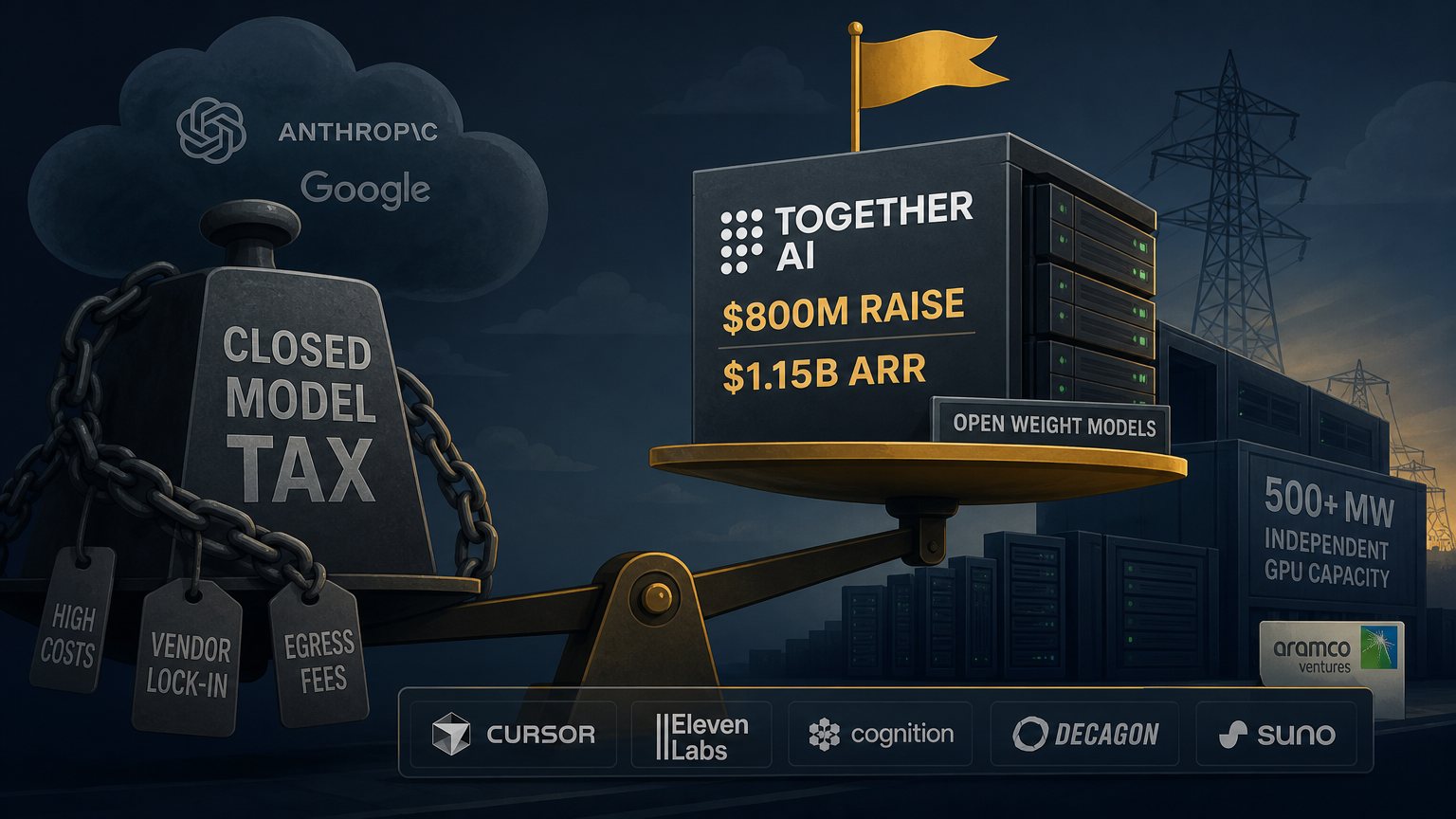
Together AI announced an $800 million Series C on July 1, 2026, at an $8.3 billion valuation. Alongside the funding, the company reported $1.15 billion in annual bookings in Q2 2026. Those figures suggest substantial demand for its main offering: running open-weight AI models on managed GPU infrastructure rather than relying entirely on closed-model APIs.
The economic argument is straightforward. A closed frontier model can be worth its price when a task needs its capabilities. For repetitive production work, that premium is harder to justify if an open-weight model can deliver comparable results for much less. Together is building a business around that difference.
The funding includes a large compute commitment
Aramco Ventures led the round, with NVIDIA, Vista Equity, General Catalyst, Emergence Capital, Salesforce Ventures, and about a dozen other investors participating. For a company founded in 2022, the reported annual bookings figure points to significant commercial scale. Bookings should still be kept distinct from recognized revenue or annual recurring revenue.
The round also includes commitments for more than 500 megawatts of compute capacity, capitalized independently by investors. The arrangement is described as giving Together direct control of GPU clusters rather than requiring it to lease that capacity from Azure or AWS.
That control matters to the service Together can offer. Its economics depend on access to compute and on how efficiently its software uses that compute. It also changes the dependency question for customers. Moving away from a closed-model API can reduce dependence on a model provider while leaving substantial dependence on the company operating the GPUs.
How much cheaper is open-weight inference?
Together claims that customers running open-weight models through its platform can achieve costs 6x to 20x lower than closed frontier APIs, with equal or better performance for their specific workloads. It cites one customer that reduced inference costs sixfold after migrating.
The qualification about workloads is important. Classification, summarization, extraction, and embedding involve different demands from complex, multi-step reasoning. An open-weight model that performs well on a narrow, high-volume task may be a good replacement even if it doesn't match a leading closed model across a broader evaluation.
DeepInfra's analysis of open and closed models puts open-model performance at roughly 90% of closed-model performance at release, with the gap closing quickly, and estimates that open models cost 87% less to run. These are provider-published comparisons, rather than a guarantee of savings for every application. The model, evaluation, and workload determine how useful the headline numbers are.
OpenRouter data cited in the comparison puts the share of tokens handled by closed models from OpenAI, Anthropic, and Google at nearly 80% in 2026. That is a measure of activity represented in OpenRouter's data, not necessarily the entire AI market. It nevertheless suggests that closed models retain a large share of usage despite the reported cost difference.
The argument that this amounts to a closed-model tax applies where a team keeps paying a capability premium it no longer needs. Switching costs and existing integrations can help explain that choice. So can a genuine performance advantage. A broad pricing comparison alone doesn't establish which explanation fits a particular application.
The software behind the GPU service
Together's technical work is central to its cost argument. Its recent releases include FlashAttention-4 optimized for NVIDIA Blackwell, the Together Megakernel, and together.compile.
The Megakernel is a fused kernel that reduces operator-level overhead across the inference stack. In simpler terms, it combines low-level work to reduce the overhead between operations. together.compile is a compilation toolchain for workload-specific kernel optimization. These tools target the efficiency of running a model, rather than changing what its weights have learned.
For customers running DeepSeek, MiniMax, or Llama, the appeal is access to an optimized inference system without having to build and maintain that system internally. A model's benchmark score doesn't establish whether a deployment will meet production speed and cost requirements. The software around the model can make a substantial difference.
A rough self-hosting break-even estimate puts the threshold at around 2 million tokens per day after infrastructure, engineering time, and operational overhead are included. That figure is best treated as a planning estimate, not a universal cutoff. Below it, managed inference may be cheaper. Above it, self-hosting can become attractive, provided the operator can do the optimization work.
Together is selling that work as part of a managed service. Its competition includes both closed-model APIs and the cost of a customer's internal infrastructure team.
Production customers and workload fit
Together's customer list includes Cursor, Eleven Labs, Cognition, Decagon, and Suno. These companies depend on AI inference in production, where per-request costs can affect product margins. Their presence supports the case that managed open-weight inference is an established infrastructure option, although a customer name alone doesn't reveal which workloads run on the platform or the savings achieved.
The strongest economic case is for high-volume work where latency requirements are moderate and the capability gap between open and closed models is small enough to accept. At those volumes, a sixfold reduction in inference costs can materially change whether a feature is affordable to operate.
There is a familiar infrastructure risk here. A convenient platform can accumulate dependencies over time. In cloud hosting, egress charges and proprietary services can make an eventual migration expensive. With AI, model behavior and API integrations can similarly make an initially convenient choice harder to revisit.
Energy is part of the investment
Aramco Ventures' role also deserves attention. Saudi Aramco is one of the world's largest energy companies, and a compute commitment exceeding 500 megawatts represents substantial power demand.
One interpretation is that energy investors see AI infrastructure as a source of future demand for their industry. That doesn't establish Aramco Ventures' specific motive, but it helps explain why an energy-linked investor might lead an inference company's funding round.
The comparison with National Grid's investments in generation capacity near data centers follows the same reasoning: expanding compute capacity requires expanding the infrastructure that supplies it. For AI operators, vendor dependencies reach beyond the model API into power, networking, and physical compute.
Choosing where to use open weights
The useful production decision is which workloads justify a closed-model premium. Several distinctions matter:
- Performance needs to be measured on the task. The case for open weights is strongest for high-volume automation where the capability gap is small. Complex, multi-step reasoning may still justify a closed frontier model.
- Cost comparisons need the full operating bill. Together's claimed 6x to 20x savings are substantial, but self-hosting comparisons also need engineering time and operational overhead.
- Managed inference has meaningful commercial scale. Together's reported $1.15 billion in annual bookings supports that conclusion without needing to treat bookings as revenue.
- Open weights reduce one kind of lock-in. The model weights can move to another provider, but the performance and cost of Together's optimized system may not move with them. Infrastructure dependency remains.
A split architecture follows from these tradeoffs: closed frontier APIs for reasoning-heavy tasks where the capability premium earns its cost, and managed open-weight inference for high-volume automation and retrieval. Analysis of enterprise AI architecture in 2026 describes this pattern emerging among companies working to improve their unit economics.
TechCrunch's reporting on the raise presents Together as a neocloud, a cloud provider focused on GPU infrastructure. That description captures the hardware business, but the investment also rests on a broader expectation: many production tasks can run economically without a closed frontier model.
Over the next twelve to eighteen months, the cost difference could prompt more teams to move suitable workloads. The hardest reasoning tasks may remain on closed APIs for longer. For high-volume applications, the choice depends on whether the current model's extra capability is worth the extra operating cost.