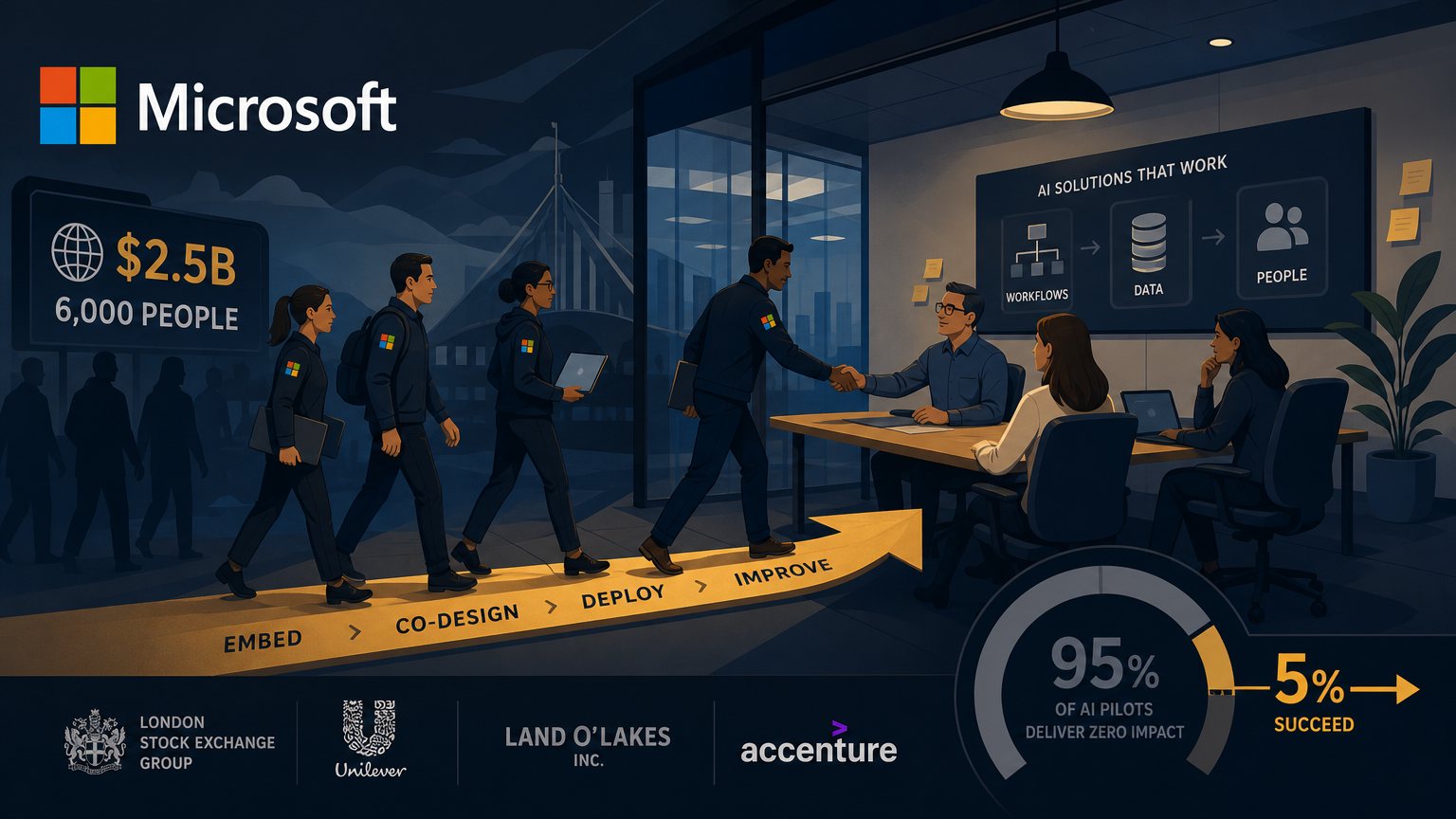
Microsoft announced Microsoft Frontier Company on July 2, 2026, a new operating unit backed by $2.5 billion and approximately 6,000 engineers and industry specialists. Its staff will work inside customer organizations to design, deploy, and improve AI systems alongside the people who use them.
The commitment addresses a problem that buying more software hasn't solved. In August 2025, MIT's NANDA initiative reported that 95% of enterprise generative AI pilots delivered no measurable impact on profit and loss. The research drew on 150 executive interviews, a survey of 350 employees, and analysis of 300 public deployments.
That finding points to a substantial gap between a successful demonstration and a useful production system. A model can perform well on a prepared task while the deployment around it struggles with internal data, established workflows, unusual cases, and employees who had little involvement in choosing the tool.
Microsoft's approach is to supply people who can work through those problems with the customer. It's a substantial commitment to the argument that organizational integration is the main obstacle to enterprise AI returns.
An established services model at a larger scale
Embedding engineers with customers isn't a new idea. IBM's Global Services division built a $20 billion business around implementation services in the 1990s. Palantir became known for forward-deployed engineers, or FDEs, who work inside government agencies and large enterprises to adapt software to their operations.
The reasoning is straightforward. Complex software needs to fit the customer's systems and working practices. Engineers who work alongside employees can see where that fit breaks down, adjust the implementation, and stay involved as it moves into production.
Judson Althoff, Microsoft's Commercial Business CEO, said Frontier Company goes beyond what has been called forward-deployed engineering. As of July 4, Microsoft hadn't fully explained that distinction. The proposed scale is clearer: about 6,000 people, compared with an estimated few hundred FDEs globally at Palantir.
Named early partners include the London Stock Exchange Group, Unilever, Land O'Lakes, and Accenture. Accenture's involvement adds a complication because it already sells systems integration services. Microsoft is partnering with a company that can also compete for enterprise implementation work. The arrangement suggests that partnerships and competition will overlap as vendors expand their deployment businesses.
Where AI pilots get stuck
The MIT NANDA study points to several problems with how organizations choose, fund, and implement AI projects. These findings support an emphasis on deployment, although Frontier Company still has to show that its approach can produce better results.
The first problem is what the researchers call the learning gap. Generic AI tools don't adapt to an organization's workflows without substantial work. Connecting Claude or Copilot to internal systems involves more than making data accessible. The deployment also has to account for proprietary terminology, business rules, and the procedures employees follow when something falls outside the normal process.
That can mean months of integration work. A pilot tested on clean, prepared data may produce convincing results while leaving those requirements untested. Production users then encounter exceptions the demonstration never covered. A tool that looked ready can still require considerable engineering before it becomes dependable.
The second problem is where the money goes. More than half of generative AI budgets in the MIT study went to sales and marketing applications. Those projects offer appealing targets such as better lead qualification, automated outreach, and faster revenue growth.
MIT found the strongest returns in back-office automation, including reduced outsourcing costs, more efficient operations, and less repetitive knowledge work. These uses may be less impressive in a board presentation, but they have costs and outcomes that can be easier to measure.
The third problem concerns the choice between buying and building. MIT reported that companies purchasing tools from specialized AI vendors succeeded about 67% of the time. Internal builds succeeded about one-third as often.
Internal development brings continuing obligations that a pilot budget can miss. Model updates can change behavior. Prompts can become less reliable as models, data, or tasks change. Data pipelines can break. Specialized vendors can draw on domain knowledge accumulated across many deployments, while an internal team has to develop and maintain that knowledge for its own system.
The fourth problem is ownership. Companies often put a central AI team or innovation lab in charge of adoption. MIT found significantly better outcomes when line managers were empowered to drive it. Those managers understand the workflow and are responsible for its results.
A central team can provide technical depth, but it may lack the authority or detailed process knowledge needed to change daily work. The practical requirement is to bring technical staff and the person accountable for the business outcome into the same project, with clear responsibility for decisions.
AI vendors are expanding into implementation
Microsoft's announcement followed several similar moves. Amazon committed $1 billion to a comparable forward-deployed AI initiative two days earlier. OpenAI and Anthropic both launched enterprise deployment ventures in May 2026.
These investments suggest that major AI suppliers see implementation as a larger part of what customers need to buy. For the previous three years, much of the competition centered on model capabilities: larger context windows, lower latency, better reasoning, and support for multiple types of input and output. Those improvements still matter, but they don't resolve problems with workflow ownership, data integration, or maintenance budgets.
The comparison with enterprise resource planning software, or ERP, is useful. ERP systems connect functions such as finance, purchasing, and operations. Their implementations have been expensive, complicated, and heavily dependent on services for roughly forty years. Implementation partners have built businesses that can earn as much as the software vendors, and successful customers have needed to develop internal expertise over time.
Enterprise AI appears to be following a similar path. Its potential reach across knowledge workers' daily tasks could make the integration effort especially broad. Better model performance won't remove the need to decide how work should change, who approves that change, and who maintains the system afterward.
Smaller organizations still need a deployment plan
The early partner list points toward large enterprises. A mid-market SaaS company, regional healthcare system, or engineering firm shouldn't assume that Microsoft's embedded teams will be available to solve its deployment problems. A premium implementation service can be a sound business while leaving much of the market to handle the same work through smaller vendors or internal teams.
The research suggests several practical choices for organizations without a large deployment partner:
- Start with one back-office workflow where failure is recoverable. Choose something repetitive, well-defined, and costly enough to justify the effort. Avoid making the first deployment customer-facing or revenue-critical. This gives the team room to learn the integration costs before the system becomes essential.
- Make the process owner responsible for the deployment. A line manager who owns the outcome should guide priorities, with an engineer responsible for implementation. Technical expertise is necessary, but it doesn't replace knowledge of the work or authority to change it.
- Consider a specialized vendor before building internally. If a vendor already addresses the problem category, evaluate that option before committing to custom development. Internal engineering capacity is more valuable for workflows that are genuinely proprietary.
- Budget for integration and maintenance explicitly. Connecting the tool to real data and keeping it working as models change can cost an estimated three to five times the initial setup. That estimate needs testing against the particular deployment, but treating setup as the whole cost leaves a serious gap in the budget.
- Define success before starting. Establish a measurable baseline and decide what improvement would justify the ongoing cost. Without that baseline, a team may be unable to show whether the tool helped, even if employees use it.
These choices don't eliminate deployment risk. They make the costs, responsibilities, and expected returns clearer before a pilot becomes a production commitment.
Implementation could shift the competitive advantage
If enterprise AI buyers increasingly choose vendors based on deployment results, established customer relationships and services capacity become more valuable. That would favor companies such as Microsoft, Salesforce, and SAP. AI labs without comparable implementation teams would need to build them or rely on partners.
There could also be room for specialists with deep knowledge of particular industries. Legal, healthcare, and financial services deployments have different workflows and requirements. An implementation partner that understands those details may offer more than a generalist team. Generalist firms could face pressure from both large vendors with extensive staffing and smaller specialists with stronger domain knowledge.
This resembles the consolidation pattern in hosting and infrastructure. Technical differences attract early customers, standardization puts pressure on margins, and operational performance becomes a stronger source of advantage. Deep integration can also make switching vendors expensive. AI infrastructure appears to be moving through that pattern quickly, though the pace remains a judgment rather than an established measure.
Microsoft's commitment gives it substantial capacity to compete on implementation. Whether 6,000 engineers and specialists can consistently turn stalled pilots into systems with measurable returns remains open. The useful test will be whether customers get deployments that fit their workflows and can be maintained at a cost the results justify.