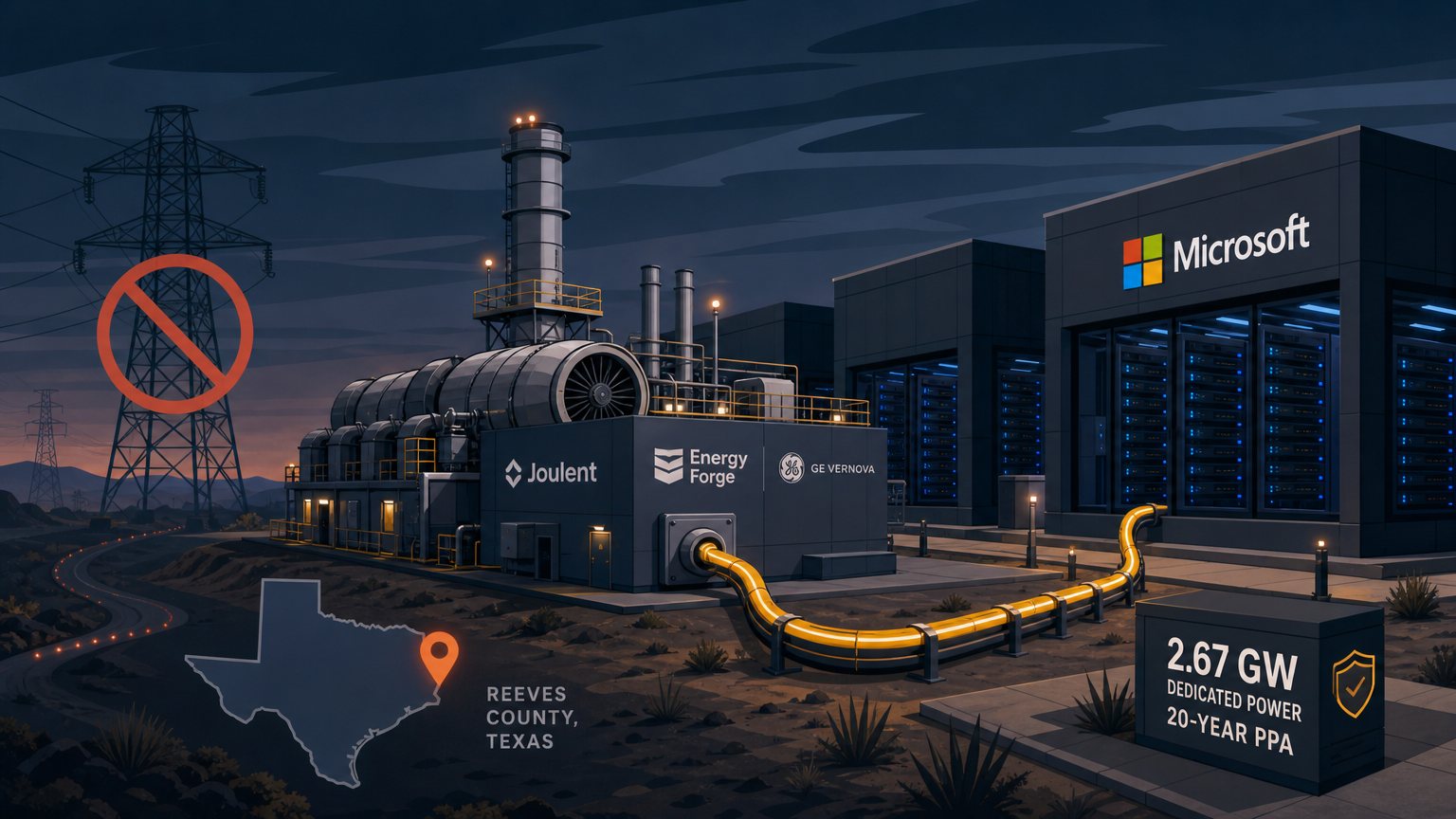
National Grid Ventures is investing $1.75 billion for a 35% stake in Joulent, a US energy startup developing dedicated power infrastructure for AI data centers. Its lead project, Kilby, is a planned 2.67-gigawatt natural gas facility in Reeves County, Texas. Joulent is co-developing it with Chevron's Energy Forge division and GE Vernova, with Microsoft as the customer under a 20-year power purchase agreement.
First power delivery is targeted for 2028. A final investment decision is expected before the end of 2026, so the investment announcement doesn't mean construction and delivery are assured.
The deal puts money from a major grid operator behind a project designed to operate without waiting for the public transmission system. That makes sense when the time needed to secure grid access threatens to exceed the useful competitive window for the computing equipment a campus will house.
How dedicated generation avoids the wait
Joulent's approach, called the “across-the-meter” model, places generation directly beside a data center campus. Electricity travels from the plant to the campus without passing through the public transmission system. The initial power supply therefore doesn't depend on a public-grid connection or the transmission upgrades needed to support it.
That distinction matters in Texas's ERCOT electricity market. A developer seeking to connect new generation submits an interconnection request to the system operator. Requests undergo review through an interconnection queue, a process that can take years.
As of July 2026, the timetable described for a new West Texas data center relying on public-grid power could put a reliable interconnection agreement in 2029 or 2030. The schedule presented puts that wait before construction, permitting and equipment-delivery lead times even begin.
For an AI training campus, a delay of that length can undermine the business case. Capital committed to the site and equipment carries costs while the facility waits for power. Hardware also loses its competitive advantage as newer generations arrive. A four-year wait is difficult to reconcile with a plan built around current computing equipment.
Joulent founder Chris James framed the problem as a mismatch in development speeds: “American innovation is moving faster than the power infrastructure built to support it.” Joulent's answer is to build generation next to the customer rather than make the customer's opening date depend on grid expansion.
Dedicated generation removes that particular dependency. It still leaves a large power plant to finance, permit, equip and build. Kilby's targeted 2028 delivery date needs to be read alongside its pending final investment decision.
A power plant sized for one customer
Kilby's proposed 2.67 GW capacity is substantial even by utility standards. The scale comparisons are useful:
- A typical large combined-cycle natural gas plant has between 400 and 800 megawatts of capacity.
- Three Mile Island's Unit 1 reactor, which Microsoft restarted in late 2024 to power its Pennsylvania data centers, ran at about 835 megawatts.
- At 2,670 megawatts, Kilby would have roughly three times that reactor's capacity, serving one customer under one contract.
This is a primary electricity supply intended to serve Microsoft for two decades, rather than backup generation for occasional outages. The 20-year power purchase agreement, or PPA, ties the project to a long-term customer commitment.
The demand forecasts help explain the size of that commitment. According to Data Center Knowledge, data centers consumed roughly 1.5% of global electricity in 2025. Electricity demand from AI-specific workloads grew 17% that year, compared with 3% growth in total global electricity use.
By 2030, annual data center electricity demand is projected to reach 945 terawatt-hours, about double current levels. AI-specific workloads account for about 20% of data center demand today and are expected to account for 40% by 2030. Those are forecasts, but they support the case for securing large amounts of power years ahead. If demand develops as projected, even commitments on Kilby's scale may leave substantial needs unmet.
Power availability is changing site selection
Commercial data center developers have traditionally weighed network proximity, diverse fiber routes, tax incentives, labor availability and regulation when choosing sites. They then worked with the local utility to arrange the required power. That sequence becomes harder to follow when electricity delivery is the longest and least predictable part of the schedule.
Developers are increasingly selecting locations where power can be delivered on a credible timetable, then arranging fiber connections to suit. An analyst quoted during the week of the announcement described power availability as becoming the primary determinant of data center development.
This could influence where hyperscalers build cloud regions and how they structure availability zones, the separate infrastructure locations used to keep services running through failures. The effects on cloud pricing and network design will take longer to become clear. For now, the practical change is that a location with good connectivity and attractive incentives may still be unusable if power arrives too late.
Joulent's design also allows for eventual grid interconnection. Dedicated supply is intended to let the campus operate while transmission infrastructure catches up, rather than keep the plant permanently separate from the public system.
Once a connection becomes available, the plant could tie into the grid and potentially sell surplus capacity. That option adds to the investment case for National Grid Ventures. The project could earn revenue from a long-term Microsoft agreement first and gain access to a broader electricity market later. Favorable terms for that later integration remain an investment expectation, not an established outcome.
What happens to shared infrastructure?
The logic resembles the move from shared hosting to dedicated servers and colocation in the early 2000s. When a shared resource can't meet an operator's capacity or delivery requirements, dedicated infrastructure becomes more attractive. At a data center, that might mean dedicated circuits and redundant fiber paths. At Kilby's scale, it means an adjacent power plant.
The comparison has limits. A long-term electricity contract isn't the same as owning and operating every part of the power supply. It does, however, give the customer a project designed around its demand instead of a schedule dependent on shared transmission capacity.
That raises a concern for customers unable to fund dedicated generation. If large, creditworthy electricity users meet their needs outside the grid, they could reduce the demand base supporting transmission investment. The economics of shared infrastructure may change when its largest prospective customers make other arrangements.
That doesn't look like the dominant near-term outcome here. Kilby's 2.67 GW is small relative to national electricity demand, and Joulent anticipates eventual grid integration. Still, the terms under which privately developed plants later connect will matter to both their owners and other grid users.
Big Tech collectively plans to spend $700 billion on AI infrastructure in 2026. Against that spending, securing a credible power-delivery date is a necessary part of deciding whether a campus can earn a return.
National Grid Ventures' investment looks well judged on that basis. It backs dedicated supply now while retaining the possibility of public-grid participation later. AI infrastructure developers that don't establish a workable power strategy over the next two years risk having sites, equipment and customers ready before electricity is available.