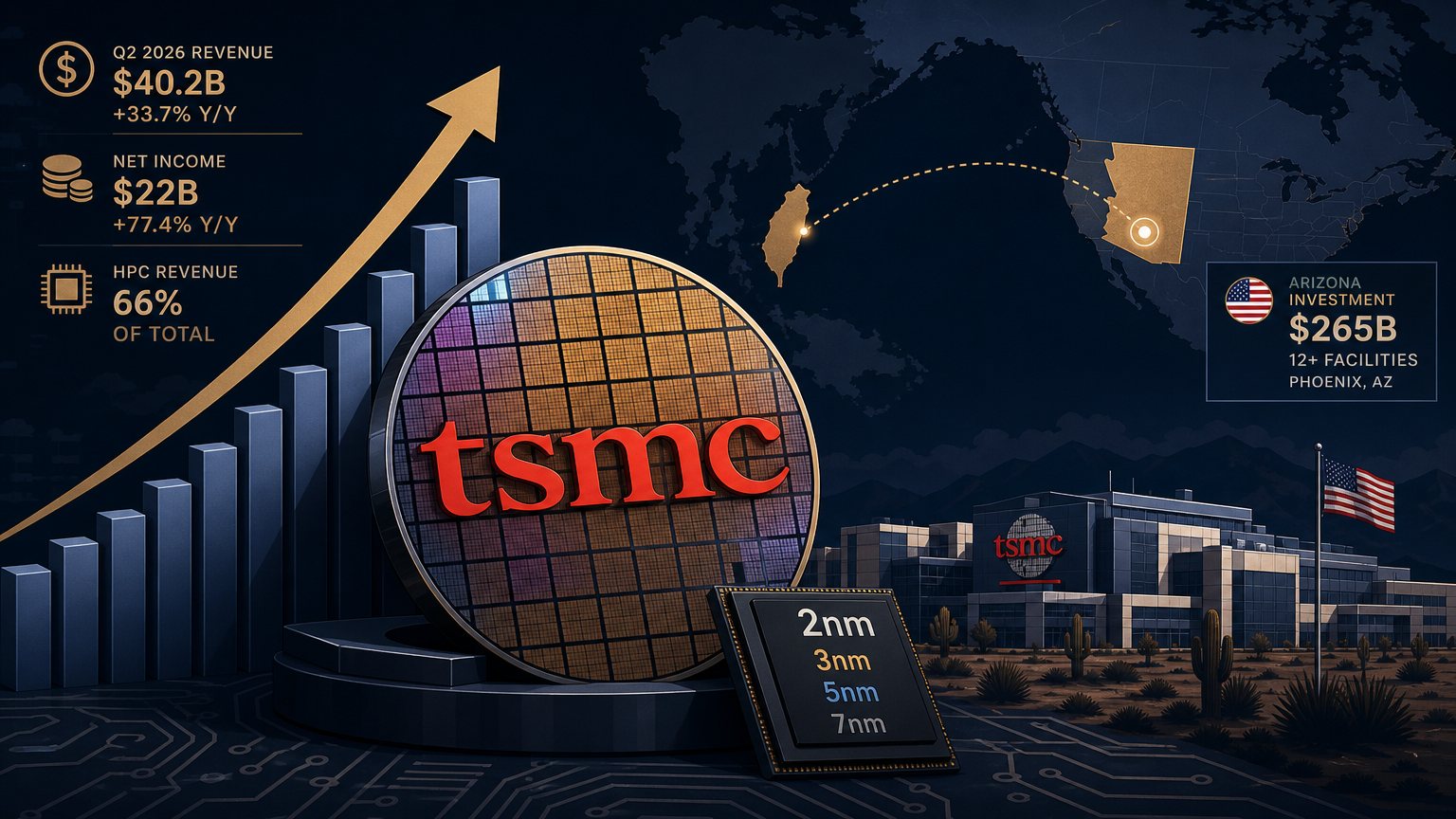
On July 16, Taiwan Semiconductor Manufacturing Company reported its fifth consecutive record quarter. Net income hit NT$706.56 billion — that's roughly $22 billion — up 77.4% year-over-year. Revenue came in at $40.2 billion, up 33.7% from the same period in 2025, beating Wall Street expectations handily. CEO C.C. Wei simultaneously announced an additional $100 billion investment in Arizona, bringing TSMC's total committed US spend to $265 billion across what will eventually be twelve or more fab and packaging facilities in the Phoenix area.
I've been watching chip supply chains since the days when a DDR shortage could knock a hosting fleet offline for a quarter. The cadence of TSMC's results — five straight records, each larger than the last — is the kind of signal that deserves more attention from infrastructure teams than it typically gets. We spend a lot of energy analyzing the models, the APIs, the orchestration layers. The supply chain underneath all of it is getting restructured in real time, and the decisions being made right now will shape what you can actually build and at what price for the next five to ten years.
Five Consecutive Records — What the Streak Actually Means
A single record quarter is noise. Five consecutive records is a structural demand shift. TSMC's results aren't being driven by consumer electronics or PC refresh cycles — high-performance computing, which is almost entirely AI chip production, accounted for 66% of Q2 revenue. That's not a rounding error; it's a complete inversion of the historical revenue mix for a company that used to be best known for making iPhone processors.
The node breakdown tells an equally clear story. Leading-edge nodes — 7 nanometer and below — accounted for 77% of total wafer revenue. Three-nanometer is now at 30% of the mix, 5-nanometer at 33%, and 2-nanometer just entered volume production and already represents 3% of revenue after one quarter. That ramp rate for 2nm is steep. CFO Wendell Huang called it out explicitly: "continued strong demand for our leading-edge process technologies, including the steep ramp-up of our 2-nanometer technology."
What that means in plain terms: the customers who are paying TSMC to run their AI chips — NVIDIA, Apple, AMD, Qualcomm, Broadcom — are consuming advanced manufacturing capacity as fast as TSMC can bring it online, and the company is raising its own capital expenditure guidance to $60-64 billion for 2026 (up from prior guidance of $52-56 billion) to try to keep pace. That's a $10 billion upward revision in a single quarter. You only do that when your order book makes it non-negotiable.
The 2nm Ramp Changes the Pricing Equation
The 2-nanometer ramp matters beyond the performance specs. Each new process node historically commands a significant price premium over the prior node — customers pay it because the performance-per-watt gains justify the cost for AI training and inference workloads where power efficiency maps directly to operating economics. As 2nm scales, it pulls 3nm and 5nm pricing down with it over 12-24 months in the same way 3nm pulled 5nm pricing down.
For infrastructure teams buying or renting GPU capacity, this matters more than it might seem. Cloud GPU pricing is, at its foundation, a function of what the chips cost to manufacture and what they can be sold for at the hyperscaler or cloud provider layer. The current period of elevated GPU pricing reflects constrained supply at leading-edge nodes. As TSMC's 2nm capacity scales through 2026 and into 2027, the supply picture loosens. Q3 2026 guidance alone — $44.6 to $45.8 billion in revenue — suggests another substantial production increase is already in the pipeline.
I'm not predicting a GPU price collapse; the demand side is growing fast enough that it will absorb capacity for years. But teams locked into long-term GPU compute contracts signed at 2025 pricing may find themselves overpaying relative to spot market rates by 2027. If you're negotiating cloud AI compute contracts today, build in flexibility clauses. The supply picture a year from now will look different than it does today.
$265 Billion Is a Geopolitical Hedge, Not Just a Capacity Bet
The Arizona investment number deserves specific scrutiny. $265 billion is not a capacity expansion in the traditional sense — TSMC is already the world's dominant advanced chip foundry, and it doesn't need twelve Arizona fabs to serve existing demand out of existing Taiwan facilities. This is geographic diversification of the most strategically critical manufacturing on the planet.
Virtually every advanced AI chip in existence — from NVIDIA H100s to B200s to GB200 Blackwell Ultras to Google TPUs — is fabbed at TSMC in Taiwan. The Taiwan Strait is not a theoretical risk; it's the most closely watched potential military flashpoint in the world. The US government's CHIPS Act was explicitly designed to reduce the concentration of risk in a single geography, and TSMC's Arizona commitment is the most concrete result of that policy to date.
As CEO C.C. Wei put it in the earnings announcement: "We believe this investment will help to further foster the development of the U.S. semiconductor ecosystem, strengthen the supply chain." That's the diplomatic framing. The operational framing is: if access to Taiwan's fabs is disrupted for any reason — military, regulatory, natural disaster — the AI chip supply chain as currently constituted stops. Arizona is insurance against that scenario becoming existential.
For infrastructure teams, the practical implication is a multi-year transition to a dual-source supply chain for advanced silicon, with US-fabbed chips gradually becoming a meaningful percentage of the mix. This will likely affect chip certification requirements for government and regulated-industry customers first, then percolate into standard enterprise procurement over the next three to five years.
What This Means for Infrastructure Teams Building on AI Today
I've run hosting infrastructure long enough to remember when "fab risk" wasn't in anyone's operational vocabulary. A fire at a resin plant in Japan once caused a global hard drive shortage. A flooding season in Thailand disrupted disk supply for eighteen months. Those were single-component constraints that knocked teams sideways. The concentration of advanced AI chip production in Taiwan is a risk of a different order of magnitude — it's not one component, it's the entire substrate.
TSMC's record results and Arizona investment are the first credible evidence that this risk is being actively hedged at scale. But "being hedged" and "being resolved" are separated by about a decade of construction, workforce development, and supply chain maturation. The Arizona fabs won't operate at Taiwan's yields and volumes overnight — fab ramp times are measured in years, not quarters.
A few things I'd actually do based on this:
- Don't lock in multi-year GPU contracts without flexibility clauses. Supply constraints are easing as 2nm ramps; pricing will follow. Contracts signed today that look reasonable might look expensive by 2027.
- Start tracking which chips your critical workloads run on and where they're fabbed. As US-fabbed silicon becomes available, regulated-industry requirements will likely mandate it for certain workloads. Getting visibility into your chip provenance now puts you ahead of that curve.
- Treat TSMC's quarterly results as a leading indicator. When HPC revenue share goes up, AI chip demand is outpacing alternatives. When it plateaus or drops, the supply/demand balance is shifting. These earnings reports give you a 90-day forward view into the hardware layer underlying your entire stack.
- Watch the 2nm yield reports in Q4 2026. Yield — what percentage of wafers produce usable chips — is the number that determines when 2nm pricing becomes competitive with 3nm. TSMC doesn't publish yield directly, but gross margin trends and customer announcements are good proxies.
The Planning Window Is Narrowing
Five consecutive record quarters should be read as a countdown of sorts. TSMC is investing $60-64 billion this year to build the capacity that will ship chips in 2027 and 2028. The decisions being made in Hsinchu and Phoenix right now — which nodes get prioritized, which customers get allocation, how aggressively 2nm ramps — will determine the hardware landscape for the AI applications you're building today.
The infrastructure layer of AI isn't just about what models you run or which cloud you deploy to. It's about what hardware those clouds are built on, where it comes from, and how much of it exists. TSMC's results are the clearest available signal that the demand side of that equation is structurally larger than the supply side right now, and that the supply side is being rebuilt at a pace and geographic distribution that we haven't seen since the post-war industrial buildout.
That's worth watching closely. The teams that understand the supply chain dynamics aren't just better positioned for procurement — they're better positioned for every architectural decision that depends on hardware availability, cost curves, and where the next bottleneck will land.
TSMC will report Q3 results in October. By then, the 2nm ramp will be further along, Arizona will have broken ground on additional phases, and the revenue mix will tell us whether AI chip demand sustained through the second half of 2026 or started hitting its first real plateau. I'll be watching those numbers as carefully as any model benchmark.