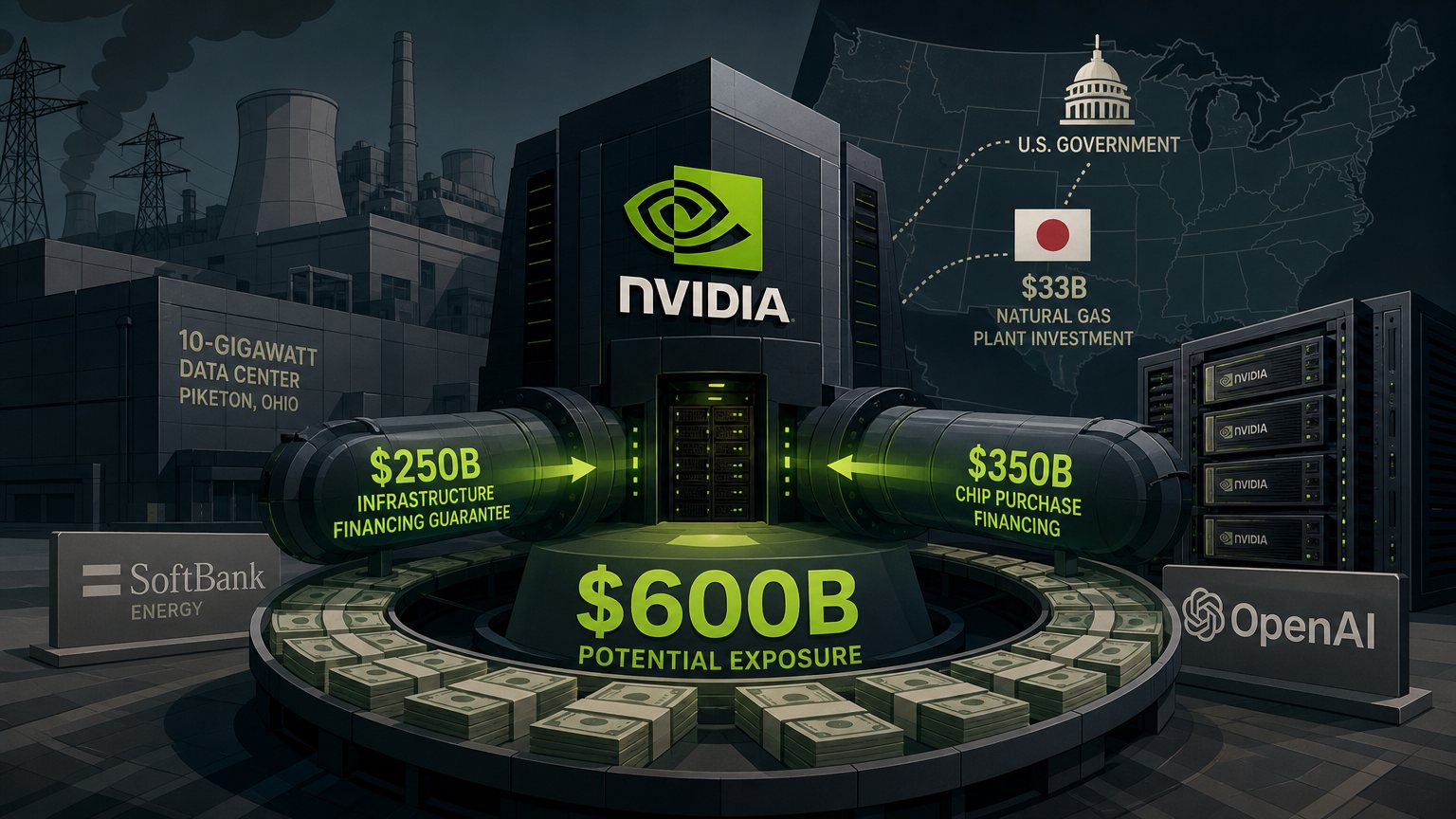
Nvidia is reportedly discussing two financing arrangements for OpenAI that could give it roughly $600 billion in combined exposure. One would back the lease of a huge Ohio data center. The other would finance purchases of Nvidia's own chips.
The Wall Street Journal reported the talks on July 26, 2026. The proposed campus in Piketon, southern Ohio, would have a full capacity of 10 gigawatts and would be developed by SoftBank's energy subsidiary on the site of a decommissioned uranium enrichment plant.
As of July 27, the talks were described as early-stage. Reuters said it could not immediately verify the Journal's report, and Nvidia, OpenAI, and the U.S. Commerce Department did not respond to requests for comment. The arrangements could change substantially or fall apart.
Even with that uncertainty, the proposed structure deserves scrutiny. Nvidia would be selling the hardware while also helping finance both the purchases and the facility that houses it. Its exposure to OpenAI would extend well beyond whether the customer places another chip order.
What the proposed financing covers
The reported arrangements have several separate parts:
- Nvidia would guarantee roughly $250 billion in debt financing for OpenAI to lease SoftBank's Piketon facility.
- Separately, Nvidia would finance up to $350 billion in purchases of Nvidia chips.
- The full campus, including infrastructure and chips, would cost more than $500 billion.
- The first phase, with roughly 800 megawatts of compute capacity, is targeted to become operational by 2028.
The $600 billion figure combines the potential lease-financing guarantee and chip financing. It isn't a report of a single $600 billion cash payment or guarantee. For a sense of scale, that combined exposure would be larger than Sweden's GDP.
The project also involves government decisions and international energy investment. Commerce Secretary Howard Lutnick is reportedly overseeing allocation decisions. A $33 billion Japanese investment in a natural gas plant, connected to recent trade agreements, forms part of the energy financing picture. That would tie the campus to policy commitments as well as commercial negotiations.
OpenAI wants more control over capacity
OpenAI's strategic reason for pursuing a dedicated campus is understandable. It relies on compute leased from Microsoft, Amazon, and Oracle, leaving it dependent on infrastructure providers that have their own investment priorities and competing services. Greater control over capacity could reduce its exposure to their pricing and allocation decisions.
The distinction between control and ownership matters here. The reported financing concerns a lease of SoftBank's facility. That could give OpenAI more direct control over its infrastructure without making it the owner of the campus.
Cloud capacity shortages add pressure. Microsoft disclosed that broad demand continues to exceed available Azure capacity, requiring allocation decisions across customers, internal services, and research and development workloads. Enterprise teams are facing longer lead times for AI-optimized virtual machines, while developers and startups in East US and West Europe are encountering hard limits.
Microsoft is spending approximately $190 billion on infrastructure in calendar 2026 and still cannot meet all demand. For OpenAI, a dedicated campus could provide a way to plan around inference costs and capacity needs without relying entirely on cloud providers' expansion schedules. The business rationale is clear enough. The financing introduces a different set of dependencies.
Several risks would sit with the same supplier
Financing a customer's equipment purchases isn't unusual. Banks lend against equipment, and vendors operate financing and leasing businesses. Such arrangements can help customers spread costs while giving suppliers a route to additional sales.
The concern here is the combination of roles and the scale of the commitment. Nvidia would be the chip supplier, the guarantor for facility financing, and the financier for chip purchases. Those positions would all depend, to varying degrees, on the same customer's ability to make the project work.
If OpenAI's inference revenue falls short, a competitor changes the economics of serving models, or regulation limits its business, Nvidia could face weaker chip demand alongside losses or obligations from financing it had already supported. A guarantee can create exposure even when the guarantor doesn't provide the initial cash.
This is concentrated counterparty risk: several financial commitments depend on one business meeting its obligations. A setback at OpenAI could therefore affect Nvidia through more than lost sales. At this scale, difficulties could also reach the project's lenders, developer, and other partners.
That doesn't mean the arrangement is bound to fail. OpenAI generates substantial revenue, and there is a real market for AI inference. Supplier financing can support useful infrastructure. But when a supplier helps a customer borrow to buy its products, sales growth and customer creditworthiness become closely connected. The reported figures alone don't establish how much risk Nvidia would ultimately bear under the final terms.
Ten gigawatts is also a power problem
The proposed campus would be enormous even by the standards of current AI construction. A July 27 report described a record 37% increase in Google's electricity use in 2026, driven by data centers. Meta is building a campus it describes as gigawatt-scale. Piketon's full 10-gigawatt target would be roughly ten times a one-gigawatt facility.
At full buildout, the project is being described as the largest single compute installation in history. That comparison depends on reaching the full target, rather than only the initial 800-megawatt phase planned for 2028.
The former uranium enrichment site offers an industrial starting point. Existing high-voltage infrastructure, permitted industrial land, and proximity to grid interconnections could avoid some of the work required at a new site. Those features help explain the location's appeal, although they don't by themselves establish that enough power is available for the entire campus.
For a project this size, racks and chips are only part of the construction problem. Power supply, cooling, grid connections, and permits can determine when capacity becomes usable. Access to established industrial infrastructure could be a durable advantage, especially when comparable connections would take years to build elsewhere.
The broader infrastructure argument is that power and cooling may constrain AI expansion more severely than chip availability. Companies that secure those resources early could gain an advantage that competitors cannot quickly reproduce by buying the same hardware.
What infrastructure teams can take from the proposal
The immediate operational issue remains cloud availability. Capacity constraints are likely to persist through at least the end of 2026. Pay-as-you-go customers and those with small Cloud Solution Provider arrangements may have less priority when hardware is rationed. For time-sensitive AI workloads, reserved instances, flexibility across regions, and contingency plans involving another cloud deserve consideration despite the extra operational work.
The proposed deal also shows how closely chip suppliers, infrastructure providers, and model developers could become tied together. Larger, more integrated operations may support greater scale and lower costs. They could also leave customers with fewer credible alternatives at the infrastructure layer. Vendor concentration matters when switching requires changes to capacity contracts and deployment plans.
The construction schedule creates another risk. The first 800 megawatts are targeted for 2028, leaving time for model architectures, inference economics, and regulation to change before the initial phase opens. Long-term commitments need assumptions about all three. A facility can be completed as planned and still face a different market from the one used to justify it.
The terms remain unsettled
The reported Nvidia-OpenAI negotiations could lead to a major dedicated compute operation. They could also fail during due diligence, leaving OpenAI to seek a smaller cloud reservation and Nvidia without the proposed exposure.
The argument for arrangements like this is that frontier AI projects have become large enough to require unusually close coordination among suppliers, customers, financiers, and governments. Whether ordinary capital markets could fund this project on acceptable terms remains unclear. The reported negotiations don't establish that supplier backing is the only workable option.
The details that matter next are the financing obligations, the campus's power and permitting progress, and whether the 2028 first-phase target holds. Those will help show how much of the announced capacity can be delivered and who bears the cost if demand or construction falls short.