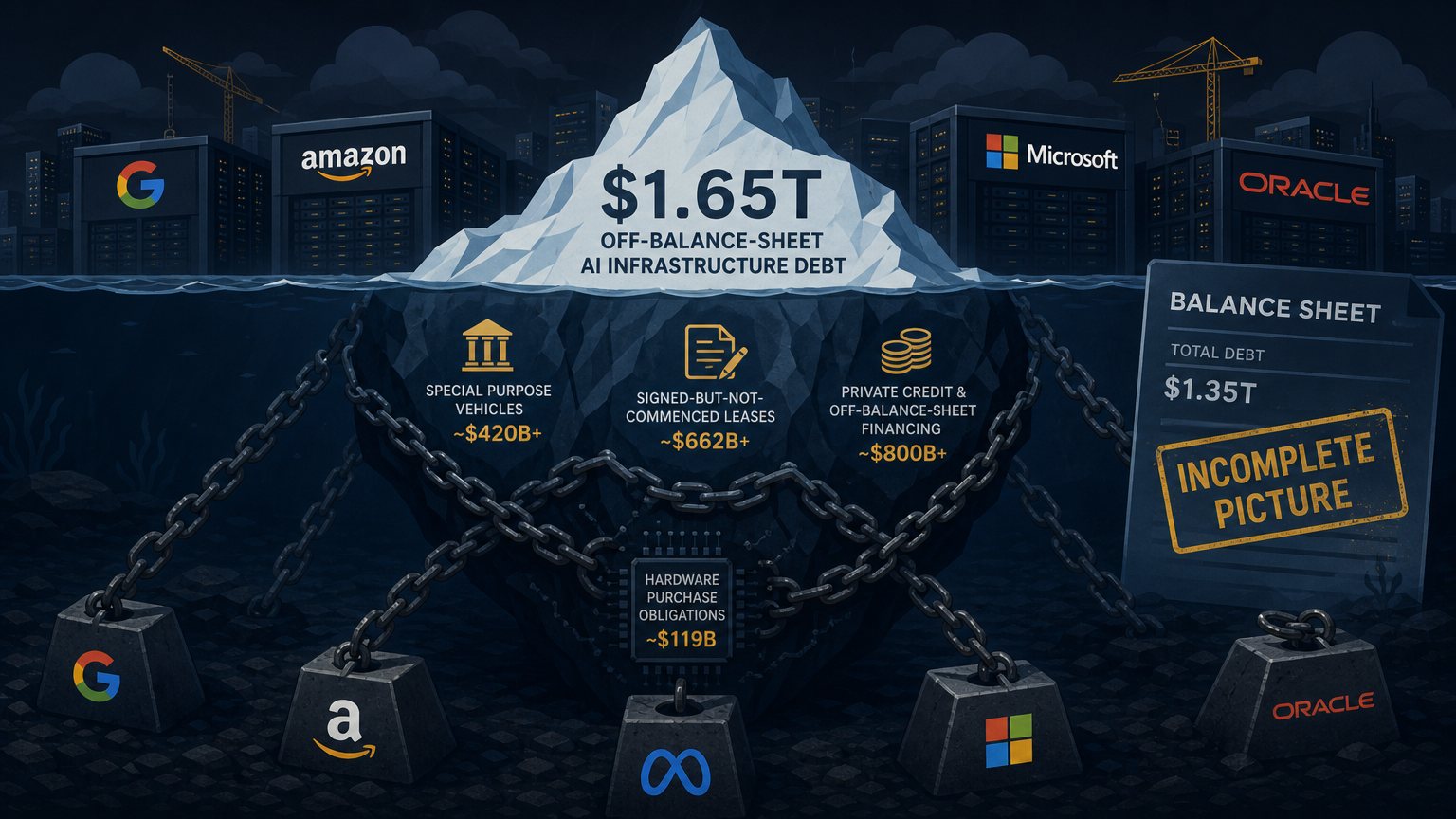
Alphabet, Amazon, Meta, Microsoft and Oracle have approximately $1.65 trillion in off-balance-sheet obligations tied to AI infrastructure, according to reporting published on July 22, 2026. Futurism reported the estimate, which was also covered by The Next Web. That compares with $1.35 trillion in reported on-balance-sheet debt for the same period. The off-balance-sheet figure is about 122 percent of the visible debt total.
Those numbers need careful reading. The reporting groups together several kinds of financing and future commitments, including obligations that haven't yet become balance-sheet liabilities. Off balance sheet also doesn't necessarily mean undisclosed. Many of these arrangements appear elsewhere in financial filings rather than in the headline debt figure.
For infrastructure teams, the concern is how these commitments could affect the providers behind long-term cloud contracts. A provider's ability to finance capacity, absorb delays in revenue and maintain competitive pricing belongs alongside service reliability and technical lock-in when evaluating dependency.
Where the obligations sit
The reported total involves three main financing structures. Their accounting treatment differs, but each can leave substantial commitments outside a company's primary balance sheet.
- Special purpose vehicles and separate legal entities. These entities hold financing for particular projects. Meta reportedly has roughly $420 billion in off-balance-sheet obligations, nearly three times its officially reported debt. Its Hyperion data center project carries $27 billion in debt packaged into a separate legal entity. The financing exists, but it isn't reflected in Meta's quarterly balance sheet in the same way as a direct corporate obligation.
- Leases that have been signed but haven't started. Moody's has identified approximately $662 billion in data center lease commitments in this category. Under GAAP's lease commencement standard, they don't become balance-sheet lease liabilities until the leases commence, potentially years after signing. The reporting describes these commitments as appearing in footnotes, if disclosed at all.
- Private credit and other off-balance-sheet financing. An estimated $800 billion in data center buildout is reportedly being routed through private credit structures. The coverage describes these arrangements as designed to avoid public disclosure obligations.
Oracle illustrates how quickly future commitments can grow. Its off-balance-sheet commitments have reportedly increased about thirtyfold in four years. The company now has $260 billion in future lease commitments that won't appear as liabilities on the face of its balance sheet until the properties become operational.
The reporting also assigns Nvidia, the hardware supplier rather than a cloud operator, $119 billion in purchase obligations. It describes those obligations as commitments from customers to buy hardware they haven't yet received or paid for. That description needs clarification before the figure can be compared directly with the hyperscalers' financing obligations.
Spending is running ahead of AI revenue
The five hyperscalers are projected to spend between $700 billion and $900 billion on capital expenditures in 2026. The reporting describes the spending increase over 2025 as 36 percent. Researchers also estimate an annual gap of approximately $600 billion between hyperscaler AI infrastructure spending and sales across the AI ecosystem, with that gap widening.
Microsoft reportedly spent $97 billion on AI over the last four quarters while generating $37 billion in AI-related annual recurring revenue. Dividing those figures produces roughly 38 cents of annual recurring revenue for every dollar spent. That is a comparison of spending with a revenue run rate, not a measure of the eventual return on infrastructure that may be used for years.
The capital intensity is still substantial. The five companies are reportedly spending approximately 34 percent of revenue on capital expenditures, compared with a peak of around 15 percent during the 1990s internet buildout. On that comparison, current capital intensity is more than twice the earlier peak, even before considering commitments outside the balance sheet.
These figures don't establish that the companies are in immediate financial trouble. Alphabet, Amazon, Microsoft and Meta generate substantial cash flows that support their ability to service debt. The longer-term concern is whether AI revenue arrives quickly enough to support the capacity being financed. Strong cash flow today provides room to absorb a delay, but it doesn't make the timing irrelevant.
What the Enron comparison does and doesn't establish
Analysts have invoked Enron when discussing these structures. Speaking to Bloomberg Law, analyst Gil Luria drew a distinction between using special purpose vehicles and hiding them. Technical accounting consultant Tom Selling raised the possibility that this accounting treatment could obscure a financially fragile company. He also described the treatment as being in fashion.
There is no allegation of fraud here. The arrangements are described as legal and, in most cases, disclosed somewhere in financial filings. Enron committed fraud, so the comparison shouldn't be treated as evidence that hyperscalers are doing the same thing.
The narrower concern is the gap between headline financial figures and the obligations held in separate structures or disclosed in footnotes. Enron's off-balance-sheet arrangements became part of its collapse when obligations returned to its balance sheet. That history explains the scrutiny, but it doesn't establish that today's data center financing will follow the same path.
For hyperscalers, pressure could emerge if credit markets tighten or AI revenue grows more slowly than investors expect. Financing structures that are manageable under current conditions may become more expensive or difficult to maintain under those conditions. The scale of the commitments makes that a reasonable risk to examine without predicting a collapse.
How cloud customers could be affected
Most discussion of these obligations focuses on investors. Infrastructure teams have a different exposure: dependence on providers whose financing decisions can affect capacity and commercial terms over several years.
Provider concentration includes financial exposure
The usual case for multiple cloud providers centers on outages, proprietary services and API lock-in. Financial concentration adds another consideration. A compute stack that depends entirely on one hyperscaler is also exposed to that company's spending commitments and response to financial pressure.
That doesn't automatically justify the expense and complexity of multi-cloud architecture. It does make a provider's financial position relevant to a dependency assessment, especially when moving workloads would take a long time.
Long-term commitments need a wider pricing comparison
A three-year reserved instance contract or committed use discount trades flexibility for a particular price. Providers carrying large future obligations have an incentive to increase revenue fast enough to support them. If financing becomes more expensive, customers should consider the possible effects on future pricing, renewal terms and capacity offers. The reported obligations alone don't establish that an existing contract will change.
There is also a risk in committing too early to capacity that later becomes cheaper. Projected AI data center spending of $3 trillion through 2028 could create substantial compute supply. If demand and revenue develop more slowly than the investment assumes, spot and preemptible prices could fall significantly.
On that outlook, an expensive reserved-capacity purchase shouldn't depend on an untested assumption that it will remain cheaper than spot capacity 18 months later. The relevant comparison includes the workload's need for guaranteed availability and whether it can tolerate interruptions.
Credit markets can provide an early warning
AI-related debt issuance is projected to reach $570 billion in 2026, according to Forbes, with bond investors already demanding higher yields as they assess the gap between spending and revenue.
Higher required yields make new borrowing and refinancing more expensive. A sharp increase in the premium attached to AI infrastructure debt would therefore be relevant to customers assessing a provider's future capacity plans and commercial incentives. It wouldn't, by itself, signal an impending service failure.
The risk of revenue arriving late
The buildout could ultimately find customers and still encounter financing trouble along the way. One useful scenario is a two- or three-year delay between the expected AI revenue ramp and the revenue that materializes. Infrastructure can have lasting value while its financing becomes difficult to sustain during that gap.
The expectation that AI compute will eventually be monetized is an investment judgment, not a settled outcome. Even under that expectation, the durability of the financing matters. The hyperscalers are much larger and more diversified than the hosting companies of the dot-com era, which gives them more room to absorb weak returns or delayed demand.
Multi-year infrastructure decisions should account for both possibilities: financial pressure that makes capacity or future contracts more expensive, and excess supply that makes flexible compute cheaper. The reported $1.65 trillion in obligations is a reason to examine those scenarios and the disclosures behind them, rather than rely on a headline debt figure alone.