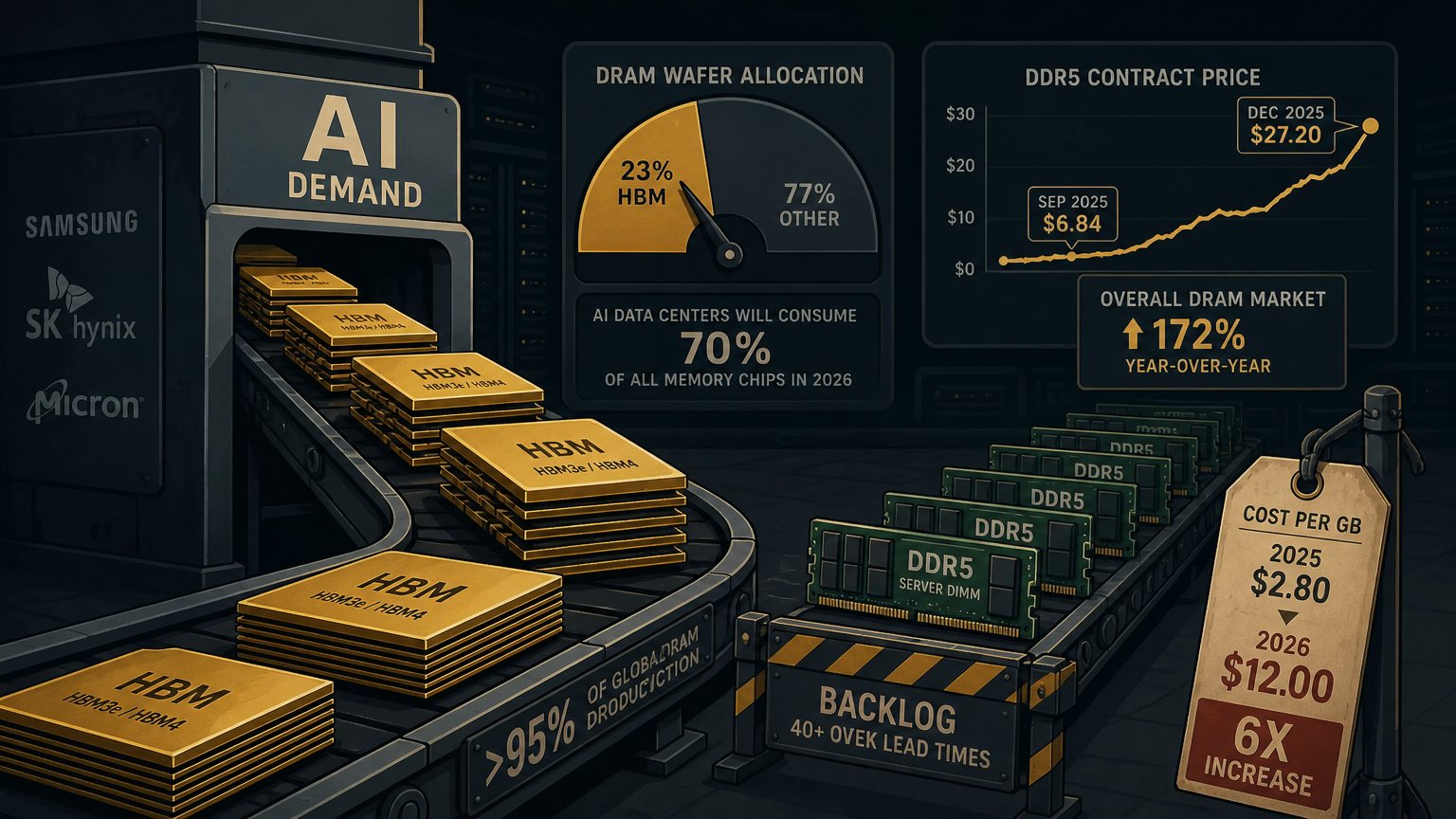
Server refresh budgets built around 2025 memory prices need another look. DDR5 contract prices rose from roughly $6.84 per unit in September 2025 to $27.20 in December, nearly quadrupling in three months. The broader DRAM market is up 172% year over year, and delivery times are stretching alongside prices.
As of July 28, 2026, the pressure extends beyond server memory. Gartner's combined DRAM and SSD forecast puts the price increase at 130% by the end of 2026. On July 27, Google reportedly said the cost of a gigabyte of RAM had risen from $2.80 in 2025 to $12 in 2026, citing memory costs as the primary reason for higher Pixel 11 prices.
For server-grade DDR5, analyst projections included a further 90% increase in Q1 2026, followed by increases of 40% to 50% through Q3. Those are forecasts, rather than confirmed results for each period, but they show how far procurement assumptions have moved.
HBM competes with server memory for production capacity
High-bandwidth memory, or HBM, supplies the memory bandwidth used by large AI accelerators. Nvidia's H200 uses HBM3e. The forthcoming Rubin-generation GPUs will use HBM4, which SK Hynix began mass-producing in 2026. The reported specifications include 36GB per chip and up to 2TB/s of bandwidth, with a claimed 60% speed improvement over previous generations.
HBM and conventional DDR5 server memory draw on the same DRAM fabrication capacity. That makes the production choices of a few manufacturers important to buyers far outside the AI market. Samsung, SK Hynix, and Micron control more than 95% of global DRAM production. HBM is more profitable than commodity DRAM, giving all three a strong reason to direct more capacity toward it.
HBM now accounts for 23% of total DRAM wafer capacity, with that share still growing. A 2026 projection puts AI data centers' consumption at 70% of all memory chips produced globally, not just HBM.
Memory configurations help explain the demand. The amount packed into a single AI accelerator unit has grown from roughly 80GB to 576GB as models have moved from the GPT-3 class to the current generation. Frontier-model clusters are described as needing an order of magnitude more memory bandwidth with each generation. Those requirements give manufacturers a large, well-funded market for HBM while conventional server buyers compete for the remaining capacity.
Higher prices come with longer waits
The supply pressure is showing up in shipments as well as price forecasts. Transcend suspended new orders and shipments outright. Innodisk and Apacer Technology temporarily halted shipments. Server DRAM lead times from multiple vendors have stretched from 32 weeks to more than 40 weeks.
The global DRAM market is estimated to be running at a 4% production deficit. New fabrication capacity isn't expected to contribute meaningfully until late 2026 at the earliest. Even a buyer with an approved budget may struggle to get memory in time for a planned deployment.
For cloud providers and hyperscalers, reported server cost increases range from 15% to 25%. Memory now represents 30% to 40% of a server's bill of materials, compared with 15% to 20% historically. In the week of July 28, Qualcomm also announced double-digit chip price increases beginning in September, adding pressure elsewhere in the hardware budget.
Cloud and hosted-infrastructure customers should expect some of these costs to reach them. That may happen through direct price increases, changes to service tiers, or reduced availability of particular instance types. The timing and form will depend on the provider and contract.
Smaller operators running dedicated servers, on-premises clusters, or hybrid environments face several related problems:
- Old refresh estimates are unreliable. A 512GB dual-socket server can have a much larger memory line item than its 2024 budget allowed. Twice the previous memory cost is a conservative planning assumption in this market, though a current quote is needed for the specific configuration.
- Late purchasing may delay the whole build. With lead times beyond 40 weeks, a Q3 2026 deployment depends on orders already placed. Q4 requirements need supplier conversations now, with delivery dates confirmed rather than assumed.
- DDR4 offers limited relief. Manufacturers are reducing its priority as they move toward DDR5 and HBM. Legacy DDR4 prices are rising too, even if they start from a lower base.
- Storage costs are rising separately. NAND flash prices are up more than 50% in some segments. Gartner's combined 130% forecast covers DRAM and SSDs, so a budget adjustment limited to RAM can still leave a substantial gap.
Supply and demand won't adjust quickly
Commodity shortages usually ease when buyers reduce purchases or manufacturers add capacity. Neither response appears fast enough to provide much near-term relief here.
Large AI buyers have a strong incentive to keep purchasing memory even at higher prices. Delaying HBM can delay training a model costing hundreds of millions of dollars or expanding an inference service used by hundreds of millions of people. These buyers are less sensitive to memory prices than operators deciding whether a conventional server refresh can wait another year.
The argument for a prolonged shortage is that this demand keeps expanding with new model generations, deployments, and AI features. That would make it harder for a normal spending slowdown elsewhere in the hardware market to bring memory prices back down.
Adding DRAM capacity takes years and tens of billions of dollars. Micron's planned $100 billion complex near Syracuse isn't expected to meaningfully affect global supply until the latter half of the decade. Samsung and SK Hynix are also making large investments, but their projects face similarly long construction and production timelines.
More capacity is coming, but that doesn't make it available for a refresh scheduled this year. Multiple market analysts expect elevated memory prices to persist through 2027. Deferring a purchase may still be sensible for an underused system, but waiting solely for a quick return to earlier prices is a risky budget assumption.
Purchasing decisions that need a fresh review
The immediate task is to separate necessary capacity from optional upgrades, then price and schedule the necessary purchases using current supplier information.
- Reprice the next 12 months of planned work. Memory upgrades and new systems scheduled for late 2026 need current quotes. Estimates from six months ago may be far enough off to require a budget reforecast. Include both the memory cost and the effect of delayed delivery.
- Consider bringing justified purchases forward. For a Q4 build requiring 256GB or more of DDR5, ordering earlier could reduce exposure to further increases. That only helps if the purchase is needed and the supplier can confirm delivery. An order without a credible delivery date doesn't resolve the deployment risk.
- Confirm lead times for the required parts. A general availability estimate isn't enough when vendors are quoting more than 40 weeks. Builds scheduled for Q3 should already have orders in progress. Any project without confirmed supply needs a vendor discussion immediately.
- Compare higher-density memory configurations. 128GB and 256GB RDIMMs can provide the same total capacity using fewer DIMM slots. In some configurations, they may also lower the total cost per gigabyte. Current configuration-level pricing matters more than assuming that either smaller or larger modules will be cheaper.
- Review cloud renewals and reserved capacity. Providers face the same hardware cost pressure. Renewal analysis should account for possible price adjustments, service-tier changes, and instance availability, rather than carrying forward the previous contract's assumptions.
- Keep a separate SSD cost check. NAND increases can materially change a storage refresh even after the DRAM budget has been revised. Price the storage requirements independently so that one shortage doesn't obscure the other.
HBM may change the price floor for conventional DRAM
The longer-term concern is how manufacturers decide which memory to produce. Conventional DRAM spent much of the past decade competing on broadly comparable specifications and use cases. HBM is co-packaged with AI accelerators, developed in close collaboration with companies such as Nvidia and AMD, and produced by a small group of manufacturers with high barriers to entry.
As HBM takes more wafer capacity, the return available from HBM increasingly affects how much conventional DRAM manufacturers are willing to make. A DDR5 production decision carries the opportunity cost of not producing a more profitable product instead. That could leave conventional memory with a permanently higher price floor, even after the immediate shortage eases.
That outcome isn't settled. High prices also encourage investment in new supply. For current infrastructure plans, though, the practical constraint is when that supply arrives. A refresh budget needs to work with prices and delivery dates available now, without depending on capacity that may arrive after the systems are needed.