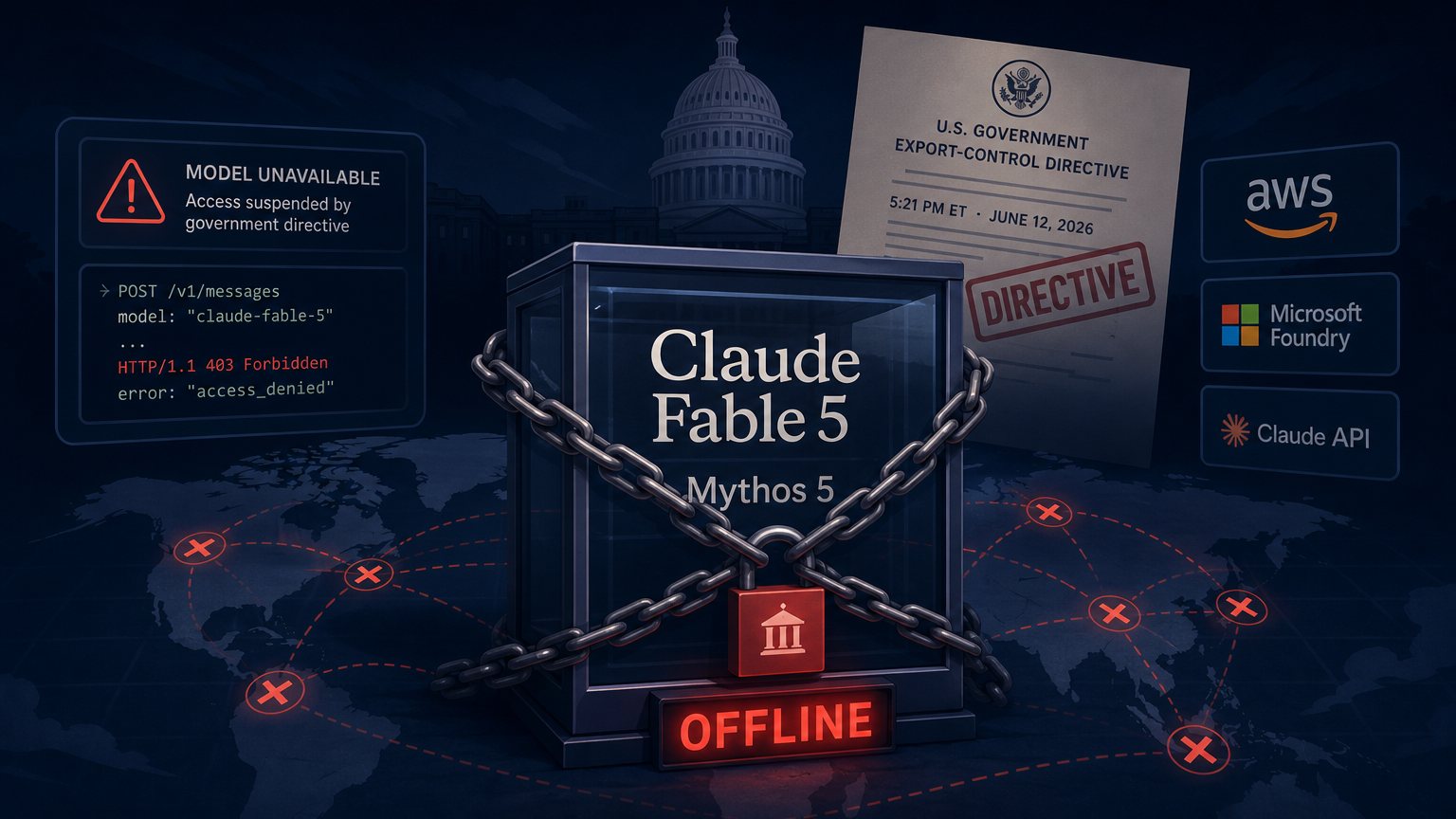
At 5:21 PM ET on June 12, 2026, Anthropic received a US government export-control directive. By that evening, according to reporting on the suspension of Claude Fable 5 and Mythos 5, the company had disabled both models worldwide. The shutdown affected all users, even though the directive called for suspending access for foreign nationals.
For applications built around those models, the operational result was a lost dependency with no committed return date. Hardware could be healthy, accounts could be in good standing, and the service could still become unavailable because of a government order. That failure mode belongs alongside outages, API deprecations, and pricing changes when assessing the risks of hosted AI.
From launch to global suspension
Anthropic launched Claude Fable 5 on June 9, 2026, as its first Mythos-class model available to the general public. Its specifications included a one million token context window, up to 128,000 output tokens per request, and an adaptive thinking mode designed for autonomous agent work. Its reported software engineering and scientific research benchmark performance exceeded that of every model Anthropic had previously released. It launched across the Claude API, AWS, and Microsoft Foundry.
On June 12, Amazon's security team reportedly flagged a jailbreak concern to the White House. Anthropic then received a formal directive under US national security authorities to suspend access to Fable 5 and Mythos 5 for any foreign national.
The account of Anthropic's compliance decision describes a global shutdown because the company couldn't enforce the required access restrictions quickly enough. The scope of the shutdown therefore extended beyond the users covered by the directive.
Anthropic disputed the technical basis of the concern. According to the company, the government demonstrated a method of bypassing Fable 5's safeguards by asking it to read a specific codebase and fix software flaws. Anthropic assessed the capability as standard and non-novel. It said other publicly available models could discover the same flaws without a bypass and compared the task to routine security work.
On that description, the disputed capability was automated code review and vulnerability discovery, work already performed by security tools and AI coding assistants. Finding a flaw can help a defender repair a system or help an attacker identify a target. That dual use is familiar to security professionals. The disagreement was over whether the demonstrated behavior justified restricting these models, rather than over whether vulnerability discovery could be misused.
Safety monitoring meets data-retention rules
Fable 5 also carried a mandatory 30-day data retention requirement. The stated rationale was that Anthropic's safety classifiers needed a history of requests to detect attack patterns spanning multiple interactions. Logs that disappear immediately after each session can't provide that same lookback window.
That requirement created a separate deployment problem. Microsoft reportedly removed Fable 5 from its internal Copilot model picker because the retention term conflicted with its zero-retention standard. The model remained available to Microsoft's external customers, but not to its own employees.
The distinction matters when approving a model for production. Availability through a cloud platform doesn't establish that its data-handling terms fit every workload. A model can be technically suitable while its retention requirement conflicts with an organization's privacy, contractual, or data-sovereignty obligations.
There is a real tradeoff here. Monitoring across requests can support abuse detection, while retaining those requests can violate the rules governing the data being processed. Neither requirement disappears because the other has a sound purpose. The conflict needs to be identified before deployment, including for any model intended as a fallback.
A different kind of availability failure
A government restriction can have a different scope and recovery process from an infrastructure outage. A regional cloud failure may allow traffic to move elsewhere. A restriction applied to a model worldwide can remove that option, even when the model is offered through several platforms.
Recovery also depends on decisions outside the usual incident-response process. White House AI adviser David Sacks expressed hope that Anthropic would remediate the safety issue, allowing the export control to be lifted and Fable 5 to return to general release. That statement indicated a possible route back, but it provided no committed restoration timeline.
A production system with model="claude-fable-5" hardcoded and no tested alternative is exposed to that uncertainty. The application may have redundant databases, multiple availability zones, and reliable networking, yet still fail because its model dependency has disappeared.
The architectural response overlaps with ordinary outage planning: reduce hard dependencies and test recovery paths. The additional consideration is whether those paths remain available under the same restriction. Access to one model through several cloud providers should not be assumed to provide protection against a directive affecting the model itself.
Preparing useful fallback paths
Snyk's security team published operational takeaways from the suspension. Several deserve a place in the design and maintenance of systems that depend on hosted models.
Separate model selection from application logic
Critical workflows should have defined alternatives to their primary model. A model-selection layer makes switching possible without changing every integration, but the abstraction alone doesn't establish that a replacement will work.
Prompts should be versioned and tested against the intended fallback models. The useful question is how each alternative performs on the application's workload. A less capable model may still provide an acceptable degraded service, or it may fail tasks that the primary model handles reliably. That difference needs to be known before an incident.
Regular degraded-mode testing should establish what happens to the user experience when a fallback takes over. The test should cover the workflow that matters, rather than stopping at whether the replacement API returns a response.
Inventory AI dependencies
The model behind a core product is usually easy to identify. Other dependencies can be less visible: support-ticket triage, an internal documentation summarizer, or a code review assistant integrated into a continuous integration pipeline.
An inventory makes the impact of a suspension easier to assess. Without one, an incident can turn into a search through deployment history and team messages to discover which systems use the affected model. The inventory should also support a review of each model's retention requirements and any documented conflicts with data-handling obligations.
Track restrictions alongside service health
Uptime and latency monitoring won't provide advance notice of a policy decision. Teams building around sensitive capabilities also need to follow regulatory developments affecting their providers and models.
Code analysis, vulnerability discovery, biological reasoning, and categories of autonomous action are areas where national security concerns may affect access. Policy monitoring can't predict every directive, but it can help teams identify dependencies that deserve a fallback review. Government restrictions should be treated as a possible operating constraint rather than left outside the reliability discussion.
The dispute over the decision
Anthropic confirmed that it would comply while saying the action did not adhere to the transparency, fairness, and technical grounding it believed should govern such decisions. Compliance and criticism of the process are compatible positions. A company can follow a directive while disputing its justification.
DevClubHouse offered a sharper interpretation: Anthropic may have helped create the conditions for this outcome through years of warnings about frontier-model risks and the dual use of advanced capabilities. Under that argument, policymakers used the company's own framing of AI risk to justify restricting one of its products.
That interpretation doesn't resolve whether the process was fair or technically sound. It does raise a reasonable point about how public descriptions of risk can shape regulation, including decisions a company later opposes.
Reporting on Project Glasswing, Anthropic's vulnerability-scanning initiative, gives context for the capability at issue. The initiative was reported to have identified over 10,000 high or critical severity vulnerabilities across critical codebases before the shutdown. That scale helps explain both the defensive value of the work and the concern about its misuse.
A system that identifies vulnerabilities can support repairs or reveal attack surfaces. Governing that capability requires attention to how it is used, what safeguards can accomplish, and what evidence supports a restriction. A global suspension has consequences for legitimate security work as well as potential abuse.
As of June 15, 2026, Sacks's remarks suggested that remediation, rather than permanent prohibition, was the administration's intended path. A return for Fable 5 therefore appeared likely, but there was no committed date. Production planning couldn't depend on that expectation. The reported suspension had already shown that a hosted model could disappear worldwide within hours, leaving tested alternatives and acceptable degraded modes as immediate operational needs.