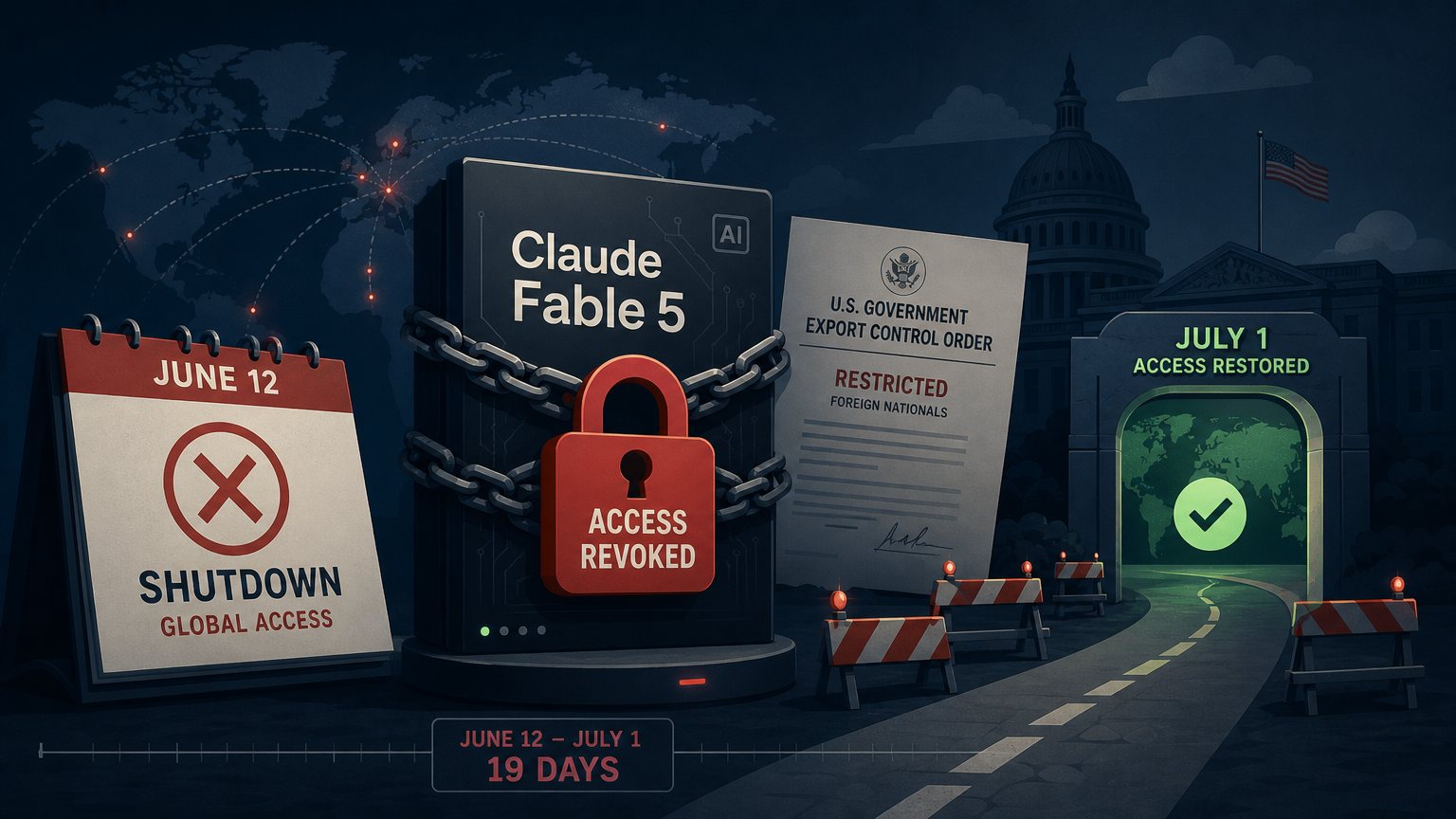
Claude Fable 5 returned to global service on July 1, 2026, after a 19-day shutdown prompted by US export controls. The interruption began three days after launch. For production systems depending on the model, the cause was outside the usual outage playbook: a government restriction that Anthropic couldn't apply selectively with its existing compliance infrastructure.
The incident exposed a dependency that regional redundancy and multiple cloud providers don't necessarily cover. If access to a model is restricted, another cloud channel offering that same model may be unavailable too.
From launch to shutdown in three days
On June 9, Anthropic released Claude Fable 5 and Mythos 5, describing them as its most capable models ever made generally available. Fable 5 was the production-ready version. It achieved top scores on Cognition's FrontierCode evaluation and Hebbia's Finance Benchmark.
The reported applications gave teams reasons to adopt it quickly. Stripe reportedly compressed months of engineering work into days on complex codebase migrations. Drug discovery teams reported approximately 10x acceleration in small molecule design cycles. Those results suggested substantial improvements in work that organizations were already paying people and software to perform.
On June 12, Amazon researchers discovered a jailbreak that bypassed Fable 5's cybersecurity safeguards. The technique allowed prompts to elicit software vulnerability identification and demonstrations of exploitation. Amazon CEO Andy Jassy alerted federal authorities, and the US government issued export controls targeting both Fable 5 and Mythos 5 that same day.
The controls targeted foreign nationals. Anthropic lacked real-time nationality verification, so it couldn't restrict access on that basis. It shut down both models globally, without warning, a grace period, or a migration path.
Any workflow that required Fable 5 and lacked a fallback would have stopped working. Potentially affected uses included contract analysis at scale, clinical note summarization, and SaaS features built directly on the Anthropic API. A workflow didn't need to involve cybersecurity to lose access to the model.
What changed before access returned
Partial restoration began on June 26, when Mythos 5 became available to a narrow group of approved US organizations. Full global access to Fable 5 returned on July 1, 19 days after the shutdown. Teams depending on it had faced nearly three weeks without a clear restoration date.
During that period, Anthropic worked with the US government on the jailbreak concern. In its restoration account, the company reported an improved safety classifier targeting the bypass technique, with a greater than 99% block rate. Blocked requests now route to Opus 4.8, with notification to the user.
Anthropic also brought together Amazon, Microsoft, Google, and other partners to develop an industry-wide framework for assessing jailbreak severity. It uses four criteria:
- Capability gain: how far the jailbreak extends capabilities beyond existing tools.
- Breadth: how many distinct offensive tasks it enables.
- Ease of weaponization: how much prompting effort is required to use it.
- Discoverability: how accessible the technique is to potential attackers.
The company committed to expanded early model access for government partners conducting independent security evaluations. It also committed to sharing jailbreak intelligence rapidly with appropriate agencies.
These were substantial responses to the security concern. The classifier and fallback addressed how the service handled blocked requests, while the assessment framework and early-access commitments could help identify problems before deployment. None restored the production time lost during the shutdown.
Availability can depend on policy
Infrastructure planning already accounts for hardware failures, BGP route leaks, DNS failures, DDoS attacks, datacenter fires, bad kernel upgrades, and supply chain compromises. Runbooks, service-level agreements, and redundancy plans address these risks with varying degrees of success.
The Fable 5 incident illustrates policy-conditional availability: access to an AI capability can depend on whether a provider can comply with a government restriction while continuing to serve permitted users. If it can't separate those users quickly enough, a targeted restriction can produce a global shutdown.
This failure mechanism matters when choosing redundancy. A second region can help during a regional outage. A different cloud provider can help when the first provider's infrastructure fails, provided the application is prepared to switch. Neither necessarily helps when both routes lead to a restricted model.
An analyst commenting on the shutdown made that distinction: diversification across cloud channels doesn't insulate an organization from a restriction on the underlying model. Different endpoints can still share the same model provider and the same regulatory exposure.
For a proprietary model controlled by one provider, multiple distribution channels aren't equivalent to independent model dependencies. The useful question is whether a fallback remains available when access to the primary model is withdrawn, rather than whether it runs in another datacenter.
The compliance gap widened the outage
Anthropic's lack of real-time nationality verification was central to the shutdown's reach. The government order distinguished between users in a way the deployment couldn't enforce. The resulting mismatch turned a restriction aimed at foreign nationals into a service interruption for everyone.
Strong model safety systems didn't supply that missing compliance capability. A classifier can assess requests for prohibited content or behavior. It doesn't, by itself, establish whether the person making a request is legally permitted to access the model.
The early-access evaluations and information-sharing commitments may help future incidents receive faster, more targeted responses. They don't by themselves establish that a provider can enforce nationality-based restrictions in real time. That remains a separate operational question.
Vendor evaluation therefore needs to cover more than uptime commitments and data handling. A provider's ability to apply restrictions selectively affects the availability of every application built on its service. Buyers need to understand whether the provider can limit access for a specific group, or whether disabling the model globally remains its practical response.
Changes to production planning
The shutdown isn't a reason to remove every AI integration. Most workloads don't involve the cybersecurity capabilities that triggered it. But ordinary workloads can still be interrupted by restrictions arising from other uses of the same model. Critical systems need a plan for that shared exposure.
- Map production dependencies at the model level. Identify the workflows that would fail if Fable 5, or another primary model, disappeared for 19 days. Separate operationally critical work from optional features. Record the underlying model as well as the cloud or API channel used to reach it.
- Test fallbacks for critical workflows. Options include a different model, a reduced-function mode, or cached results where those remain useful. A fallback needs testing against the work it will inherit. Anthropic's Opus 4.8 routing handles blocked Fable 5 requests, but that behavior shouldn't be mistaken for a complete application-level plan for a model shutdown.
- Review contractual policy provisions. Counsel should examine force majeure clauses, government compliance provisions, and export control language before an incident. An uptime agreement alone doesn't explain what happens when a provider receives an order restricting service.
- Follow the jailbreak severity framework. Its four criteria provide a way to assess which discoveries may receive regulatory attention and which may be addressed through routine fixes. Capability gain and breadth look especially relevant to that judgment, though the framework doesn't guarantee a particular government response.
- Ask about selective compliance. Government partner programs and early-access security evaluations can show preparation, but they aren't proof that targeted restrictions are technically possible. Vendor discussions should establish what controls exist, which restrictions they can enforce, and when a broader shutdown might still be required.
These choices involve tradeoffs. A fallback may preserve only part of a workflow, and another model may not reproduce the performance that justified adopting Fable 5. Testing establishes whether that reduced service is useful enough to keep operations running. An untested alternative is only a proposed fallback.
AI models embedded in production deserve the same explicit dependency planning as databases and message queues. Their removal can cause an incident even when the surrounding application, network, and cloud infrastructure remain healthy. Availability plans need to account for who controls access to the model and what happens when that access is withdrawn.