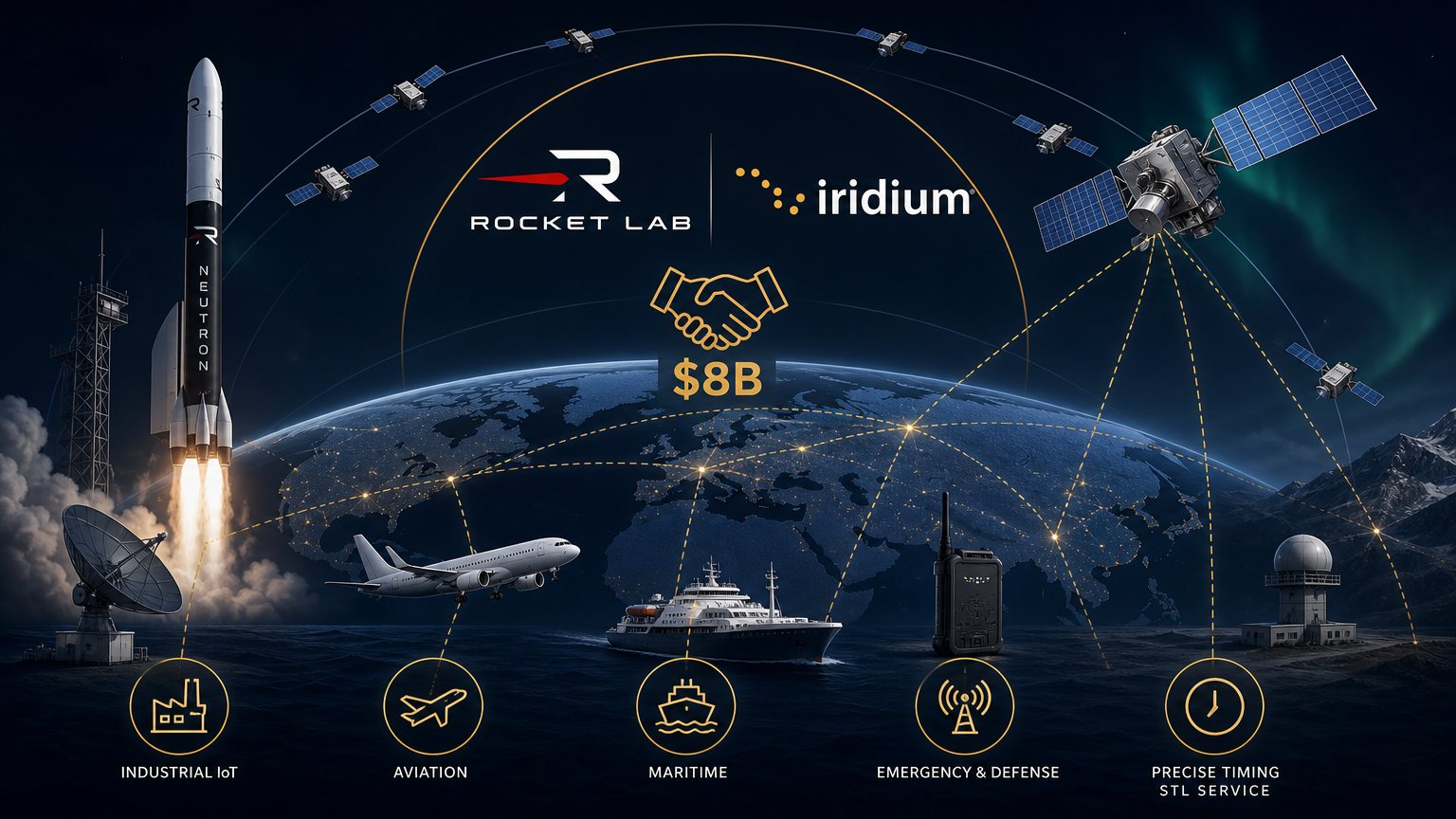
Rocket Lab announced an agreement on June 28, 2026, to acquire Iridium Communications for approximately $8 billion in cash and stock. The proposed acquisition would combine a launch and satellite manufacturing business with an established communications network serving 2.55 million active subscribers.
The SpaceX comparison is an obvious part of the deal. Rocket Lab wants to manufacture satellites, launch them and sell the services they deliver. For teams planning satellite connectivity, industrial IoT networks or backup wide-area network links, Iridium's spectrum and existing services deserve just as much attention. Those assets could affect supplier choices well before Rocket Lab's Neutron rocket reaches a regular launch schedule.
The price and the business being acquired
The agreement values Iridium at $54 per share, consisting of $27 in cash plus Rocket Lab stock. That represents a 24.1% premium to Iridium's June 26 closing price. Deutsche Bank and Wells Fargo are providing a $3.6 billion bridge loan, with further debt and equity financing planned. The approximately $8 billion enterprise-value transaction is expected to close in mid-2027, subject to regulatory approval.
Iridium operates 66 active satellites and 14 on-orbit spares in low Earth orbit, using globally harmonized L-band spectrum. It generated $871.7 million in revenue in 2025 and operates at a 57% operational EBITDA margin. Its network of more than 500 partners serves aviation, maritime, emergency response, defense and industrial IoT customers.
That gives Rocket Lab a profitable telecommunications business alongside its launch and manufacturing operations. Rocket Lab reported $601.8 million in revenue in 2025 and remains loss-making. It has carried out well over 1,700 missions with its Electron small launch vehicle and brought satellite manufacturing in-house through earlier acquisitions. Shares in Rocket Lab rose 10% on the announcement, while Iridium shares gained 22%.
Owning the launch schedule
A constellation operator depends on launch availability to replace aging satellites and introduce new capabilities. Buying capacity from another company means negotiating prices, waiting behind other customers and accepting schedule changes that can delay a service rollout.
The proposed acquisition would bring those decisions into the same business. Rocket Lab CEO Peter Beck described a combined company able to absorb, optimize and scale Iridium into a self-launching operator. His argument is that internal launch capacity would allow faster constellation refreshes than competitors dependent on third-party providers.
There is a practical difference between waiting 18 months for a launch slot and being able to schedule a replacement internally. That flexibility could change the cost of maintaining a constellation and reduce the time a new service spends waiting for hardware to reach orbit.
It still depends on execution. Neutron's first flight is penciled in for Q4 2026, and the vehicle is not yet operational. Once it reaches a regular operating cadence, Rocket Lab expects to be able to replace failing satellites on its own schedule. The strategic case is that this would give the combined business a capability no other commercial operator outside SpaceX has.
The structure resembles the model SpaceX used for Starlink: ownership of launch, satellite manufacturing and the customer service business. SpaceX completed its IPO in June 2026 at an $86 billion valuation, with Starlink's subscriber growth and margins central to the offering. Rocket Lab is pursuing a similar level of integration, though Iridium serves different customers over different frequencies.
What L-band offers infrastructure teams
Satellite networks aren't interchangeable. Frequency choice affects throughput, weather sensitivity, terminal power consumption and the kinds of devices a service can support.
Starlink operates in Ku-band, from 12 to 18 GHz, and Ka-band, from 26 to 40 GHz. Those higher frequencies support substantial throughput, but they require a clear line of sight, can degrade significantly in heavy precipitation and struggle through forest canopy. Their terminals also have relatively high power requirements. That is a reasonable tradeoff for a fixed site or vessel that needs broadband and has a clear view of the sky. It is a poor fit for a low-power soil sensor in a field.
Iridium operates in L-band between 1.6 and 1.7 GHz. These lower-frequency signals pass through clouds and light rain, handle foliage better and support low-cost, low-power hardware at modest data rates. Those characteristics help explain L-band's long use in maritime safety and commercial aviation.
Iridium's 66-satellite constellation also provides global coverage, including both polar regions. Its coverage is a central part of the case for remote deployments that cannot accept geographic gaps, including sites at 70 degrees north latitude.
The bandwidth limit is substantial. Iridium Certus tops out at 704 Kbps, so it does not compete with Starlink for video or other data-heavy applications. Its strengths are more relevant to telemetry, emergency communications, vessel tracking, remote sensor networks and limited-capacity fallback WAN links. In those applications, consistent coverage and device power consumption can matter more than maximum throughput.
The infrastructure judgment is therefore use-case specific. A broadband terminal on a ship and a battery-powered sensor reporting small measurements have different requirements. Iridium's L-band network is particularly well suited to the latter, while Starlink's higher throughput serves the former.
Timing without GPS
Iridium also operates STL, or Satellite Time and Location, which provides GPS-independent precise timing with sub-microsecond accuracy. This is a separate infrastructure opportunity from satellite internet access.
Financial systems, power grids, telecommunications networks and data centers depend on accurate timing. Where those systems rely on GPS-derived time, interference with GPS can become a shared point of failure. Jamming and spoofing events in Europe and the Middle East over the past decade make that a practical risk to assess.
A more commercially aggressive Iridium under Rocket Lab could expand STL beyond its niche defense role into a broader infrastructure service. That remains a forecast. For operators whose threat models include GPS disruption, an independent timing source deserves consideration alongside connectivity resilience.
Amazon's Globalstar agreement adds context
In April 2026, Amazon announced an $11.57 billion acquisition of Globalstar. The agreement would give Amazon globally harmonized L-band and S-band spectrum, along with Mobile Satellite Service, or MSS, licenses. Obtaining comparable regulatory assets from scratch could take years.
Amazon simultaneously announced that its Leo satellite network would power Apple's Emergency SOS via satellite, establishing a direct-to-device path for standard consumer iPhones.
The two acquisition announcements within three months suggest growing competition for licensed satellite spectrum. The investment argument extends beyond conventional broadband terminals to handheld messaging and direct-to-device services, including use where line-of-sight conditions are difficult. Companies with capital and launch or network infrastructure are buying existing spectrum positions rather than waiting to build them from scratch. That could narrow the opportunities to acquire similar assets at reasonable prices.
The proposed combinations point to three different competitive positions:
- SpaceX and Starlink: Ku-band and Ka-band broadband, high throughput and rapid growth, but limited L-band assets and incomplete polar coverage.
- Amazon and Globalstar: L-band and S-band spectrum, direct-to-device services and Apple integration, backed by Amazon's AWS-scale resources.
- Rocket Lab and Iridium: L-band service with global coverage, including the poles, an established industrial, aviation and IoT customer base, and a path to internal launch capacity.
These businesses would not compete solely on price per gigabyte. Their spectrum, devices and customer relationships support different services, leaving room for them to coexist for years.
Decisions for connectivity planning
For infrastructure teams, the useful response is to review the assumptions behind long-term connectivity contracts. A planned acquisition does not immediately change network performance or service terms, but it can change where a supplier is likely to invest.
Primary and backup WAN links
Satellite connectivity is becoming a more viable option for remote industrial facilities, vessels, agricultural networks and rural edge deployments. Depending on the workload, it can provide either the primary connection or a backup path when another carrier fails.
Additional capital and competition among these platforms could improve pricing and service-level agreements over the next two to three years. That is a reason to include satellite options in multi-year contract reviews. It is not a reason to assume every satellite service can carry the same backup workload. Certus's 704 Kbps ceiling, for example, makes application priorities important.
Large outdoor sensor networks
Asset tracking, environmental monitoring and infrastructure telemetry are strong fits for L-band's power requirements and coverage. For small, intermittent messages, the device economics can be more useful than the throughput available from Ka-band services.
Rocket Lab's potential launch autonomy and Iridium's existing subscriber relationships support the expectation of further investment in this market. Device platform requirements for deployments lasting into 2028 should account for that direction without depending on services that have not yet arrived.
Safety-critical services
Iridium's Aireon joint venture provides global ADS-B flight tracking to air navigation authorities, including Nav Canada and NATS in the UK. ADS-B broadcasts an aircraft's position and related flight information, allowing it to be tracked.
Those customer relationships depend on regulatory trust and an operational record that a new entrant cannot quickly reproduce. Alongside Iridium's maritime safety position, they give Rocket Lab an established safety-critical business. Government and aviation revenue could help support the combined company through weaker periods in other satellite markets.
As of June 30, 2026, the acquisition still requires regulatory clearance, the expected closing is about a year away, and Neutron has yet to become an operational launch vehicle. Long-term supplier planning needs to distinguish Iridium's existing coverage and services from the launch flexibility and commercial expansion Rocket Lab expects to deliver.