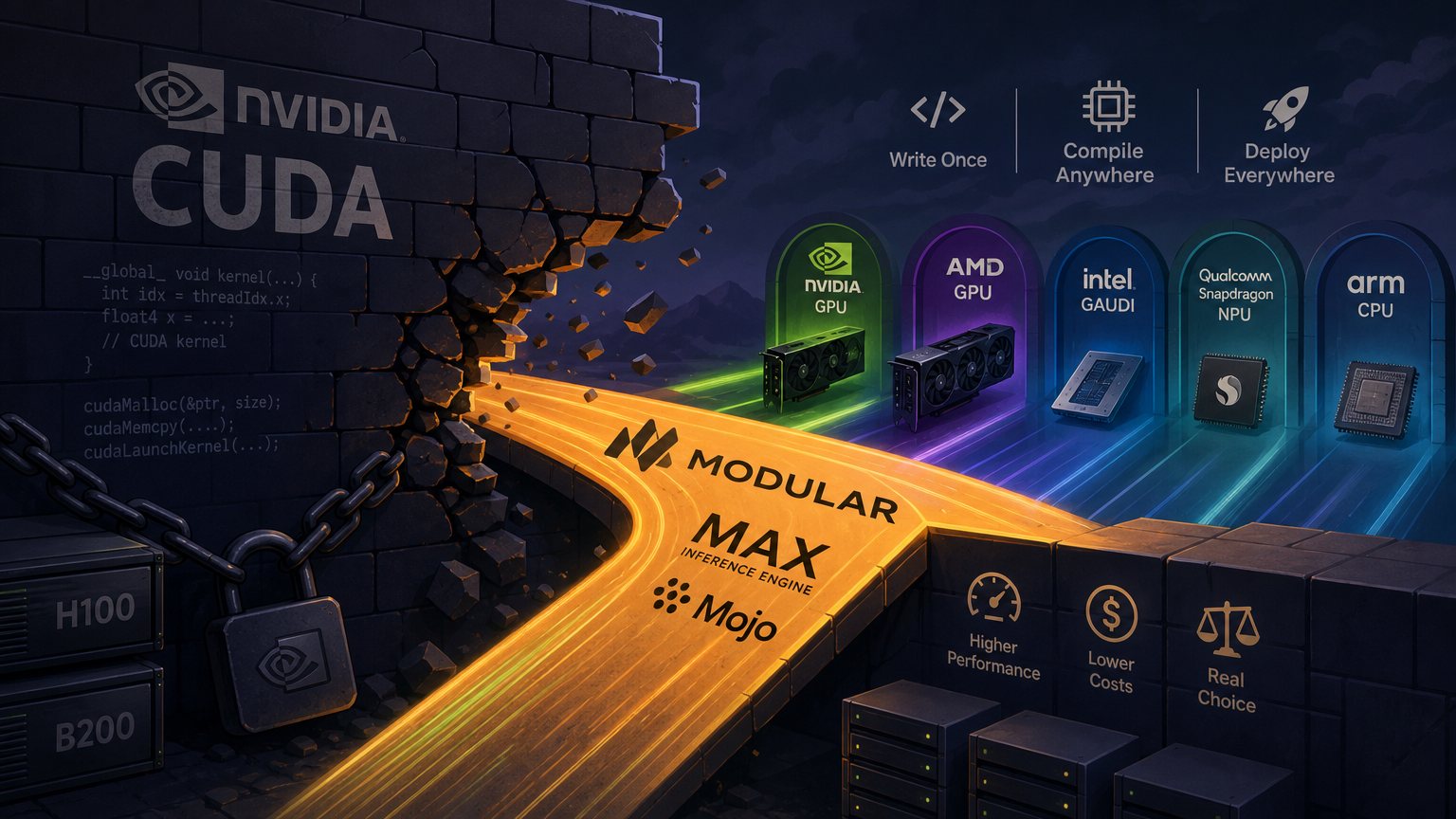
There's a question I've been asking for three years, usually late at night when I'm looking at a GPU invoice: what would it actually cost to move this workload off NVIDIA hardware? The answer is almost always the same. The hardware part is tractable. The software part is where you die. Every model serving setup I've built in the last three years has CUDA fingerprints all over it — in the kernels, in the memory management code, in the vendor-specific fused attention implementations that deliver the last 20% of throughput. The compute works because NVIDIA made the software work first.
That's CUDA's actual value proposition. It's not that their GPUs are magic. It's that they spent twenty years building a software ecosystem so deep and so useful that switching hardware means rewriting your stack from scratch. It's the best moat in enterprise technology right now.
Qualcomm spent $3.9 billion on June 24th to start dismantling it.
What Modular Actually Built
Modular isn't a household name outside AI infrastructure circles, but their two products — the Mojo programming language and the MAX inference engine — represent one of the most serious technical efforts I've seen to address hardware portability for AI workloads.
Mojo is a language designed specifically for high-performance AI code. Think Python ergonomics with C-level performance, built from the ground up with AI primitives in mind. It compiles to native code, can call Python libraries transparently, and gives systems engineers the control they need to write kernel-level operations that actually saturate hardware. You can write a Mojo kernel and have it run — without modification — on an NVIDIA GPU, an AMD GPU, an Intel Gaudi accelerator, or a Qualcomm Snapdragon NPU. That is not a small claim.
MAX is the inference serving layer built on top of Mojo. It's a graph compiler and runtime that takes your model — whether it's in ONNX, PyTorch, or native MAX format — and compiles execution plans optimized for whatever hardware you're targeting. Their benchmarks show MAX outperforming vLLM and TensorRT-LLM on Llama-class models. But the cross-vendor story is what matters here. The same model, the same serving code, running on AMD or Arm without a rewrite. Their developer community has already validated this across NVIDIA A100s, AMD MI300Xs, Intel Gaudi 2s, and Arm Neoverse CPUs.
Chris Lattner's Playbook
I want to spend a moment on who built this, because the track record matters.
Chris Lattner invented LLVM in 2000 as a university project. LLVM became the compiler infrastructure that now underlies Clang, Rust, Swift, Kotlin Native, and approximately half of all modern language toolchains. Before LLVM, compiler backends were proprietary and fragmented — you wrote for GCC's internals or you wrote for a vendor's closed toolchain. After LLVM, you could target any architecture by writing a new backend, and all the optimization passes were shared infrastructure. It didn't kill GCC overnight, but twenty years later, LLVM owns the compiler world.
After Apple, where he led the Swift language and the LLVM-based compiler stack, Lattner spent time at Google Brain and SiFive before founding Modular in 2022 with co-founder Tim Davis. The company raised over $130 million from General Catalyst and Google Ventures before this acquisition.
The pattern is identical to LLVM. LLVM's thesis: compilers don't have to be vendor-specific. Modular's thesis: AI inference runtimes don't have to be vendor-specific. Lattner is doing the same thing he did in 2000, but for the AI compute layer. And the strategic leverage is the same — whoever controls the portability layer controls the negotiating position between hardware vendors and the developers who write to them.
The Deal
Qualcomm confirmed the all-stock acquisition on June 24, 2026, valuing Modular at approximately $3.9 billion — 19.2 million Qualcomm shares. The deal is expected to close in the second half of 2026 pending regulatory and shareholder approvals. Modular's roughly 150 employees, including Lattner and Davis, will join Qualcomm.
The strategic read isn't complicated: Qualcomm has capable AI silicon — the Snapdragon X Elite has a competitive NPU, and their data center AI chip roadmap is serious — but they've been stuck behind NVIDIA's software wall. Developers don't write for Qualcomm accelerators not because the hardware is bad, but because their inference workloads are already CUDA-optimized and a rewrite is expensive and risky. MAX changes that equation. With Modular inside Qualcomm, the MAX engine becomes the bridge that lets developers run CUDA-targeted models on Qualcomm hardware without a rewrite.
It also lets Qualcomm offer something NVIDIA fundamentally can't: a credible path to hardware diversity. TechTimes reported that Meta — which has been very public about its desire to reduce NVIDIA dependence — has already been validating MAX for internal inference workloads and is watching this deal closely.
What This Means for Teams Running Inference at Scale
Let me be direct: this doesn't change your infrastructure decisions next quarter. The deal won't close until late 2026 at the earliest, MAX is still maturing, and Mojo's ecosystem is early compared to CUDA's twenty-year head start. This is not a signal to migrate off NVIDIA now.
But it's worth thinking about what the world looks like in 2027 if this plays out. Right now, when I'm doing inference capacity planning, I have no real alternative to NVIDIA. AMD's ROCm has improved significantly, but the optimization work required to get parity performance on real production workloads is substantial. The practical result: when NVIDIA raises H100 or B200 pricing, I eat it, because my code doesn't run anywhere else without meaningful engineering investment.
If MAX delivers on its promise — hardware-agnostic inference serving at within 5–10% of native CUDA performance — the procurement conversation changes entirely. You bid it out. You put AMD against NVIDIA, Qualcomm against Intel, and you have a genuinely competitive market. HotHardware's analysis estimates this kind of hardware portability could reduce inference compute costs by 20–35% simply through vendor competition that doesn't currently exist at scale.
The other angle is edge inference. Qualcomm dominates mobile NPUs — billions of Snapdragon chips are already deployed. With MAX running portable inference workloads on those NPUs, you get real on-device AI without rewriting your pipeline for each device family. That's significant for any team building AI applications that need low latency or offline capability.
The Risk Nobody's Talking About
There's a graveyard of excellent developer tools that got acquired and quietly suffocated under corporate ownership. The incentive alignment shifts the moment your paycheck comes from a chip company. Qualcomm will be tempted to optimize MAX for Qualcomm hardware, to make the other-vendor support just good enough rather than excellent, to tie the roadmap to their silicon release schedule rather than developer community needs.
Modular's value is precisely its hardware neutrality. The moment developers perceive that MAX is "Qualcomm's inference engine that also happens to run on NVIDIA" rather than a genuine hardware-agnostic platform, adoption stalls and the competitive moat they're trying to build never materializes. The LLVM parallel is instructive: LLVM succeeded partly because it remained genuinely multi-vendor under Apple's stewardship. Lattner will know this. The question is whether Qualcomm's leadership lets him execute it.
I'm cautiously optimistic, for one specific reason: Qualcomm's best outcome — breaking into data center AI at scale — actually requires MAX to be credible on NVIDIA, AMD, and Intel hardware, not just their own chips. Their business incentives support genuine neutrality, at least during the market share battle. If Qualcomm somehow captures 20% of AI inference workloads, the temptation to lock those workloads in will grow. But that's a 2028 problem, and it's one we'd be lucky to have.
The Real Story
The AI infrastructure stack has three layers: the silicon, the software stack that makes the silicon usable, and the models and applications that run on top. NVIDIA owns the first two layers in a way that has no clear precedent in compute history. Not even Intel's Wintel era was this complete — developers could always run x86 code on AMD processors from day one. CUDA code runs on NVIDIA GPUs. That's the end of the sentence.
Modular represents the first serious, technically credible attempt to decouple layers one and two at the AI inference level. It's not the only attempt — Apple has Metal, ROCm keeps improving, and there are a dozen research projects chasing the same goal — but it's the most elegant architecture, the best-led team, and now the best-funded. MLQ's coverage captures it well: this is less about Qualcomm chips and more about who ends up owning the abstraction layer above the silicon.
Whether or not Qualcomm executes perfectly, the acquisition signals something the industry has clearly decided: NVIDIA's software moat is the target worth attacking, not just their silicon. You can build a competitive GPU. You cannot rebuild twenty years of developer ecosystem in a product cycle. But you might be able to build around it.
I'll be watching what Lattner ships under Qualcomm's banner more closely than I'll be watching any GPU benchmark this year. The infrastructure bet here isn't about Qualcomm silicon. It's about who ends up owning the layer that finally decouples AI compute from vendor lock-in. That's the prize worth $3.9 billion.