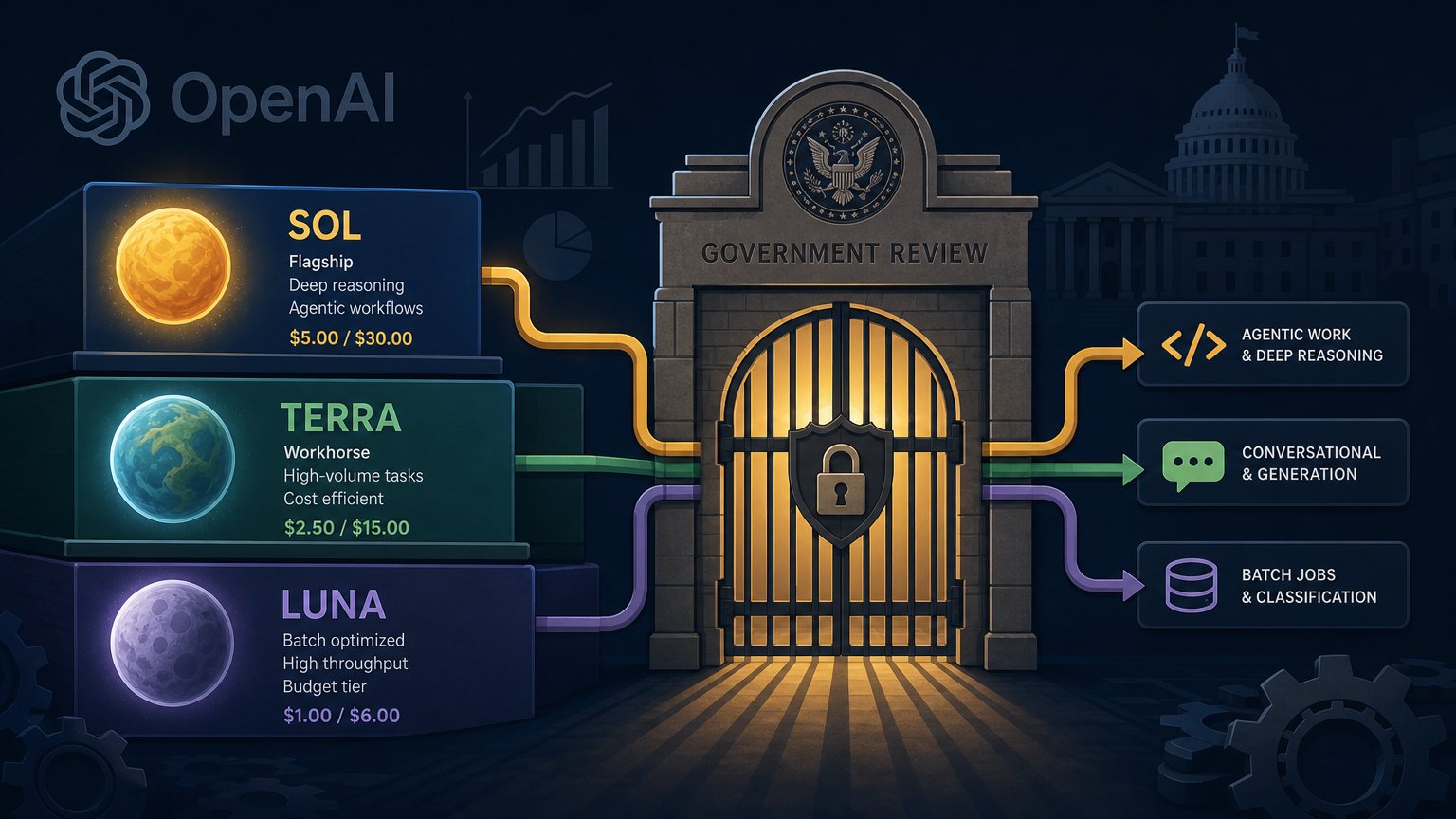
OpenAI unveiled GPT-5.6 on June 26, 2026, with three variants: Sol, Terra, and Luna. Each targets a different balance of capability, throughput, and cost. Access at launch was limited to approximately 20 approved partner organizations while the models went through a government coordination process.
For engineering teams, the announcement raises two separate planning issues. The pricing tiers offer a way to spend less on routine work without giving up a more capable model for difficult tasks. The review process adds a dependency between a model being technically ready and becoming broadly available.
What each tier is designed to do
Sol is the flagship, intended for long-horizon coding, agentic security workflows, and other tasks where reasoning depth matters more than throughput. Its “max reasoning” mode takes more time to work through complex problems. An “ultra” mode creates sub-agents that can carry out work in parallel.
OpenAI reports that Sol scores 88.8% on the Terminal-Bench 2.1 evaluation. Sol Ultra, the multi-agent configuration, reaches 91.9%. The comparison puts Anthropic's Mythos 5 at 88.0% and GPT-5.5 at 83.4%. That is a substantial improvement over the previous generation on this benchmark, though the scores alone don't establish how much better Sol will perform on a particular production workload.
Terra is aimed at document analysis, internal tools, customer support, and high-volume business automation. OpenAI positions it as matching GPT-5.5's capability at roughly half the cost. For a system making millions of API calls, that would make Terra a useful replacement for work that doesn't need Sol's deeper reasoning, provided it meets the application's quality requirements.
Luna is built for batch workloads such as classification, summarization, and background processing. Its focus is throughput and cost efficiency. At $1 per million input tokens and $6 per million output tokens, it sits in the budget tier alongside models such as Gemini Flash that serve high-volume pipelines.
Pricing makes routing worth considering
Reported GPT-5.6 API pricing is:
| Model | Per million input tokens | Per million output tokens |
|---|---|---|
| Sol | $5.00 | $30.00 |
| Terra | $2.50 | $15.00 |
| Luna | $1.00 | $6.00 |
Terra costs half as much as Sol at those token rates. OpenAI's claim of GPT-5.5-level capability at roughly half the cost also makes it a candidate for replacing existing GPT-5.5 workloads. That gives teams an option between keeping the older model and paying flagship rates for every call.
Luna offers a larger price reduction for work it can handle reliably. A classification step or routine summary may not need the same reasoning capability as a coding agent working through a complex task. Sending both to Sol would mean paying the same premium rates despite their different requirements.
A practical design is a thin routing layer in the application that selects a model based on the task:
- Sol: agentic work and tasks that need deep reasoning.
- Terra: conversational tasks, document analysis, and general-purpose generation.
- Luna: classification, routine summarization, and suitable batch steps.
These categories are starting points, not guarantees about quality. Running a task in the background doesn't necessarily make it simple. The routing decision needs to reflect the work being done, rather than just whether the call happens inside an interactive request or a batch job.
The savings depend on classifying those tasks well. Routing too much work to Sol keeps costs high. Routing demanding work to Luna risks lower-quality results. The engineering work is in identifying which calls can use a cheaper tier without losing the quality the application needs.
The government review step
A preview limited to roughly 20 organizations would ordinarily look like a familiar staged rollout. According to reporting on this launch, the reason for the restriction is different: an executive order issued June 2, 2026 requires federal agencies to collaborate on benchmarking and capability assessments of new AI models before broad release.
OpenAI shared the models and release plans with the U.S. government before the June 26 announcement. The same coordination process reportedly applied to Anthropic's Mythos 5 release. This creates a review window between technical readiness and general availability.
As described, the requirement is a mandatory coordination step. It doesn't amount to the government directing what OpenAI should build, or to a stated prohibition on particular model capabilities. Its immediate operational effect is to put part of the release timeline outside the model provider's control.
That is different from waiting for additional serving capacity or negotiating preview access. An engineering team cannot assume that a larger budget or a closer relationship with the API provider will shorten a government review. A product plan that depends on an unreleased model now has another upstream dependency.
Planning around a release that can slip
Model upgrades already involve uncertain schedules and integration work. Pricing can change, APIs can be deprecated, and applications tied closely to specific GPT-5-family behaviors can require adjustments between versions. A government review adds a constraint with a different set of incentives and deadlines.
A review could take longer for reasons unrelated to technical readiness. Its scope could change, or a completed model could remain unavailable while the process continues. Those are planning risks rather than evidence that GPT-5.6 itself faces a long delay.
As of June 28, 2026, general availability was expected in the coming weeks. Initial government coordination for the OpenAI and Anthropic releases appeared to have been relatively quick. Most teams therefore may see little immediate disruption, but products built around access to the next frontier model need a fallback if a later review runs longer.
Useful preparation includes keeping application logic separate from model-specific calls, retaining the ability to run on an older generation, and checking where vendor-specific behavior would make a switch difficult. These boundaries won't remove an external delay. They can make it possible to keep operating while access is pending.
The government coordination around the rollout is still an evolving constraint. A quick initial process doesn't establish a fixed turnaround time for future releases. The unresolved issue is whether review settles into a routine step or becomes slower as models gain capabilities.
The larger design decision is still cost per task
For high-volume applications, the three-tier structure is likely to have a more direct effect on daily operations than the initial review window. Sol, Terra, and Luna, alongside similar tiers from Anthropic and Google, give teams more choices at each point where an application calls a model.
Choosing the most capable affordable model for every request is simple, but it can mean paying for reasoning capability that routine work doesn't use. Choosing the cheapest model everywhere carries its own quality risks. A router makes those decisions explicit and gives teams a place to enforce them.
The useful work is to categorize calls carefully enough that the application can distinguish a Luna task from a Sol task. Terra provides a middle option for general-purpose workloads. Keeping that selection separate from application logic also makes it easier to change the routing when prices, capabilities, or availability change.
Government review timing remains outside an application's control. Task selection and model boundaries do not. Those are the parts of the GPT-5.6 rollout that engineering teams can act on before broad access arrives.