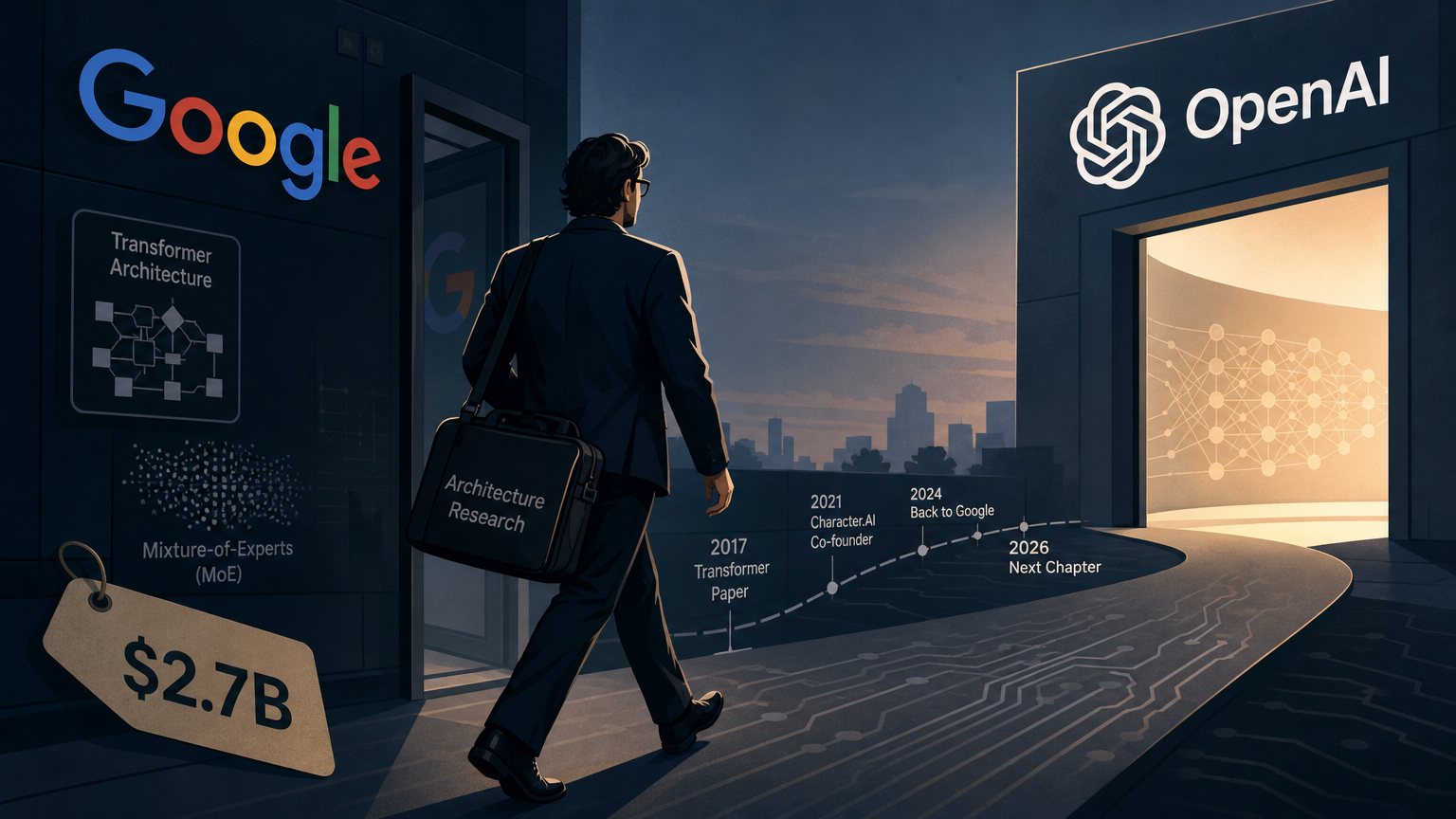
OpenAI announced on June 18, 2026, that Noam Shazeer, a co-inventor of the transformer architecture, was joining as Lead for Architecture Research. The move comes less than two years after Google paid roughly $2.7 billion in a deal that licensed Character.AI’s technology and brought him back to Google.
Sam Altman described the hire as “only 10 years in the making” and said Shazeer had been among the people he most wanted to work with since OpenAI began. Shazeer called the move a “difficult decision.”
For teams building on large language models, the useful question is what his work could change in future models. Shazeer’s contributions extend beyond the transformer to techniques that affect how much computation a model needs, how much memory it consumes, and how difficult it is to serve reliably.
From the transformer to Gemini
In 2017, Shazeer and seven co-authors at Google published “Attention Is All You Need”. The paper introduced the transformer, the architecture underlying model families such as GPT, Gemini, and Claude. The “T” in ChatGPT refers to it.
Before transformers, sequence modeling relied heavily on recurrent networks, including LSTMs and GRUs. These processed sequences one step at a time and had difficulty retaining information across long sequences. The transformer replaced that recurrent processing with attention mechanisms that could operate in parallel, making the architecture much easier to scale.
The paper has accumulated more than 100,000 citations. Its practical influence is visible in everyday engineering decisions. Context window size, memory requirements, and inference costs all depend in part on how a model implements and extends that architecture.
Shazeer spent more than 20 years at Google, contributing to infrastructure before and after the transformer paper. His work also includes mixture-of-experts routing, efficient attention mechanisms, and sparse activation techniques. These approaches help determine whether a large model can run economically at production scale.
He left Google in 2021 to co-found Character.AI, a consumer AI company focused on long-form conversations with AI personas. The company gained significant product traction. In August 2024, Google paid roughly $2.7 billion to license its technology and bring Shazeer back as VP of Engineering and Gemini co-lead.
That distinction matters. The payment was part of a technology-licensing arrangement, rather than an acquisition or a payment solely for hiring Shazeer. His return was nevertheless a major part of the deal.
Shazeer was credited with helping Gemini close its capability gap with ChatGPT. His return coincided with more competitive Gemini releases, following Google’s visible difficulties in 2023 and into 2024. That supports the case that his return helped, though it doesn’t isolate his contribution from the work of the wider team.
How mixture-of-experts affects serving costs
Mixture-of-experts, usually shortened to MoE, is especially relevant to the economics of large models. A standard dense transformer uses its full set of model parameters to process each token. An MoE model routes each token through only a subset of specialized subnetworks, called experts.
This separates a model’s total parameter count from the amount of computation it uses for a given token. A model can contain hundreds of billions of parameters while using far fewer of them at each step. Its compute requirements can therefore be closer to those of a much smaller dense model.
That doesn’t make the model cheap or simple to serve. The full parameter set still creates a large memory requirement, even when only part of it is active. Routing also creates load-balancing problems. If too many tokens go to the same experts, those experts become bottlenecks while other capacity sits idle.
The serving system has to manage those imbalances well enough to deliver predictable performance. Sparse computation offers savings, but some of those savings can be lost through inefficient routing or underused hardware. A headline parameter count says little about how well a deployment handles these problems.
Shazeer has worked on this class of problem for years. His experience with routing, efficient attention, and sparse activation is directly relevant to the cost of future models. Architectural choices made over the next 18 months could influence inference costs for years, although the effect will depend on how those designs are implemented and deployed.
Google no longer holds the original team together
The transformer paper had eight co-authors. Ashish Vaswani, Niki Parmar, Jakob Uszkoreit, and Llion Jones have all left Google. Aidan Gomez left and co-founded Cohere. Shazeer is now joining OpenAI.
Google and DeepMind still have substantial research talent. The departure of the original authors doesn’t mean the company has lost the ability to develop competitive architectures.
It does mean that knowledge once concentrated within Google is spread across competing labs. Papers explain an architecture, but they don’t capture every abandoned experiment or every reason behind a design choice. Researchers carry that less formal knowledge with them, including an understanding of which choices were deliberate and which were practical compromises.
For model customers, the effect is likely to emerge over several generations rather than a single quarter. Research leadership can influence which problems a lab pursues and which tradeoffs it accepts. It cannot, by itself, establish which provider will deliver the best model for a particular workload.
The IPO expectation adds another layer
As of June 24, 2026, OpenAI is expected to file for an IPO in fall 2026. Against that expectation, hiring Shazeer has an investor-facing role as well as a technical one. It signals to investors, enterprise customers, and researchers that OpenAI intends to invest in new architectures alongside improvements to its existing models.
The timing invites an interpretation that the hire serves both a long-term research strategy and the company’s presentation ahead of a potential public offering. There isn’t enough evidence to determine how much either consideration influenced the decision. A prominent hire can support that presentation without showing how quickly the research will produce a useful model.
What Google loses
Google’s 2024 deal appears to have delivered short-term technical value. Gemini became more competitive after Shazeer returned, and he received credit for part of that improvement. The available evidence doesn’t establish a financial return on the roughly $2.7 billion agreement.
His departure creates a more specific loss of continuity. As Gemini co-lead, he would have had close knowledge of the architecture’s tradeoffs, the reasoning behind optimizations, and the work needed for future releases. Replacing that understanding is harder than filling a job title.
There is also a difference between carrying out a research roadmap and helping decide what belongs on it. Shazeer’s record places him in the latter group. His move gives OpenAI more experience at that level while removing it from Google’s leadership team.
Google retains substantial advantages, including its TPU fleet, data resources, and distribution through enterprise and consumer products. Those assets, along with its remaining researchers and engineers, leave it well equipped to continue shipping frontier models. One departure doesn’t erase them.
What to watch in model evaluations
The hire is relevant to long-term provider decisions, but it isn’t a reason to change providers on its own. The practical implications are more specific:
- A three-year commitment needs room for change. Capability rankings can shift on a six-month cycle. An integration layer that allows models to be replaced is more useful than assuming one hire identifies the long-term winner.
- Watch OpenAI’s releases over the next 12 to 18 months. Any architectural influence is more likely to appear in benchmark profiles, behavior at longer context lengths, and inference costs than in hiring announcements. Even then, attributing a model’s performance to one researcher will be difficult.
- Evaluate MoE through serving behavior. For cost-sensitive workloads at scale, understanding a provider’s architecture and its handling of routing and memory constraints can be more useful than capability benchmarks alone. MoE offers an important route to lower compute per token, but the deployment has to deliver the savings.
- Keep Google in the comparison. Losing Shazeer again is a setback. Its infrastructure and distribution advantages still matter, and future Gemini releases should be judged on their measured performance.
The next two model generations from both labs will provide better evidence of the move’s technical consequences. Production teams can assess those models on capability on real workloads, context scaling, serving reliability, and cost.