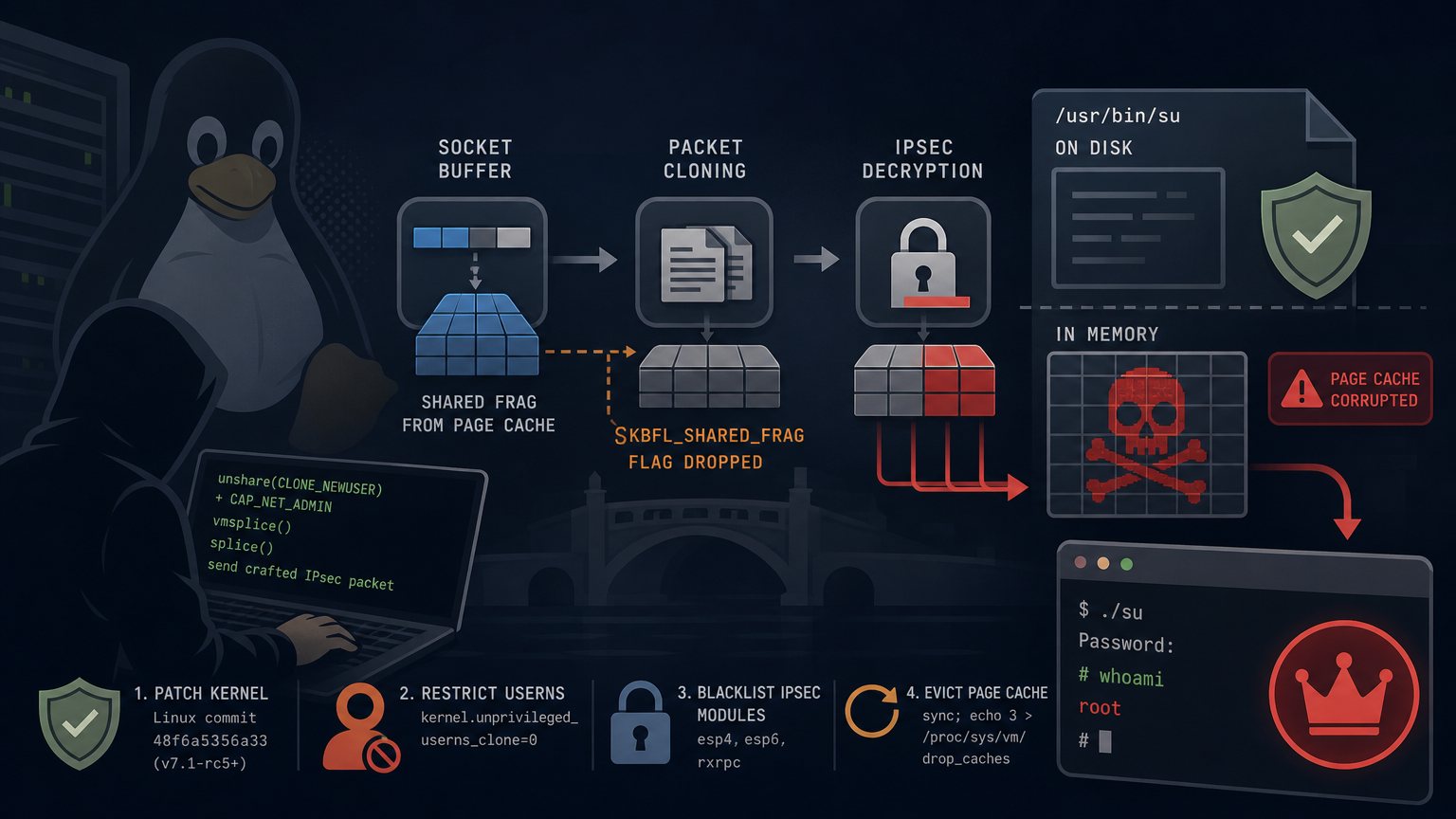
On June 25, 2026, JFrog Security Research researchers Eddy Tsalolikhin and Or Peles published a working exploit for DirtyClone, CVE-2026-43503. The Linux kernel local privilege escalation has a CVSS score of 8.8. On an affected system with the required namespace access, an unprivileged process can use it to gain root.
The fix entered Linux mainline on May 21, but distribution packages remained unevenly available as of June 29. That leaves a practical concern for Linux servers running untrusted code, especially shared Kubernetes nodes and CI runners.
DirtyClone modifies the kernel's cached copy of an executable rather than its contents on disk. That distinction is central to both the exploit and the difficulty of investigating it.
Where the kernel loses a safety flag
DirtyCOW in 2016 and DirtyPipe in 2022 also allowed unprivileged processes to modify memory that should have been protected. DirtyClone follows more directly from DirtyFrag, a 2025 vulnerability involving file-backed page-cache memory and socket buffers. A socket buffer is a kernel structure used to hold network packet data.
The DirtyFrag fix added SKBFL_SHARED_FRAG, a flag marking socket-buffer fragments that share their backing memory with a file. Code handling a marked fragment must avoid modifying that shared memory in place. Otherwise, a packet operation could corrupt the file's in-memory representation.
DirtyClone exploits a failure to preserve that flag when packet data is copied or rearranged. The affected paths include __pskb_copy_fclone() and related helpers skb_shift(), skb_try_coalesce(), skb_segment(), and skb_gro_receive().
Once the flag is lost, later code can treat the fragment as ordinary writable packet memory. The fragment still points to memory backing a file in the page cache, so writing to it changes the cached file contents.
How the published exploit reaches root
The JFrog technical writeup describes a chain that combines user namespaces, packet duplication, and IPsec decryption:
- Create a user namespace. This provides access to
CAP_NET_ADMINwithin the namespace without granting the process administrative privileges over the host. Debian and Fedora enable unprivileged user namespaces by default. - Map a privileged executable into memory. The published example uses
/usr/bin/su, bringing its pages into the kernel page cache. - Attach those pages to a UDP socket buffer. The exploit uses
vmspliceandspliceso a socket-buffer fragment shares physical memory with the cached executable. - Configure a loopback IPsec tunnel. A netfilter TEE rule duplicates outbound packets onto a second path inside the namespace.
- Send a crafted IPsec packet. Duplication reaches the vulnerable
__pskb_copy_fclone()path, and the clone losesSKBFL_SHARED_FRAG. - Trigger in-place AES-CBC decryption. The
esp_input()path writes attacker-controlled bytes into the shared memory, corrupting the cached pages of/usr/bin/su. - Execute the modified binary. With its authentication check overwritten,
sugrants root.
The operation is local. The tunnel uses loopback, so the exploit doesn't require an outbound network connection. The Hacker News coverage describes the attack as leaving no audit trail and reports that a reboot restores the original executable because its disk copy was never changed.
The detection concern is in memory
File-integrity monitoring commonly checks whether a file's hash differs from a known-good value. That is useful for detecting an executable replaced or edited on disk. DirtyClone targets a different copy of the data.
In the described attack, the on-disk /usr/bin/su remains byte-for-byte identical to the distribution package. A SHA-256 or SHA-512 hash of that unchanged disk content would still match. The corrupted bytes live in the page cache, the memory layer the kernel uses to avoid repeatedly reading files from storage. Execution can use those cached bytes.
This raises concerns for checks built around file hashes, including AIDE, Tripwire, Wazuh file-integrity rules, and the kernel's Integrity Measurement Architecture, or IMA. The important distinction is which representation a check measures. An unchanged disk copy alone cannot establish that the executable's cached contents are clean.
The exploit also avoids an ordinary file-write system call when it changes the executable. The write occurs through IPsec decryption into shared memory. An investigation focused only on file-write events would therefore miss the operation that corrupts the cached binary.
A reboot removes the page-cache modification described in the exploit. That can also remove useful evidence before an investigator has captured memory. A clean executable on disk after a reboot doesn't settle whether the host was previously compromised.
Which systems are exposed
The published attack depends on a kernel without the May 21 fix and access to unprivileged user namespaces. Distribution backports matter more than the apparent age of a kernel version.
- Debian: Unprivileged user namespaces are enabled by default, and an advisory has been issued.
- Fedora: Unprivileged user namespaces are enabled by default, and an advisory has been issued.
- Ubuntu: Advisory
USN-8373-1covers the issue. Ubuntu 24.04 LTS has partial mitigation through AppArmor restrictions on namespace creation, but it is still listed as affected. - SUSE / openSUSE: An advisory has been issued.
- Red Hat Enterprise Linux: The issue was tracked in Red Hat Bugzilla at the time of JFrog's disclosure. No backported kernel package had shipped to customers as of June 27.
Shared hosts deserve particular attention. On a Kubernetes node that allows the required operations, a tenant able to run arbitrary code could use the flaw to reach node root. That would put other workloads on the node at risk and could provide a route to further cluster compromise.
CI/CD runners executing untrusted code face a similar problem. A cloud instance behind a firewall can also remain exposed if an attacker already has local code execution. DirtyClone is a privilege escalation, not an exploit that needs direct inbound network access.
Patching and temporary mitigations
Install a fixed distribution kernel
The mainline fix is commit 48f6a5356a33, first included in v7.1-rc5, released May 24, 2026. The preferred fix for production systems is the distribution's backported kernel package.
For Ubuntu, the relevant advisory is USN-8373-1. Debian and SUSE administrators should check their distribution security trackers. RHEL administrators should follow the Bugzilla entry for package availability. The howtofix.guide coverage collects distribution-specific patching commands.
Restrict unprivileged user namespaces
Restricting namespace creation blocks a prerequisite of the published exploit and is an immediate mitigation where patching isn't yet possible. The proposed setting is:
sysctl -w kernel.unprivileged_userns_clone=0To persist the setting across reboots:
echo 'kernel.unprivileged_userns_clone=0' >> /etc/sysctl.d/99-dirtyclone.conf
sysctl -p /etc/sysctl.d/99-dirtyclone.conf
This restriction can break legitimate software, including rootless container runtimes, some browser sandboxes, and development tools that depend on unprivileged namespaces. Test the change outside production before deploying it broadly.
Block unused protocol modules
For affected systems that don't use IPsec, the proposed module-loading mitigation includes the following entries:
echo 'install esp4 /bin/true' >> /etc/modprobe.d/dirtyclone-block.conf
echo 'install esp6 /bin/true' >> /etc/modprobe.d/dirtyclone-block.conf
echo 'install rxrpc /bin/true' >> /etc/modprobe.d/dirtyclone-block.conf
These entries are intended to prevent the listed modules from loading. They are a temporary restriction, not a replacement for the kernel fix.
Consider the evidence cost before clearing caches
The proposed cache-clearing command is:
sync; echo 3 > /proc/sys/vm/drop_cachesIt requests the release of page cache, dentries, and inodes, allowing discarded file contents to be read again from disk. Performance can drop while caches warm up. Clearing potentially corrupted pages does not patch the vulnerability or establish that a previously compromised system is trustworthy.
Cache clearing also has an incident-response tradeoff: it can remove the memory state needed to investigate the page-cache modification. Evidence collection should be considered before a reboot or cache eviction.
Investigating a suspected compromise
The reported exploit doesn't need to alter the executable on disk. File hashes and file-write logs therefore shouldn't be the only basis for deciding whether a host was affected.
A live kernel memory dump could theoretically preserve a modified page-cache entry for examination with a tool such as Volatility. That is an advanced investigation and depends on capturing the relevant memory before it disappears.
For a host believed to have been compromised, rebuilding from a known-good image is the safer recovery recommendation. The lack of a modified binary on disk should not be treated as evidence that root access was never obtained.
The CyberSecurityNews summary provides another account of the seven-step exploit chain. For affected systems, the immediate priority remains installing a fixed kernel and limiting the published exploit's prerequisites while that update is pending.