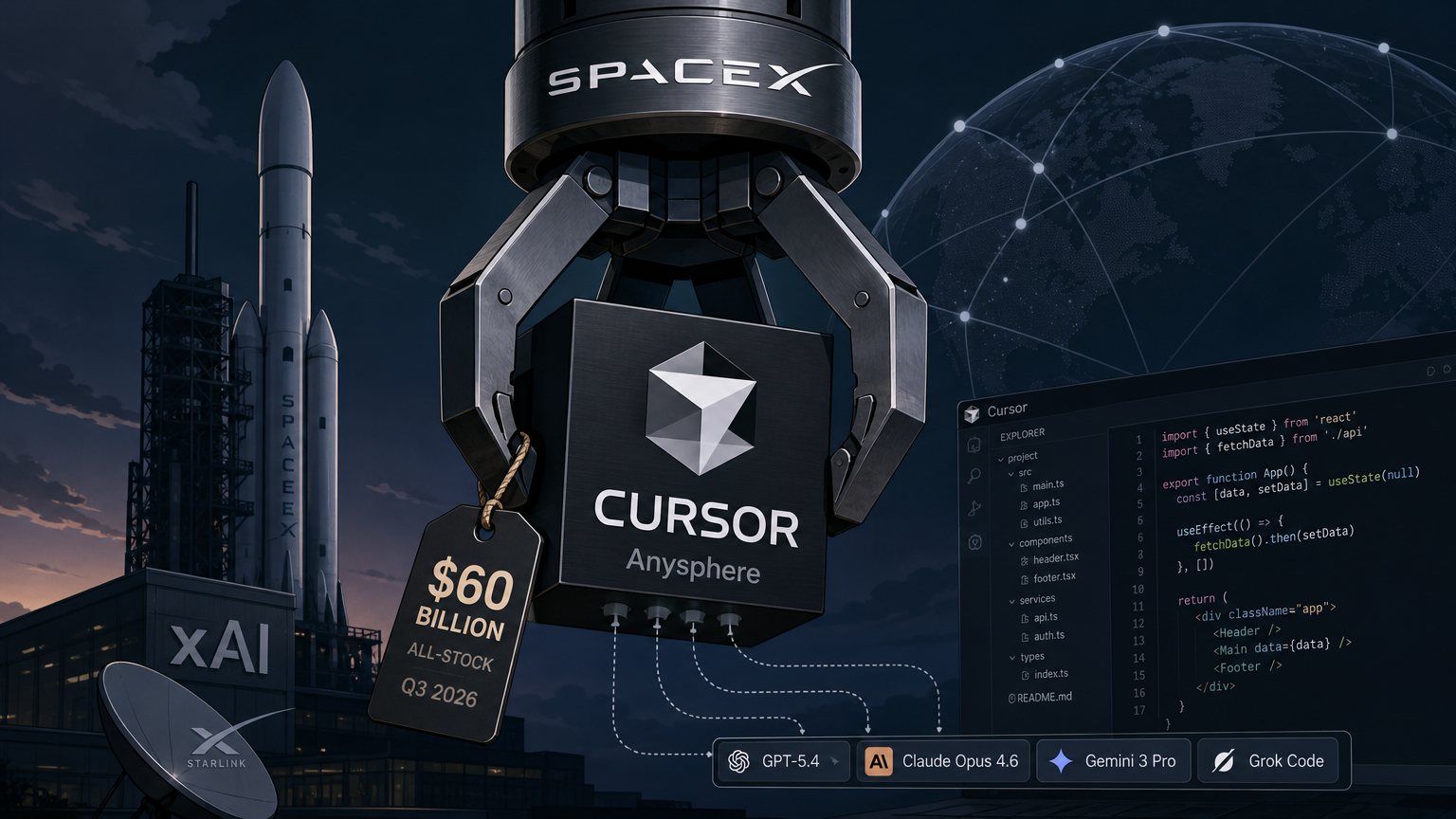
SpaceX announced on June 16, 2026, that it will acquire Anysphere, the company behind the AI code editor Cursor, for $60 billion in stock. The announcement came four days after SpaceX's IPO. Reported as the largest acquisition of a venture-backed startup on record, the deal is expected to close in Q3 2026, subject to regulatory review.
As of June 18, the ownership transfer hasn't happened. Teams that depend on Cursor therefore have some time to review what a new parent could mean for model access, enterprise agreements and workflows built around the editor.
What SpaceX is buying
Cursor is a code editor built as a fork of VS Code, with AI features integrated into the development environment. Anysphere launched it in 2022. By late 2025, the company had raised $2.3 billion at a $29.3 billion valuation. In early 2026, it was reporting more than $2 billion in annualized recurring revenue, roughly 60% of it from enterprise customers. OpenAI was among those customers.
According to figures attributed to JetBrains' January 2026 developer survey, 18% of respondents used Cursor at work. That put it close to Claude Code and behind GitHub Copilot's 29%. Those figures show substantial adoption, though a share of survey respondents isn't the same as a measured share of the entire developer market.
Cursor's appeal rests partly on multi-file editing and model flexibility. Where Copilot began with inline autocomplete, Cursor built its development environment around broader AI-assisted tasks. Its Composer feature supports edits across 10 to 50 files in a single operation. An enterprise plugin marketplace, shipped in March 2026, lets teams govern and distribute custom extensions across their organizations.
Cursor Pro also routes requests across GPT-5.4, Claude Opus 4.6, Gemini 3 Pro and Grok Code depending on task complexity. That access to several model families is an important part of the product's value. A team can use one editor without committing every task to one model provider.
How Cursor fits with SpaceX and xAI
The acquisition makes more sense in the context of SpaceX's merger with xAI earlier in 2026. The combined business already includes launch vehicles, Starlink connectivity and AI models. Cursor would add a widely used coding product and an established enterprise customer base.
The deal also comes during a difficult period for xAI. All 11 of its co-founders had reportedly departed by March 2026, and Grok had faced serious controversies involving harmful content and safety guardrails. Meanwhile, Anthropic and OpenAI were shipping enterprise coding products.
Buying Anysphere gives SpaceX access to its engineering talent, product and distribution. The reported $2 billion in annualized recurring revenue and substantial workplace adoption represent relationships that would be difficult to build quickly from scratch.
SpaceX's IPO materials describe a claimed $26 trillion total addressable market, including $2.4 trillion in AI infrastructure and $22.7 trillion in enterprise applications. Those are the company's estimates of potential markets, not revenue forecasts. Cursor gives SpaceX and xAI a route into engineering organizations, including large enterprises, that could support those ambitions.
What could change for teams using Cursor
In the short term, the editor may change relatively little. Anysphere is set to operate as a wholly owned subsidiary. Both companies have said joint AI model training is already underway, with a new product release planned in the near term.
Multi-model access is likely to remain available for a while. Removing it would give customers a reason to consider alternatives such as Copilot and Claude Code. Over time, though, ownership could affect how models are selected, what enterprise contracts permit and how the service is priced.
Model selection and default routing
As xAI's models mature, the parent company would have an incentive to favor Grok Code in Cursor's default routing. That doesn't require removing competing models. A change to defaults could shift usage while leaving the model selection menu largely intact.
For teams with provider-specific compliance requirements, that distinction matters. Access to an approved model isn't enough if some requests can be routed elsewhere. Reviews should cover both the models available and the controls governing which providers receive requests.
Enterprise data terms
Cursor's enterprise security posture has been a selling point. A change in ownership gives security and compliance teams a reason to revisit the agreements supporting that posture before the expected Q3 close.
Grok's safety controversies may add scrutiny, but they don't establish that Cursor's enterprise data protections have failed or will change. The useful questions concern the terms governing enterprise data, any changes associated with joint model training, and the notice or consent required before those terms can change.
Pricing and switching costs
Cursor Pro currently costs $20 per month, with flexible enterprise tiers. Cursor competes aggressively on price and can undercut Copilot in some configurations, though the comparison depends on the plans and usage involved.
Higher prices after the acquisition are a risk rather than an announced change. As teams build more workflows around Cursor, moving away becomes more expensive and disruptive. That can give the supplier more room to change pricing or terms. Enterprise reviews should therefore consider renewal provisions and switching costs alongside the current subscription price.
A more concentrated coding-tool market
The deal would put another major AI coding tool under a company that also owns an AI platform. The mid-2026 landscape already has several close ties between coding tools and their parent ecosystems:
- GitHub Copilot belongs to Microsoft, which also owns Azure and has a major partnership with OpenAI.
- Claude Code is Anthropic's first-party coding tool, closely integrated with the Claude model family.
- Cursor would join the combined SpaceX and xAI business if the acquisition closes.
- Google's AI coding features sit within its Gemini and Google Cloud ecosystem.
This concentration could bring more investment and better products. It also gives parent companies reasons to favor their own models and services. Cursor's proposed sale would narrow the field of major independent tools, particularly for teams that value an editor offering access to competing model providers.
What to review before the expected close
There isn't a clear reason to abandon Cursor solely because of the announcement. Greater model investment could improve it. The practical response is to understand the dependency before changes to the product or contract make that work urgent.
- Document which teams use Cursor and which workflows depend on its specific features, extensions and model choices.
- Review enterprise agreements for ownership-change provisions, data-handling terms, renewal conditions and rights to change pricing or service behavior.
- Check whether model-routing controls meet compliance requirements, including when defaults change.
- Assess how difficult it would be to move essential workflows to another editor or coding assistant.
The $60 billion purchase price reflects the value SpaceX places on Cursor's product and reach into software development. For customers, the expected Q3 2026 close provides a window to review their commitments while the transfer remains subject to regulatory approval.