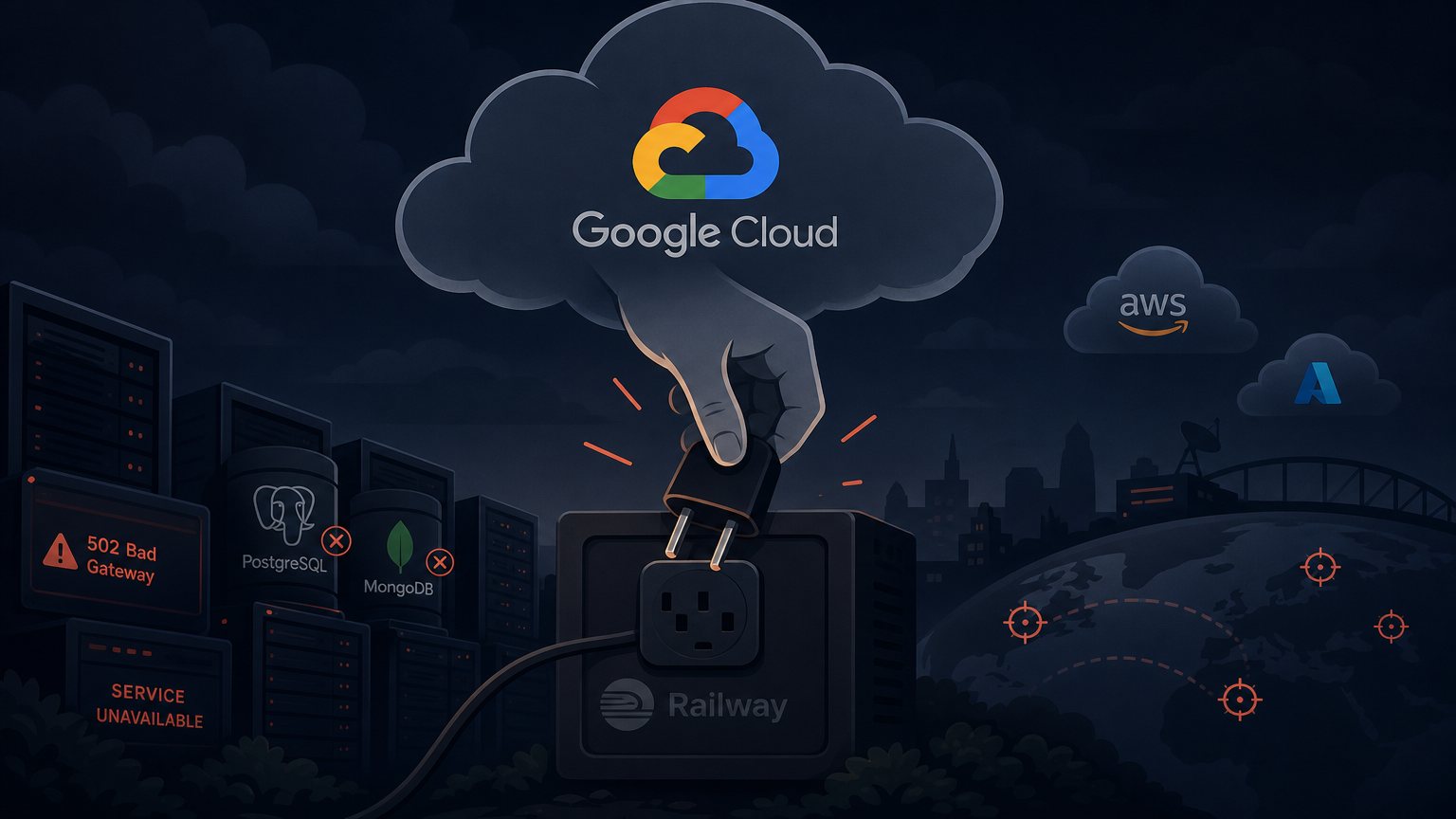
On May 19, 2026, Railway was effectively taken offline after its Google Cloud account was automatically placed into restricted status. The platform, used by thousands of developers and businesses to host production workloads, suffered a cascading outage within minutes of the restriction.
The disruption lasted roughly six hours, with significantly longer downtime for many customers. PostgreSQL and MongoDB instances crashed, and APIs returned 502 errors. As edge routing caches expired, the failure spread beyond services hosted on GCP to the rest of Railway's platform. Some customers reported more than eight hours of downtime.
Railway's team said it did not fully know why the account had been suspended automatically. The leading theory was that abuse signals associated with free VPN tutorials circulating on YouTube had triggered enforcement against the entire account. That explanation remained unconfirmed as of May 20, 2026.
A cloud account is a shared dependency
The incident raises a recovery problem that applies well beyond Railway. A business running on a single hyperscaler, whether AWS, GCP, or Azure, depends on continued access to that provider's infrastructure and account systems.
An automated trust-and-safety flag, a billing dispute, compromised credentials, or a regional outage can interrupt that access. These failures have different scopes, but a recovery plan needs to account for each. Infrastructure redundancy alone doesn't establish whether a business can recover from an account-wide restriction.
Railway's outage also shows how a shared dependency can extend the damage. Workloads outside GCP were still affected when edge routing caches expired. Placing services in separate environments offers limited protection if they depend on something that fails with the primary environment.
Cloud infrastructure can be reliable and still require an independent disaster recovery plan. The useful question is how long the business can keep serving customers, or how quickly it can resume, when its primary account becomes unavailable.
Two ways to provide an independent recovery target
Active redundancy across providers
One approach is to distribute replicas and failover targets across cloud providers, or across cloud infrastructure and a physical facility. The aim is to keep a usable environment outside the account, region, or provider affected by the incident.
This costs more and adds operational work. Full multi-cloud operation may be excessive or impractical for many small and mid-sized businesses. It also needs to address shared dependencies: a second hosting location won't solve the problem if routing still depends on the suspended account.
Disaster recovery to a physical site
Another option is Disaster Recovery as a Service, or DRaaS, with a recovery target in an owned or colocated facility. That target sits outside the primary hyperscaler's trust-and-safety, billing, and policy systems, so a restriction there need not also disable the recovery environment.
For businesses that can't justify full active redundancy, warm replicas and tested recovery runbooks can provide a more practical alternative. Warm replicas are copies maintained in advance for recovery; runbooks document the steps needed to restore service. Their value depends on whether the copies remain accessible and those steps work during an outage.
What the recovery plan needs to answer
An architecture review should establish specific answers to these questions:
- If the primary cloud account is suspended at 10 p.m. without warning, how long will it take to serve customers again?
- Who at the provider has authority to reverse an automated suspension, and how can that person or team be reached at 3 a.m.?
- Are backups stored in the same account, provider, or trust boundary as production? Could the same restriction make both inaccessible?
A backup within the affected account may still be useful for other failures, but it cannot provide independent recovery if the suspension blocks access to it. Recovery testing needs to cover that access problem as well as the ability to restore the data.
As of May 20, Railway was expected to publish a detailed postmortem and harden its architecture, including decoupling its API from edge routing. Those were anticipated next steps, not completed fixes.
Other businesses don't need to wait for those changes to test their own exposure. A useful exercise is to attempt failover with the primary account treated as unavailable, then identify which data, routing services, and recovery steps still depend on it. That establishes whether the recovery target can support the business when it is needed.
For disaster recovery planning or cloud spending support, contact Summit through Marc Pope.