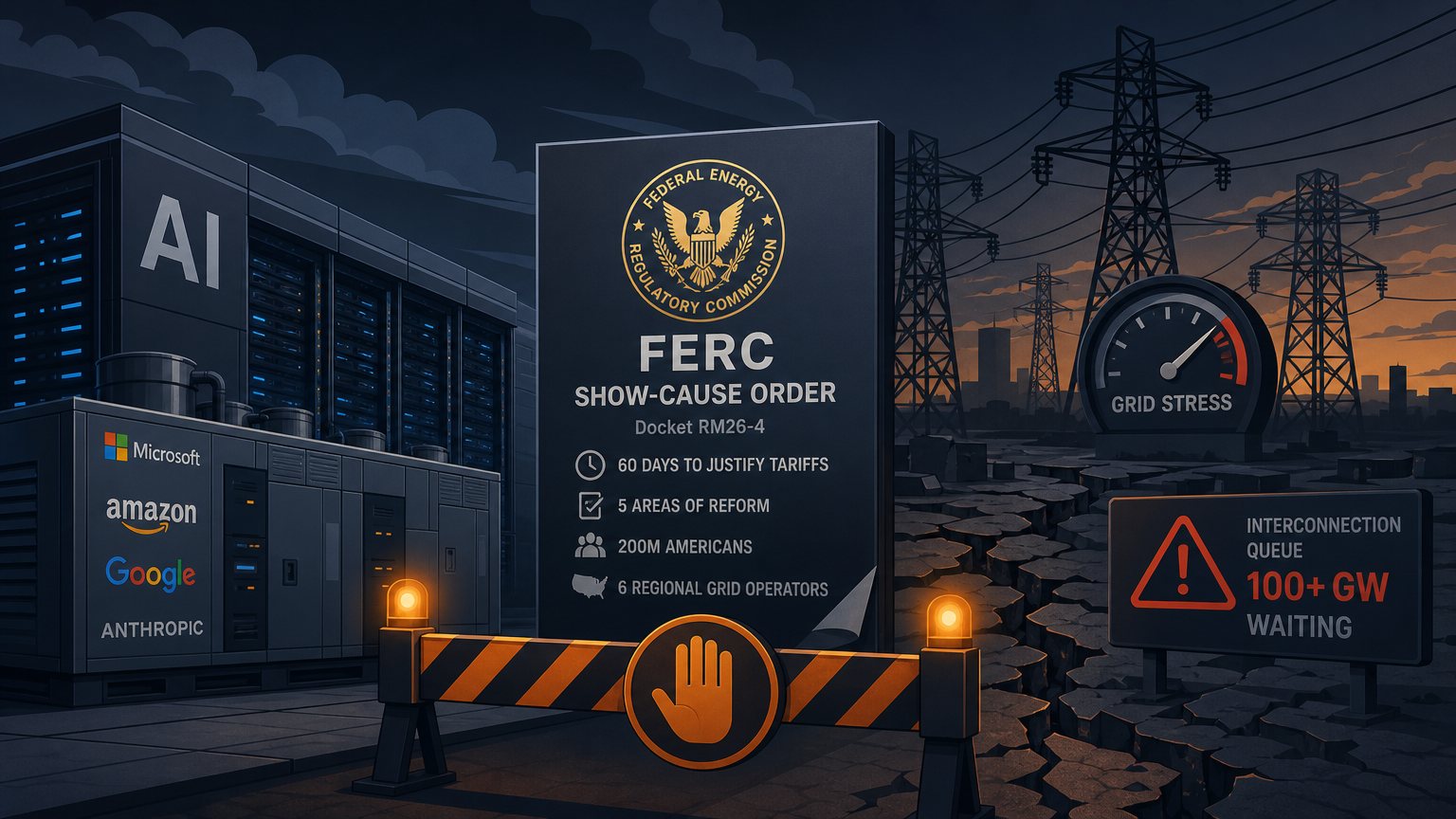
On June 18, 2026, the Federal Energy Regulatory Commission unanimously issued show-cause orders giving six regional grid operators 60 days to justify their current tariffs for large power users or propose changes. For AI data center developers, the responses could affect connection timelines, transmission upgrade bills, and the terms under which a facility can draw power.
The orders cover PJM Interconnection, the Midcontinent ISO, Southwest Power Pool, the California ISO, ISO New England, and the New York ISO. Together, these organizations manage electricity delivery to roughly 200 million Americans across more than 30 states. Their tariffs establish the rates and rules for using the transmission system.
FERC is acting under Section 206 of the Federal Power Act, requiring operators to defend their existing tariffs or explain how they would revise them. Chair Laura Swett described large-load integration as a “national priority.” The immediate task is a regulatory response, not a promise that new data centers will receive power within 60 days.
Large loads are outgrowing the connection process
AI training clusters routinely exceed 100 MW, and a single hyperscale inference facility can draw 200 to 500 MW continuously. Individual campuses are seeking power contracts on a scale that could have served mid-sized cities a decade ago.
The interconnection queue, the line of projects waiting to connect to the transmission grid, has grown to hundreds of gigawatts nationwide. Studies can take years. By the time a project receives a definitive connection cost estimate, the technical and cost assumptions behind its application may have changed.
Intel's Prithpal Khajuria described the mismatch directly: “load growth is now outpacing the grid's ability to plan, price, and integrate it under the existing framework.” That leaves developers making expensive commitments before they know when power will be available or what the connection will cost.
The orders follow an October 2025 directive from Energy Secretary Chris Wright asking FERC to consider reforms for large-load interconnection. The proceeding identified as Docket RM26-4 has led to targeted show-cause orders rather than waiting for a longer, general rulemaking process.
Five areas under review
Faster transmission studies
FERC wants operators to improve the studies used to assess new large loads. These studies determine whether the grid can serve a proposed facility reliably and what upgrades it would require. Long waits make both construction schedules and budgets harder to trust.
The commission is pushing operators to consider alternative transmission technologies, including advanced conductors and grid-enhancing technologies, while accelerating the study process itself. Those options could help operators make better use of existing transmission infrastructure.
Connection timelines could shorten if operators submit acceptable reforms and put them into practice. Developers still need to distinguish a proposed process improvement from an approved connection date.
Clearer responsibility for transmission costs
A large data center connection can require new transmission lines, substation work, and transformer replacements. Under current rules in several regions, some of those costs are spread across existing ratepayers rather than paid by the customer whose connection triggers them. FERC is targeting that cost shifting and seeking more transparent transmission charges.
Jane Rueger, co-chair of Perkins Coie's data center practice, said that “projects seeking transmission-level service should expect clearer requirements around applications, study procedures, readiness criteria, operating obligations, and transmission service terms.”
For a developer, the electricity price alone won't capture the financial exposure. A project that assumed other ratepayers would share its upgrade costs could become more expensive if those charges move onto its own budget. Existing customers could receive some protection from paying for infrastructure needed by a neighboring data center.
Co-location and behind-the-meter generation
FERC is also examining arrangements that place generation alongside a large load or electrically close to it. Behind-the-meter generation supplies a facility on its side of the utility meter. These arrangements raise different questions from a data center buying all its electricity through a conventional grid connection.
Potential designs include gas turbines, nuclear microreactors, and utility-scale solar paired with storage. They are part of a broader move toward combining on-site or nearby generation with grid service.
Microsoft, Amazon, and Google have all signed agreements with nuclear operators in the past 18 months. Anthropic has also signed leases on more than 12 US data centers with combined capacity exceeding 1 GW. Generation co-location could be part of the planning for that expansion, although that remains an inference.
The commission's attention to co-location suggests it could become a more common route for large loads seeking faster treatment. It doesn't, by itself, establish a universal requirement for data centers to build generation.
Transmission service for flexible loads
Another reform area concerns data centers that can reduce or shift electricity use when the grid is under stress. This is demand-side flexibility: the customer changes consumption in response to system conditions, similar to a demand response program, but at the scale of an AI cluster.
Some inference work can be queued, batch jobs can be throttled, and training runs can be deferred during periods of peak stress. That flexibility has to be designed into the infrastructure and workload scheduling. A facility cannot promise to reduce demand reliably unless its operating systems can deliver the reduction.
FERC is laying the groundwork for transmission services that recognize those capabilities. The stated 20 MW threshold for the new requirements would capture a broad range of large AI facilities, including projects far smaller than a 100 MW campus.
Flexible service could eventually offer advantages in connection cost treatment or energy pricing. The regional filings will determine what operators propose and what obligations participating customers would accept.
Studies for electrically nearby generation
Generation built next to a data center still needs a clear regulatory treatment. Operators must determine whether it qualifies as behind the meter, whether it involves transmission service, and how to study its effects on reliability.
Those answers currently vary by region. A behind-the-meter gas turbine in PJM territory can receive different treatment from an equivalent arrangement in California ISO territory. That variation slows planning and makes regulatory risk part of site selection.
FERC wants greater consistency in the study process for electrically proximate generation. This is related to its broader work on co-location, but addresses a specific practical problem: how operators evaluate a nearby generator and the load it is intended to serve.
The deadlines and regional responses
The June 18 orders put the 60-day tariff response deadline in mid-August. Separate 30-day resource adequacy reports are due in mid-July. Resource adequacy concerns whether enough electricity supply is available to meet demand.
PJM has described the orders as “a continuation of work already underway.” It has been dealing with substantial demand growth from data centers and electric vehicle charging for years, and its existing reform work gives it a starting point for the response.
Other regions face different constraints. California's generation mix and established demand response programs may require substantial changes to accommodate large AI loads. In New England, geography and transmission limitations make new facilities particularly difficult to site and connect.
FERC isn't imposing a single national tariff through these orders. Each operator will submit its own response. How closely those responses align could shape the development landscape for large AI infrastructure over the next three to five years.
What developers should account for now
The filings aren't complete as of June 23, 2026, but the five reform areas identify several assumptions that deserve closer attention in current projects.
- A credible generation plan for facilities above 100 MW. Depending entirely on grid supply at that scale can bring significant connection costs and multi-year delays. Options include a power purchase agreement with a nearby nuclear plant, behind-the-meter gas generation, or solar paired with storage. The planning case for evaluating these options is strong, even where co-location isn't a formal requirement.
- Flexible load capability in procurement and design. Workload scheduling and power controls should be evaluated together. Facilities able to participate in demand response may gain advantages as operators develop new services, particularly where inference or batch workloads can tolerate changes in timing.
- A closer review of transmission upgrade assumptions. Development budgets that rely on spreading upgrade costs across other customers may need revision. Projects and ratepayers currently carrying costs caused by adjacent development could benefit from clearer allocation rules.
- Regional rules as a site-selection factor. Differences won't disappear when the 60-day deadline arrives. Study procedures, readiness requirements, operating obligations, and transmission terms could remain more favorable in some regions than others.
AI demand is concentrated in large facilities, often in locations where transmission capacity is already constrained. Regulatory changes take months or years, while model deployments and infrastructure commitments can move in weeks. A project schedule needs to account for both.
Tom's Hardware's coverage describes the emerging expectation as bringing power or being prepared to cut usage during high demand. Either approach affects facility design and day-to-day operations.
Interconnection agreements, generation studies, and demand response controls therefore need attention before a campus design is fixed. Outside specialists can handle parts of that work, but infrastructure teams still need enough internal expertise to judge the costs, scheduling commitments, and operating restrictions they are accepting.