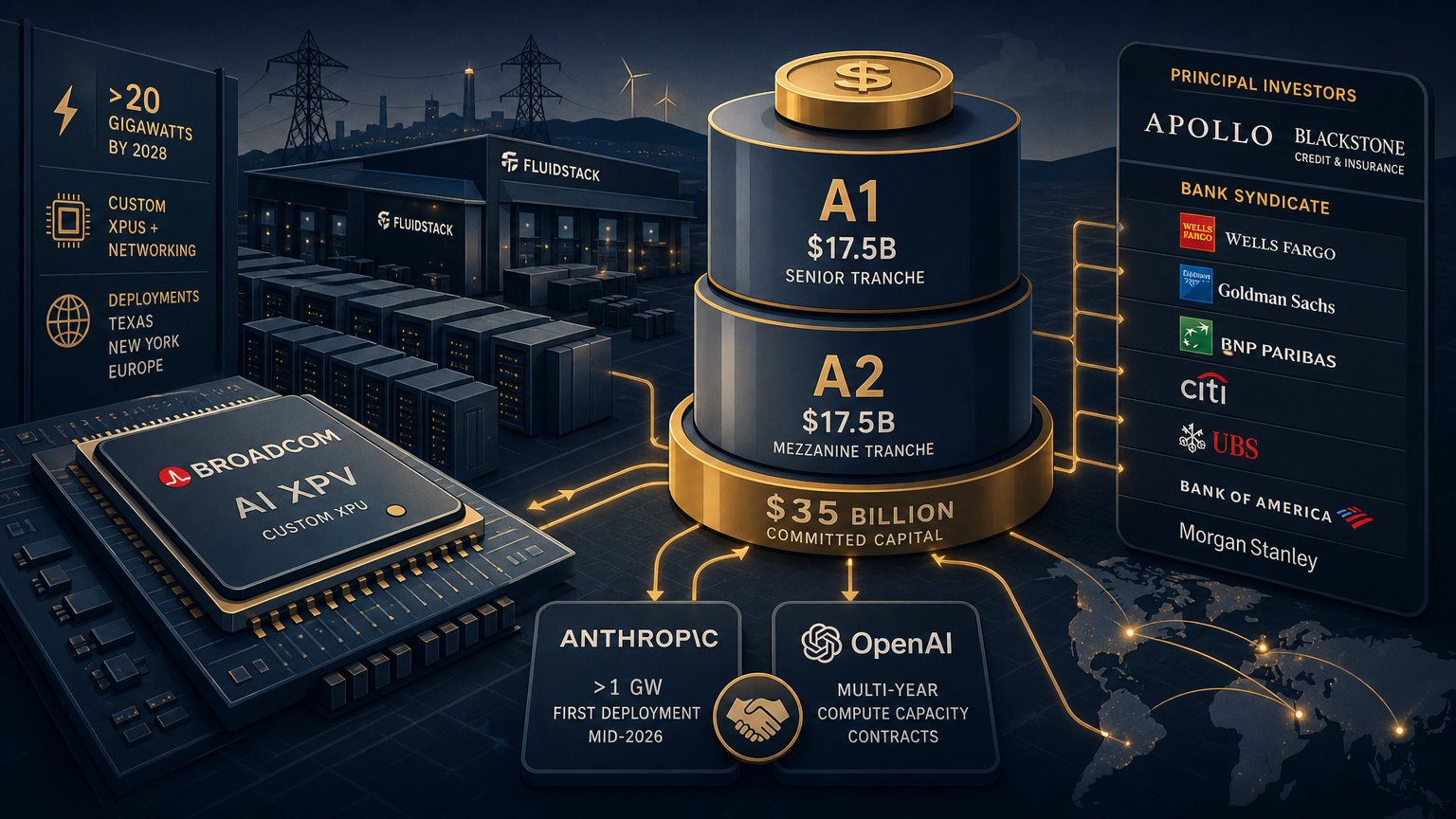
Broadcom, Apollo, and Blackstone announced a $35 billion financing platform on June 9, 2026, to fund dedicated AI computing infrastructure. The Broadcom AI XPV Platform targets more than 20 gigawatts of capacity by 2028, with Anthropic's expansion as its first deployment.
The size is striking, but the financing structure deserves equal attention. Long-term compute contracts from frontier AI labs provide the revenue around which investors finance the infrastructure. Broadcom supplies custom chips and networking, while specialist operators run the facilities. That arrangement brings an infrastructure investment model to hardware that changes much faster than a power plant or a toll road.
How the platform is structured
Broadcom supplies custom XPUs, application-specific integrated circuits, or ASICs, designed for AI training and inference. It also provides optimized networking to connect those chips. Apollo leads the financing as principal investor, supported by Blackstone's Credit and Insurance business and global banks. Frontier AI labs, starting with Anthropic and including OpenAI, sign multi-year contracts for dedicated capacity.
The initial $35 billion tranche has two layers, A1 and A2, with separate bank syndicates. The banks involved include Wells Fargo, Goldman Sachs, BNP Paribas, Citi, UBS, Bank of America, and Morgan Stanley.
Anthropic's first deployment covers more than one gigawatt of compute capacity at Fluidstack-based sites in Texas and New York, starting in mid-2026. The wider platform's target is more than 20 gigawatts by 2028.
For scale, estimated global data center peak power demand was approximately 104 gigawatts in 2025 and was projected to reach roughly 132 gigawatts by the end of 2026. A 20-gigawatt platform would be equivalent to about 15 percent of that projected year-end demand. This is a comparison of scale, not capacity already in service.
Why long-term contracts matter to investors
Apollo is acting as a principal investor rather than simply making a conventional loan. It is committing capital through its High-Grade Capital Solutions, Apollo Capital Solutions, and ATLAS SP Partners platforms. Its announcement describes “committed, certain capital across a multi-year draw schedule” for infrastructure with “contracted cash flows, mission-critical utility.”
That is language normally associated with utilities, fiber networks, and power generation. Investors in those assets look for revenue that can support financing over many years. Power purchase agreements and toll road revenues serve a similar role to the compute contracts here.
Apollo and Blackstone together manage more than $2.3 trillion in assets. The platform applies that institutional investment approach to compute silicon, which has historically changed too quickly and been too difficult to resell to fit comfortably into this model.
The investment case rests on two related arguments. Large AI customers need capacity years ahead of time and are willing to sign multi-year agreements. Substantial switching costs may make that revenue more predictable. At the same time, Broadcom's custom chips promise lower per-token costs and better power efficiency than general-purpose GPUs for the workloads they are designed to run.
Those technical advantages help explain why a lab might commit for years. They don't make silicon as durable as utility infrastructure, but they give investors a reason to finance deployments against contracted revenue rather than rely only on future demand estimates.
The tradeoff between custom chips and GPUs
The case for custom ASICs deserves more weight at very large scale. Nvidia's strength in AI training comes from both the CUDA software ecosystem and the flexibility of general-purpose GPUs. When future workloads are uncertain, that flexibility is valuable. It remains especially important for startups and mid-market organizations.
The economics look different for training runs that consume hundreds of megawatts or inference services supporting hundreds of millions of daily active users. Power efficiency and the cost of processing each token have much greater financial consequences than they do for a team renting a hundred A100s for a fine-tuning job.
A custom ASIC can be designed around a particular model family, including its memory bandwidth needs and the way chips exchange data. For a well-matched workload, that design can offer a substantial efficiency advantage over a general-purpose GPU. The tradeoff is less flexibility if requirements change.
Broadcom supplies custom silicon for Google's TPU program and has production engagements with multiple hyperscalers. The XPV Platform bets that this chip-design capability, paired with financing for large deployments, can support a lasting business through 2028 and beyond.
For Anthropic and OpenAI, giving up some hardware flexibility can be a reasonable exchange for more certain capacity and better per-token economics, provided their multi-gigawatt compute needs remain predictable. The long-term contract and the chip choice are closely connected decisions.
Power procurement becomes part of capacity planning
Global data center electricity consumption grew 17 percent in 2025, and Gartner projects another 26 percent increase in 2026. The IEA has flagged that supply bottlenecks are already driving a scramble for solutions.
A target of 20 gigawatts only becomes usable compute if the facilities can secure electricity. As these plans turn into power purchase agreements and utility contracts, they can reduce the capacity available to other projects in the same markets. Northern Virginia, Texas, New York, and emerging European corridors are among the markets where competition for power matters to expansion plans.
Organizations planning data center expansions for 2027 or 2028 have reason to begin power procurement now. Hardware delivery alone won't determine when a facility can operate.
Separating financing, chips, and operations
Anthropic's initial deployment uses Fluidstack-operated facilities rather than an entirely Anthropic-built data center estate. Fluidstack runs a hybrid model: a marketplace that aggregates third-party GPU capacity and a private cloud business that directly owns and operates infrastructure. It currently manages more than 100,000 GPUs.
The XPV arrangement separates responsibilities that a hyperscaler might otherwise hold together. Apollo and Blackstone provide financing, Broadcom supplies silicon and networking, and Fluidstack handles operations for the initial deployment. Long-term compute contracts connect those layers.
This is an emerging template for purpose-built AI facilities. It allows specialist providers to handle different parts of a project, rather than requiring a single cloud company or AI lab to fund, equip, and operate the whole deployment.
It also points to a growing difference between ordinary cloud computing and frontier AI capacity. AWS, Azure, and Google Cloud remain appropriate for the vast majority of workloads. But some of the most cost-efficient frontier compute may increasingly sit in dedicated facilities that aren't available through public spot markets.
For organizations training large models or serving inference at very high volume, access to suitable hardware may increasingly depend on long-term capacity agreements. On-demand pricing remains useful, but it may not provide the same access or economics as a dedicated commitment.
A larger pool of capital for AI infrastructure
The platform fits a broader pattern that has been developing since 2024. AI infrastructure's capital requirements are pushing companies toward financing arrangements beyond ordinary technology balance sheets. OpenAI's Stargate program targets ten gigawatts, and China has committed $295 billion to data center buildout.
Other developments reported in the week of June 11, 2026, point in the same direction. NVIDIA and SK Hynix announced a multi-year co-development partnership for next-generation memory tied to AI infrastructure roadmaps. Marvell is joining the S&P 500 amid strong AI infrastructure demand. Chips, memory, facilities, and financing are becoming more closely connected.
Broadcom CEO Hock Tan described June 9 as a “historic inflection point.” The more concrete significance is that the XPV Platform gives institutional investors a way to finance custom AI compute against long-term contracted revenues.
This infrastructure-style private credit model could attract hundreds of billions of dollars in institutional capital over the next decade. Its appeal depends on the contracts remaining dependable and the hardware delivering the expected economics. For large compute buyers, the immediate consequence is that power procurement, chip selection, and financing terms increasingly need to be considered together, years before the capacity is required.