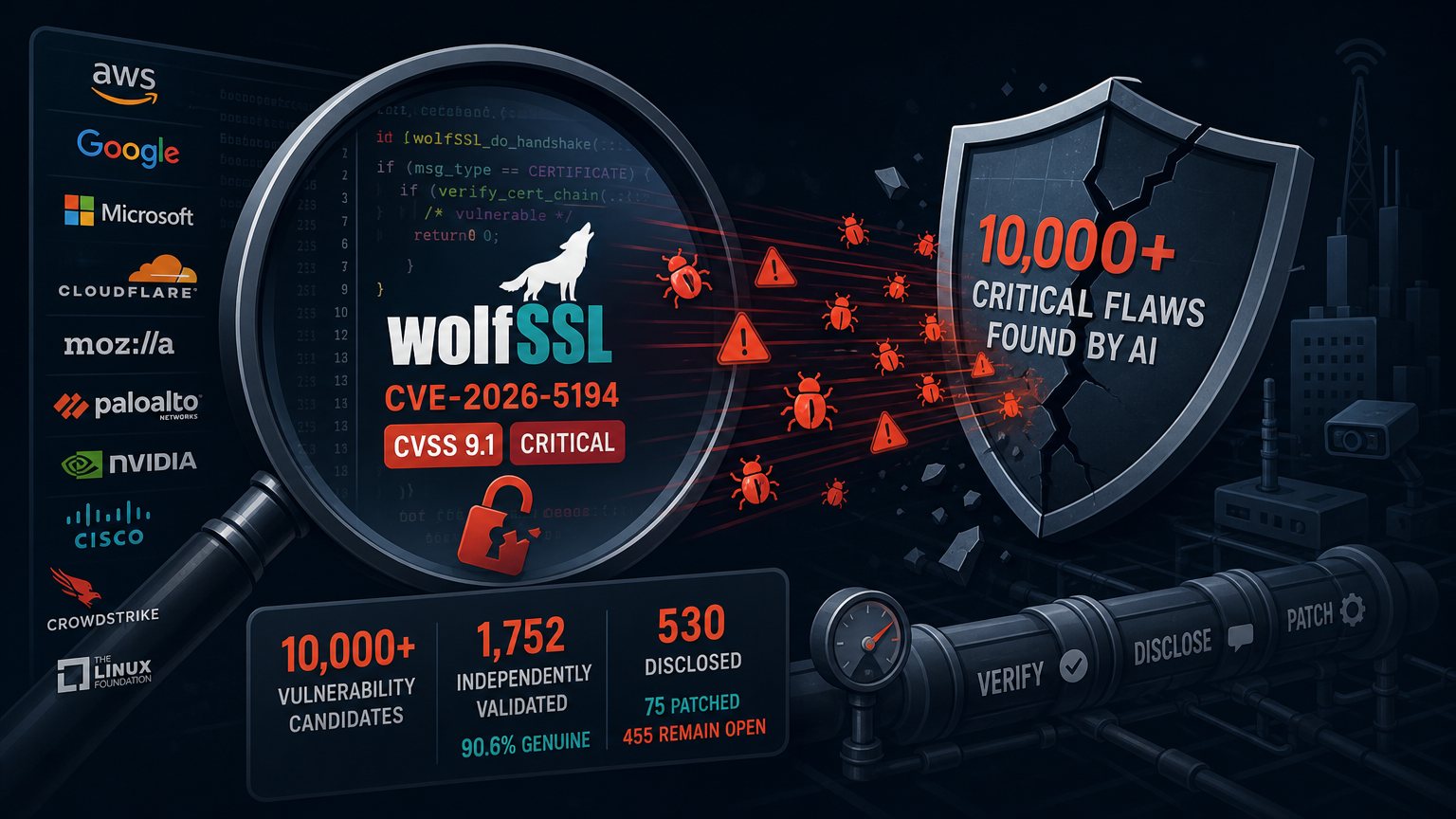
Anthropic's Project Glasswing reported more than 10,000 high- or critical-severity vulnerability candidates across over 1,000 open-source projects in its first month. Of 530 high- or critical-severity vulnerabilities disclosed to maintainers, 75 had been patched and covered by public advisories at the time of the initial update.
Those figures describe different stages of the security process. A candidate needs verification. A confirmed vulnerability needs a fix, and that fix still has to reach the systems running the affected software. Glasswing's early results suggest that finding problems can move much faster than resolving them.
Launched in April 2026, Project Glasswing paired Anthropic's unreleased Claude Mythos Preview model with roughly 50 partner organizations. Participants included AWS, Google, Microsoft, Cloudflare, Mozilla, Palo Alto Networks, NVIDIA, Cisco, CrowdStrike, and the Linux Foundation. The initiative gave the model access to critical software to search for vulnerabilities before attackers found them.
According to the initial results, independent security firms evaluated 1,752 findings. Of those, 90.6 percent were genuine vulnerabilities, and 62.4 percent were classified as high or critical severity. That is a substantial volume of findings, though the full set of more than 10,000 candidates should not be treated as confirmed critical flaws.
A certificate-forgery flaw in wolfSSL
One of the most consequential examples in the initial disclosures was CVE-2026-5194, a critical vulnerability in wolfSSL with a CVSS severity score of 9.1.
wolfSSL is an open-source cryptographic library used in IoT firmware, embedded systems, and network appliances. Such libraries can be present inside a product without being visible to the organization operating it. That makes identifying affected systems harder than checking the version of a directly installed application.
According to Anthropic, Mythos also constructed a working exploit that could let an attacker forge certificates and impersonate a legitimate service. The reported result went beyond flagging suspicious code: the model demonstrated an attack.
Certificate forgery could enable man-in-the-middle attacks against affected devices. Potential downstream environments include routers, sensors, industrial controllers, and medical equipment, where updates may be infrequent or depend on the equipment vendor. wolfSSL's reported footprint spans billions of devices, although that footprint should not be read as the number affected by this particular flaw.
What partners reported
The partner-level results show both the volume of discovery and its effect on release work:
- Cloudflare reported 2,000 identified bugs, including 400 classified as high or critical severity. It also reported that Mythos had a lower false-positive rate than human testers.
- Mozilla reported 271 vulnerabilities in Firefox 150 alone.
- Palo Alto Networks shipped five times its usual number of patches in its latest release cycle.
- Microsoft expected elevated patch volumes to continue for some time.
- Oracle reported accelerating vulnerability detection and response by multiple times over its previous baseline.
These results aren't interchangeable measures. Bugs found, severity classifications, patches shipped, and response speed describe different outcomes. Still, the reports suggest that even large vendors with established security programs have substantial additional work to absorb.
For infrastructure operators, that work eventually arrives as advisories, software updates, appliance firmware, and decisions about how quickly to deploy them.
Verification and patching take time
Anthropic described the operational problem plainly: vulnerability discovery had become rapid, while verification, disclosure, and patching remained slower.
Security programs have long devoted considerable effort to discovery. Human penetration testers have limited time and code coverage. Static analysis tools can produce large numbers of false positives, and bug bounty findings arrive unevenly. Glasswing's reported validation rate suggests that AI can produce a large stream of credible findings, creating pressure further along the process.
The initial update reported an average patch development time of two weeks. Against a 90-day disclosure window, that may sound manageable. But an average doesn't show how work is distributed. Findings can arrive in bursts, and many open-source projects depend on a single maintainer or a small volunteer team.
Of the 530 high- or critical-severity vulnerabilities disclosed to maintainers, 455 had not yet reached the reported milestone of a patch and public advisory. That figure doesn't establish that every one remained unfixed, but it does show how much work had yet to reach a publicly documented resolution.
Patch development is also only part of the delay. A fix in an upstream library still has to reach dependent packages and products, pass testing, and be installed by operators. Faster discovery cannot complete those steps on its own.
Arctic Wolf's analysis cites a figure of 76 percent of actual compromises involving known vulnerabilities with available patches. That points to a separate deployment problem: organizations can remain exposed even after maintainers have finished their work.
Changes infrastructure teams should consider
Shorter patch cycles, with an urgent path
Anthropic is urging vendors and operators to shorten patch testing and deployment timelines. A routine 30-day or 60-day cycle could leave a long exposure window if tools with capabilities similar to Mythos become more widely available.
A two-week deployment target for high- and critical-severity findings is a reasonable operational goal, with a faster path for CVSS 9.x vulnerabilities. That is a recommendation, not a reported Glasswing standard. Severity and exposure need to inform the response, and faster deployment still requires testing. The practical challenge is making urgent updates possible without waiting for the next routine maintenance cycle.
An inventory that includes embedded dependencies
A software bill of materials, or SBOM, records the components included in software. A current inventory helps operators determine whether a newly disclosed vulnerability applies to their systems.
wolfSSL illustrates the difficulty. It may be embedded in a third-party appliance rather than installed as an obvious package. Similar inventory problems arise with OpenSSL dependencies, other TLS libraries, and cryptographic components several levels down a dependency tree.
When an advisory such as CVE-2026-5194 appears, the goal should be to identify possible exposure within hours rather than spend days discovering which products contain the library. An SBOM is useful only if it reflects what is deployed and can be connected to the relevant vendor advisories.
Monitoring while fixes are being deployed
Visibility across endpoints, networks, cloud systems, and identity services remains important while vulnerable systems await updates. Certificate transparency log monitoring and anomaly detection around TLS handshakes are proposed detection measures in the certificate-impersonation scenario.
They should not be treated as guaranteed detection for CVE-2026-5194. Their usefulness depends on how an attack works and what the affected environment records. Monitoring can support the response, but it doesn't remove the need to identify and patch affected software.
AI-assisted patching, with review
Alongside the Glasswing update, Anthropic launched Claude Security in public beta for Enterprise customers. In a three-week test, Claude Opus 4.7 reportedly generated patches for 2,100 vulnerabilities.
That makes AI-assisted patching worth evaluating, particularly for teams supporting open-source projects with limited maintainer time. Generating a patch is not the same as establishing that it is correct or deploying it safely. Human review and testing remain necessary, but assistance with patch development could address part of the backlog created by faster discovery.
The capability is still restricted
Anthropic has not released Claude Mythos Preview publicly, saying its safeguards against misuse aren't yet adequate. The UK AI Security Institute independently tested the model and reported that it was the first model to complete cyber range simulations end to end, covering both vulnerability discovery and exploitation.
Those are results from simulated environments, but the combination matters for defense. A tool that can find a flaw and build an exploit could shorten the time available to respond if comparable capabilities reach attackers.
Restricting access while the defensive partnership develops is a reasonable precaution. It should not be treated as a permanent barrier. Wider availability of comparable tools is a forecast rather than a settled timetable, but it is a credible basis for planning. Help Net Security's coverage presents the update as a warning as well as a report of defensive progress.
Infrastructure teams can identify affected dependencies and make urgent patch deployment practical without waiting for public access to Mythos. They can also test whether assisted patch development reduces the time from a confirmed finding to a safe fix.