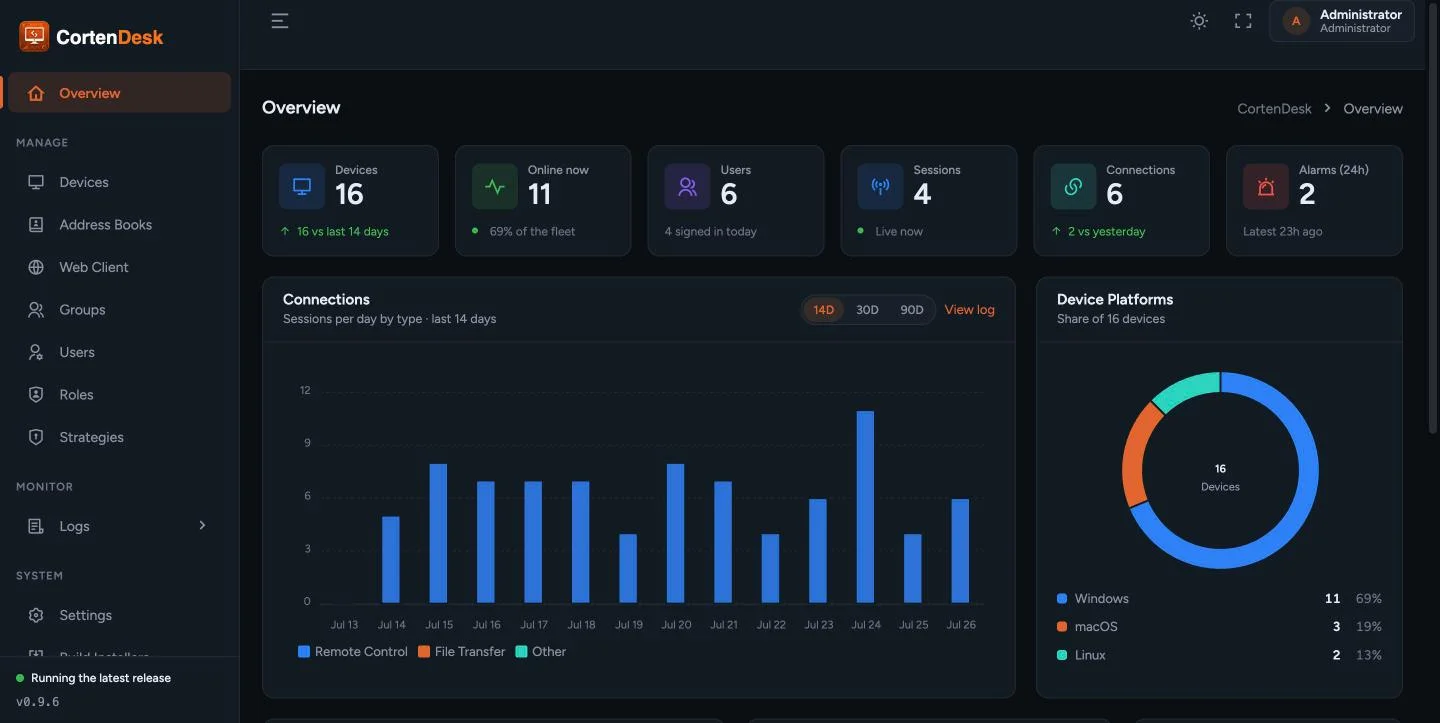
CortenDesk is the free enterprise control plane the open-source RustDesk server was missing. One self-hosted container can run the ID server, relay and full web console: fleet management, scoped access, device policy, audit history, enterprise identity and a browser-based remote desktop client. There is no paid tier, no patched desktop client and no hosted control plane.
Three days to a working platform
RustDesk had a capable open-source remote-access engine, and other front ends already existed. I saw room for the polish, features and security I expect from enterprise software: a cohesive interface, scoped access, device policy, enterprise identity and an audit trail. I used a three-day weekend to build the first working version of CortenDesk around those needs.
The initial build was fast because the problem was clear. The work since then has been about turning that clear idea into a durable product: tightening permissions, expanding deployment options, handling real fleet behavior and making the interface work everywhere from a wide operations screen to a phone.
Momentum became part of the product
In its first six weeks, CortenDesk reached nearly 100 GitHub stars and received more than 30 pull requests. Multiple outside contributors are now improving the product alongside its users. I run that loop the same way I run the code: listen, make the tradeoff visible, protect the architecture and ship the improvement.
That early momentum is useful proof. CortenDesk did not begin as a technology demonstration. It solved a missing-product problem that other RustDesk users already felt.
The whole deployment in one container
- Fleet ownership. Live presence, aliases, folders, pre-registration, approval gates and scoped device access.
- Policy and governance. Device strategies enforced on heartbeat, delegated administration, exportable audit history and retention controls.
- Enterprise identity. TOTP two-factor authentication and OpenID Connect for providers including Keycloak, Authentik, Entra ID, Okta and Google Workspace.
- Automation. Scoped REST tokens and unattended device assignment for repeatable rollouts.
- Bundled ID and relay servers. CortenDesk ships with its own forked hbbs/hbbr with bug fixes and improvements, making deployment quick and simple.
The browser is a RustDesk client
The standout technical piece is a from-scratch TypeScript implementation of the RustDesk protocol in the browser. It handles rendezvous, relay, encryption and login over WebSocket relays, then uses hardware-accelerated WebCodecs for video. Operators can view and control devices, switch monitors, share a clipboard and transfer files without installing another desktop client.
Deliberately boring to operate
CortenDesk uses Laravel and Livewire with precompiled assets, a self-contained Docker image and a one-command importer for users, devices, address books and history from an existing RustDesk API server. Every screen supports light and dark themes and is designed down to 390 pixels. It is licensed AGPL-3.0 and developed in public at GitHub.