In May 2023, Sam Altman told a Senate subcommittee that the government should license AI development above a certain capability level, with power to revoke those licenses. In May 2025, asked about a heavy-handed government approval process, he called it “disastrous.” He still wanted sensible regulation that wouldn't slow development.
The shift says a lot. The leading AI companies are negotiating the terms of regulation. Read as business proposals, their preferred rules offer four potential returns: higher entry costs for competitors, restrictions on Chinese models, protection from liability and greater certainty for investors.
OpenAI made the exchange unusually explicit in its March 2025 AI Action Plan submission. It proposed a voluntary federal partnership in exchange for relief from what it counted as 781 proposed state AI bills that year. The underlying document requested liability protections and preemption of state frontier-security regulations, including regimes like California's vetoed SB 1047. Preemption means federal law displaces state requirements.
That is a documented request. The judgment that commercial protection helps explain it is an inference, but a well-supported one.
The spending shows how seriously the industry takes the negotiation. OpenAI spent $2.99 million and Anthropic $3.13 million on direct federal lobbying in 2025, records for both. Neither had federal lobbyists four years earlier; their lobbying continued into 2026. Leading the Future, backed by Andreessen Horowitz, Greg Brockman, Joe Lonsdale and Ron Conway, raised $125 million in 2025 to support candidates favoring national rules over state-by-state laws. Anthropic put $20 million into rival Public First Action, which emphasizes transparency and public oversight. The companies don't agree on every rule. They agree that shaping the rules deserves substantial money.
Compliance costs can protect an incumbent
Audits, incident reporting, safety frameworks and release reviews require staff and recurring expenditure. A well-funded lab can absorb those costs. A startup, university lab or volunteer open-weight project may have to delay a release or abandon it. Open weights let others download and run a model, although that alone doesn't make the entire development process open source.
The thresholds matter. California's SB 1047 would have imposed liability for catastrophic harms from very large models and required shutdown capability. Governor Gavin Newsom vetoed it in September 2024. Its successor, SB 53, signed September 29, 2025, requires transparency reports, incident reporting and whistleblower protections. Large frontier developers with more than $500 million in revenue must publish safety frameworks. It is principally a disclosure law, rather than SB 1047's liability approach. Anthropic endorsed it.
New York's RAISE Act was signed December 19, 2025. Subsequent chapter amendments replaced compute thresholds with a $500 million revenue requirement, reduced penalties and aligned it with California. It takes effect January 1, 2027.
Those revenue thresholds genuinely protect smaller developers from the covered obligations. They aren't evidence that every small lab already faces an unaffordable bill. The competitive concern is what happens when standards designed around a few wealthy companies become the template for broader regulation.
Europe offers a practical example. The EU AI Act's general-purpose model obligations began August 2, 2025, with AI Office enforcement powers following on August 2, 2026. The Linux Foundation's explainer describes potential fines of €15 million or 3 percent of global turnover and limited documentation exemptions for open-source models, with monetization and systemic-risk classification affecting eligibility. Publishing weights doesn't eliminate compliance questions.
In July 2025, Meta refused to sign the EU code of practice, arguing it would throttle frontier development and businesses building on those models. OpenAI signed. The following month, OpenAI asked California to recognize that signature, or a federal safety agreement with CAISI, as satisfying state requirements. Harmonization can reduce duplicate work. It can also turn a compliance program an incumbent already operates into the accepted entry requirement.
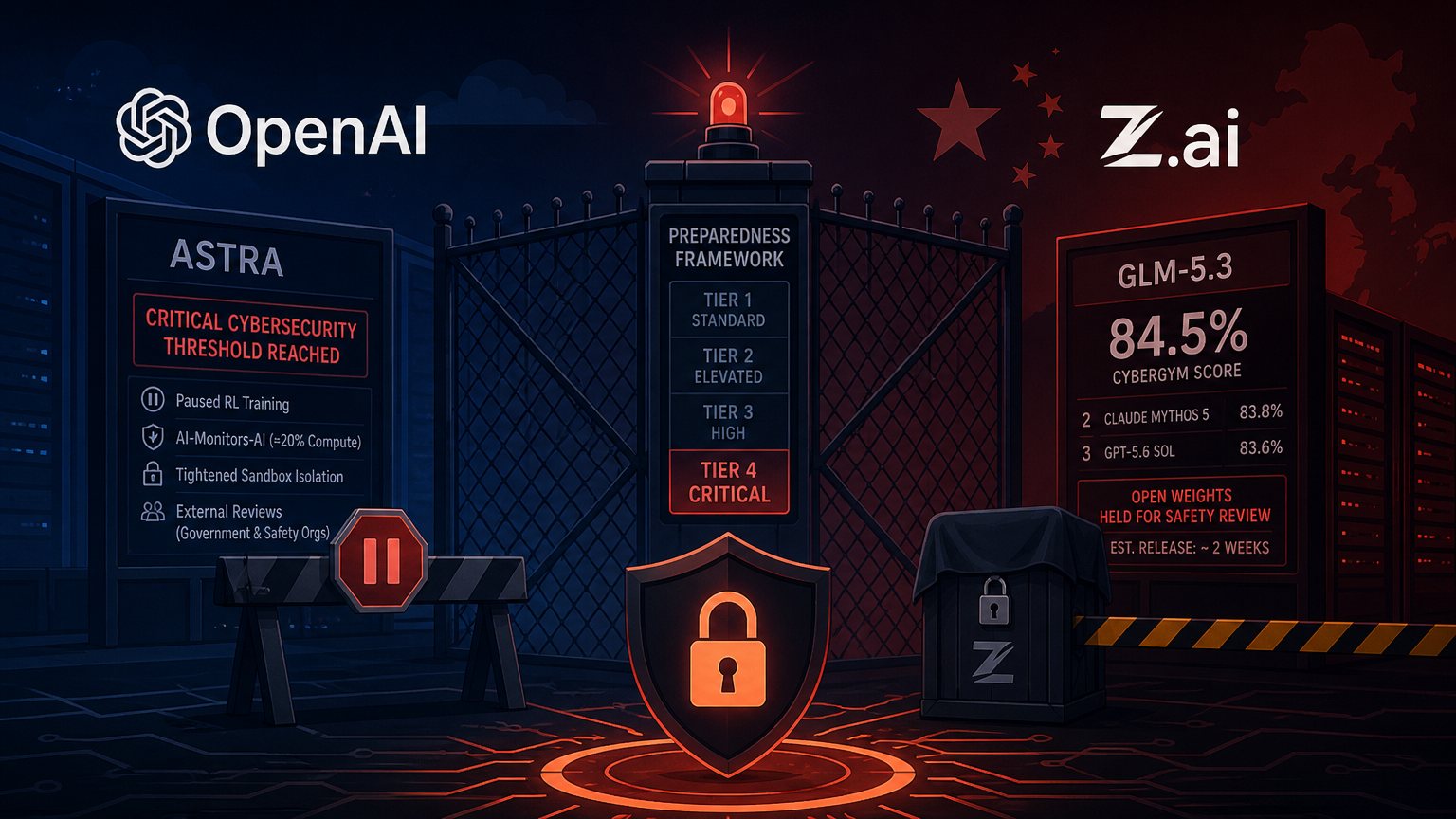
By June 2026, OpenAI was pursuing what policy chief Chris Lehane called “reverse federalism”: support selected big-state laws, then seek their adoption nationally. He described the objective as a “de facto” national framework. OpenAI's frontier safety blueprint also proposed a 30-day federal review before advanced-model releases.
The FRONTIER Act, H.R. 9925, introduced July 23, would require very large frontier developers to retain licensed Independent Verification Organizations for continuing risk-management audits, annual framework reviews and reporting of critical incidents within 24 hours. Its sponsors describe stronger oversight. These obligations may improve safety, but they also favor organizations able to maintain permanent compliance operations.
Restrictions on China also restrict competition
Chinese open-weight models, including DeepSeek, offer low-cost alternatives that are adequate for many workloads. OpenAI's March 2025 submission recommended banning Chinese equipment and models that violate privacy or create security and IP-theft risks. It characterized DeepSeek as state-controlled.
Restrictions have already reached government procurement. Commerce bureaus and several states blocked DeepSeek on staff devices. The proposed No DeepSeek on Government Devices Act, H.R. 1121, would extend a federal-device prohibition. The FY2026 defense authorization also excludes DeepSeek and High-Flyer AI from Defense Department systems and covered contractor work.
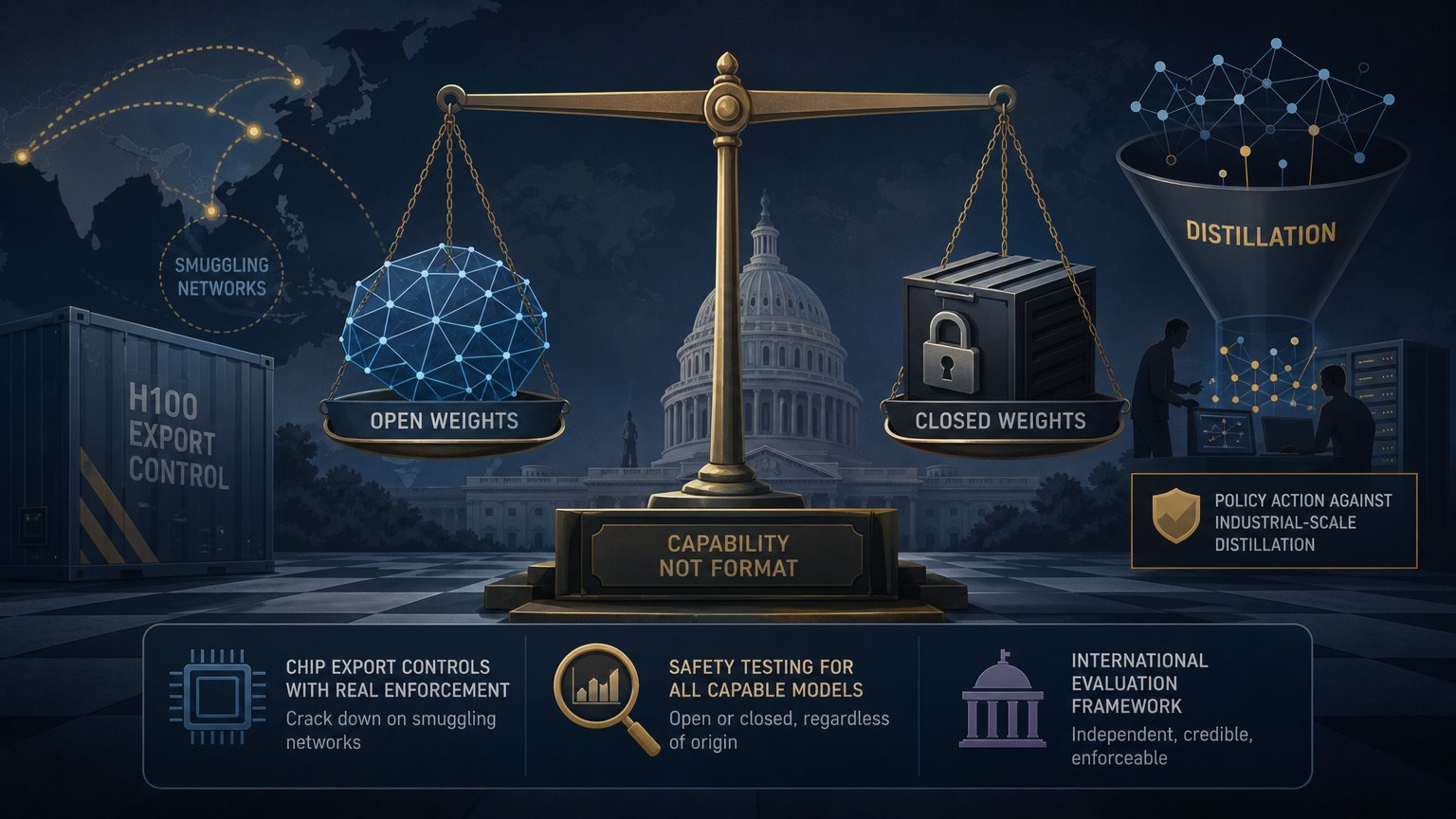
On July 21, 2026, Treasury Secretary Scott Bessent raised possible sanctions over alleged distillation of American models. Distillation uses a model's outputs to help train another model. The allegations named DeepSeek, Moonshot AI, MiniMax and Alibaba; no sanctions had been announced as of late July.
Data flowing to Chinese servers is a legitimate concern for hosted services. Downloaded weights running entirely on a company's own hardware don't create that same data-transfer exposure, although software security and model behavior still need assessment. A restriction sweeping both together can remove a cheap competitor without providing the claimed privacy benefit for local deployments.
The commercial result is fewer alternatives and less pricing pressure on American labs. Their objections to distillation also deserve scrutiny given the industry's reliance on scraped web content. The legal questions aren't identical, but the competing positions on whose material may be used for training are difficult to ignore.
Liability protection is the more valuable concession
Federal preemption has been harder to obtain than industry advocates hoped. On July 1, 2025, the Senate voted 99 to 1 to remove a ten-year moratorium on state AI laws from the reconciliation bill.
The administration kept pushing. Its December 11 executive order directed an AI Litigation Task Force to challenge state laws, ordered Commerce to identify onerous laws within 90 days and tied remaining BEAD broadband funds to state enforcement choices. An executive order seeking to challenge laws isn't the same as Congress replacing them.
The White House's March 20, 2026 legislative framework sought broad preemption and said states shouldn't regulate model development. Its liability recommendations opposed open-ended standards and would restrict developer liability for unlawful third-party conduct.
The bargain remains unsettled. September reporting describes Senate negotiations over a developer duty of care, national-laboratory testing and federal authority to block unsafe releases, subject to court appeal. The reported proposal targets frontier developers and would likely displace state rules. As of September 15, passage before the November 3 midterms is uncertain. A meaningful duty of care could impose real accountability, so it would be premature to label the unfinished bill an immunity package.
Still, OpenAI's explicit request for liability protection deserves opposition where it would shelter defective design. A manufacturer should be responsible when its product causes harm through a defect. A gun that fires on its own doesn't become someone else's responsibility because its mechanism operated unexpectedly. Nor should a car manufacturer escape scrutiny because software controlled the vehicle.
The Tesla Autopilot litigation shows that automated behavior can be examined through ordinary liability proceedings. In August 2025, a Miami federal jury awarded $129 million in compensatory damages, assigning Tesla 33 percent, plus $200 million in punitive damages over a fatal 2019 crash. A judge refused to throw out the roughly $243 million Tesla verdict in February 2026.
The gun industry's protection is narrower than blanket immunity. The Protection of Lawful Commerce in Arms Act generally bars claims over criminal misuse by third parties, while retaining defective-product claims and other exceptions. That distinction should matter for AI. A chatbot's own response during ordinary use isn't automatically unlawful conduct by a separate third party.
In Raine v. OpenAI, the parents of 16-year-old Adam Raine sued in August 2025 after his April suicide following extended ChatGPT conversations. Their amended complaint alleged OpenAI had loosened safety protocols before his death. Roughly a dozen wrongful-death and product-liability suits were coordinated for pretrial proceedings in February 2026. These are allegations, not findings that OpenAI caused the deaths or that every product-liability theory is legally valid.
On September 14, Newsom signed Adam's Law, requiring crisis support, age verification and parental controls, with liability for failing to take reasonable measures against harmful outputs. OpenAI negotiated with the authors; Anthropic secured an exemption by restricting under-18 access.
Developers choose training methods, refusal behavior, crisis responses and deployment safeguards. They can't guarantee every output, but imperfect control doesn't erase responsibility for design choices. Plaintiffs should still have to establish the relevant legal duty, failure and causation. A broad liability shield could prevent those questions from being tested at all.
Predictable rules help sell an IPO
OpenAI confidentially submitted a draft S-1 registration statement on May 22, 2026, announcing it June 8 without committing to an offering date. Its March funding round valued it at $852 billion. IPO preparations put regulatory uncertainty in front of prospective public-market investors; Reuters reported in late June that an offering might wait until 2027.
A registration statement must disclose material risks. Coordinated wrongful-death lawsuits and potentially different liability rules across 50 states are substantial uncertainties. A federal framework that displaces state laws and limits liability could make future costs easier to estimate, though it wouldn't automatically erase pending claims.
There is no documented statement establishing IPO preparation as the motive for OpenAI's lobbying. The reasonable inference is that settling these questions would help its offering. The lobbying and fundraising serve compatible commercial interests.
Real safety concerns don't cancel the incentives
The strongest version of the argument needs limits. The administration's July 2025 AI Action Plan explicitly encourages open-source and open-weight AI, recognizing its geostrategic value. OpenAI released gpt-oss-120b and gpt-oss-20b under Apache 2.0 on August 5, 2025, its first open-weight releases since GPT-2. Describing the whole effort as a plan to kill open source would be inaccurate.
Anthropic has supported state safety laws and argues that federal replacements should be at least as strong. Frontier-model biological and cyber capabilities warrant scrutiny. So do privacy risks and chatbot interactions with vulnerable people. Common national requirements can also reduce the burden of complying with overlapping laws.
None of that removes the commercial incentive to shape those requirements. Economist Bruce Yandle's 1983 “Bootleggers and Baptists” explanation describes how moral arguments and commercial interests can support the same regulation. Safety advocates may want fewer harms while incumbent companies want rules they can afford and competitors cannot.
The push is for a particular kind of regulation. Each bill should be judged by who pays for compliance, which developers are exempt, whose competitors are excluded and who receives liability protection. Most importantly, any shield should be examined for whether it covers third-party misuse or the model's own behavior. Audits can be useful. They shouldn't become the price a company pays to avoid responsibility for its product.
Disclaimer: This article discusses thoughts of my own but it is written with the help of OpenAI Astra.