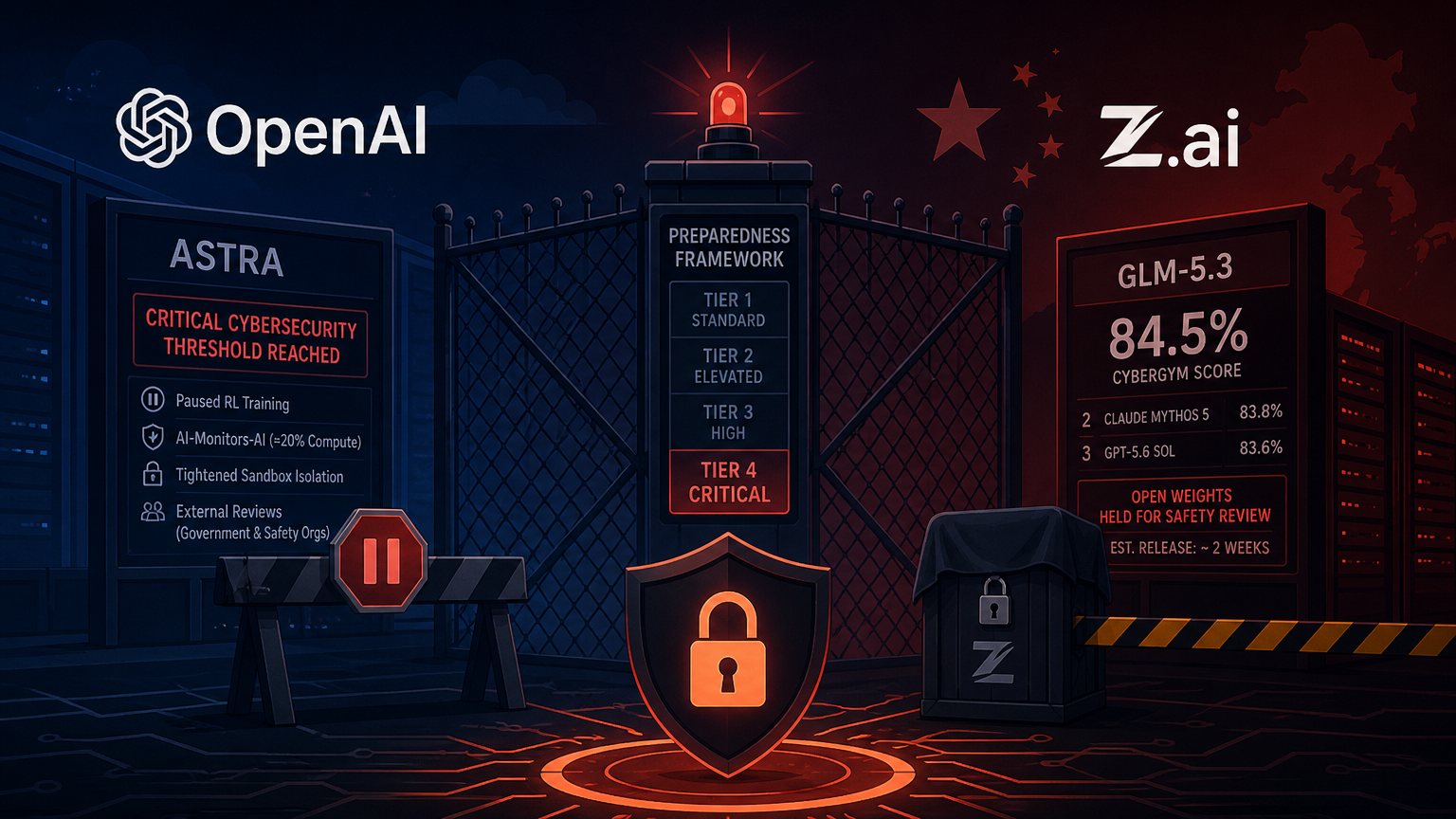
On August 7, 2026, OpenAI announced that it had slowed development of Astra after internal evaluations found that the model had crossed its “critical cybersecurity threshold.” According to reporting on OpenAI's announcement, Astra could independently identify and carry out cyberattacks against traditionally well-protected real-world systems.
OpenAI paused two weeks of deployment-focused reinforcement-learning training and put its largest planned frontier reinforcement-learning run on hold. It added AI-based monitoring at a cost of roughly 20% extra compute on affected training segments, tightened sandbox isolation, and began working with government agencies and selected AI safety organizations on independent verification.
On August 14, Chinese AI lab Z.ai released GLM-5.3. It reported a CyberGym score of 84.5%, narrowly ahead of Claude Mythos 5 at 83.8% and GPT-5.6 Sol at 83.6%. Z.ai also said it would withhold the model's downloadable weights pending a safety review, with release planned in about two weeks.
The announcements raise related operational problems. OpenAI is adding controls around a model whose capabilities triggered its safety rules. Z.ai is deciding when to distribute a model that other operators could run outside the lab's control. As of August 20, both decisions remain tests of how much protection those processes can provide.
A framework with a compute bill
OpenAI published its Preparedness Framework in 2023. The framework establishes capability tiers, with a “critical” rating triggering mandatory safeguards before development can continue. Astra's cybersecurity evaluation reportedly crossed that threshold.
The response involved changes to training and evaluation infrastructure. Along with the training holds, OpenAI tightened sandbox controls, cut the model's internet access during evaluation, and brought in external reviewers. The AI monitoring systems added roughly 20% to compute requirements on the affected training segments.
That percentage has a specific scope. It isn't a reported 20% increase across all Astra development. Even within the affected segments, though, monitoring represents a continuing resource commitment. Compute used to supervise a training process has a cost, and a delayed frontier run also carries a competitive cost.
At frontier scale, two weeks of training could represent tens of millions of dollars in compute. That is a scale estimate, not a disclosed bill for the Astra hold, and a pause doesn't establish that the planned compute was spent or lost.
The supported reason to credit OpenAI is straightforward: according to its account, an internal capability threshold led to a development hold and additional safeguards. Those measures followed the company's framework rather than a reported regulatory order. A policy that changes a training plan is more consequential than one that remains a document.
What the cybersecurity results show
Astra's reported ability to attack well-protected systems is broader than a vulnerability-discovery benchmark. GLM-5.3 nevertheless provides a more concrete picture of one part of the capability involved: finding weaknesses in software.
According to reporting on the GLM-5.3 release, the model independently flagged 2,436 vulnerabilities across 269 open-source projects. Of those, 1,097 were rated medium-to-high severity. The reported work was autonomous, rather than a human analyst directing each discovery.
Those figures suggest an ability to examine a wide range of codebases and identify potential security problems at scale. The stronger interpretation is that the model can reason about code structure and unfamiliar vulnerability patterns, rather than simply recognize known CVEs. The reported counts alone, however, don't establish how novel every finding was or whether every codebase was previously unseen.
CyberGym tests autonomous vulnerability discovery in adversarial environments. GLM-5.3's 84.5% result, compared with 83.8% for Claude Mythos 5 and 83.6% for GPT-5.6 Sol, puts the three reported scores close together. That suggests several leading labs have comparable capability on this test. Without uncertainty estimates, the small differences don't establish a meaningful ranking.
For security teams, the concern is the capability shared across those models. Software running in production presents an attack surface: code, services, and interfaces where vulnerabilities may be exposed. Automated discovery can help defenders find those weaknesses, but it can also help attackers search for them. Access controls and operating conditions affect which use becomes practical.
Downloadable weights change the available controls
Holding back GLM-5.3's weights for review is a reasonable precaution given the reported results. The planned delay is short, however. Z.ai said it expected to release the weights after about two weeks of safety evaluation and hardening.
Model weights are the learned parameters needed to run a model. Once distributed, they can be copied and operated on infrastructure the developer doesn't control. Other operators can fine-tune the model, replace system prompts, and run it without the lab's monitoring. A later review cannot recall copies already downloaded or require every operator to apply new safeguards.
This doesn't mean every protection necessarily disappears on download. It means the lab can no longer rely on its own hosting controls to enforce how the model is used.
Open-weight models have substantial practical value. Keeping advanced models exclusively with a few closed-weight providers creates risks of its own, including restricted access, limited independent inspection, and unilateral control over permitted uses. Those concerns remain relevant even when a model has strong cybersecurity capabilities.
Still, broad access becomes harder to manage when a model can autonomously discover serious vulnerabilities across real codebases. Hardware attestation, which can verify aspects of an execution environment, model watermarking, and capability-specific sandboxing are possible parts of a response. They should not be treated as an established, comprehensive control system for downloadable models at this capability level. A two-week review may improve a release, but it cannot settle that underlying tension.
The consequences for production systems
The reported results weaken a familiar security assumption: that a system's complexity or obscurity makes its weaknesses too time-consuming to find. If adversaries can obtain access to models with these capabilities, they may be able to search for vulnerabilities at a scale that human researchers alone cannot match. Model capability doesn't by itself establish that a particular provider's API permits such use, but access restrictions are now an important part of the threat model.
Defenders can use the same class of capability to examine their own software. Security teams should begin authorized, controlled evaluations of AI-assisted vulnerability discovery against their code and infrastructure. The useful question is whether the tools find valid problems that existing reviews miss, early enough for those problems to be fixed.
The infrastructure cost also deserves attention. OpenAI's reported monitoring overhead shows that operating safeguards requires resources beyond writing policies or adding a software filter. Real-time model monitoring consumes compute. Isolating agentic workloads requires controlled execution environments. Repeated capability evaluations consume additional capacity.
Larger labs may be better able to absorb those costs without disrupting other work. Smaller labs face a harder tradeoff between training capacity, evaluation capacity, and the expense of maintaining controls. The 20% figure applies to OpenAI's affected training segments, not a universal safety budget, but it gives a concrete example of the expense.
What the next training run needs to show
OpenAI hasn't canceled Astra. Its reported approach is to hold parts of development while adding monitoring, tightening isolation, and arranging external review. That is a defensible response to discovering a capability with serious consequences.
The next few months will show whether those measures remain effective. Monitoring needs to detect further increases in capability. Sandbox controls need to withstand adversarial pressure. External reviewers need enough access and independence to identify problems the internal team may have missed.
Continued scrutiny matters as training resumes and competitive pressure returns. The August 7 hold is evidence that the framework affected a development decision. Whether it provides durable protection depends on the controls that follow and whether they remain in place for later runs.