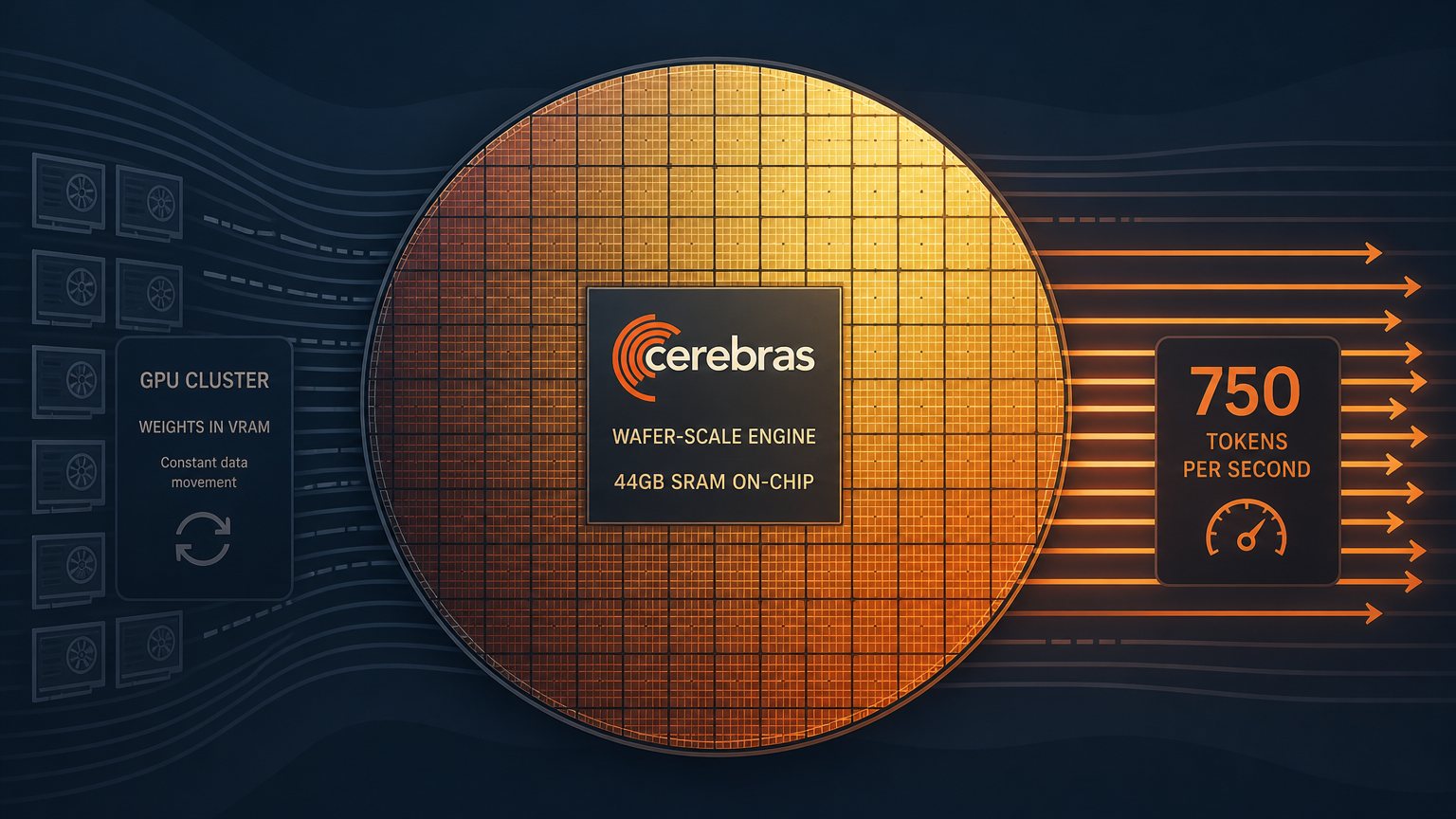
The story dropped yesterday and has been sitting at the top of Hacker News for good reason: Cerebras and OpenAI launched a new service tier called Ultrafast that runs GPT-5.6 Sol at up to 750 output tokens per second. That's 14 times faster than OpenAI's Standard tier, 11 times faster than Claude Fable 5, and fast enough that the fundamental question for people building AI systems shifts from "how do we cope with inference latency" to "what can we build now that the latency constraint is largely gone."
I've been running inference workloads since the early days of GPU-backed APIs — watching models go from novelty to production dependency — and this number lands differently than most benchmark claims. Let me explain why the mechanism matters as much as the headline figure, and what it actually changes for people building real systems.
The Real Bottleneck Was Never Compute
For most of the last four years, "inference is slow" was treated as a model problem: make the model smaller, quantize aggressively, throw more GPUs at it. That was solving the wrong problem.
Inference on a large language model at production scale is fundamentally a data movement problem. Each token generation requires fetching the model's weight parameters from memory, running a forward pass, and writing the result. On a GPU cluster, those weights live in VRAM — fast, but capped at 24 to 80 GB per card — or get paged across NVLink and HBM memory hierarchies under load. At hundreds of billions of parameters, you are moving enormous volumes of data for every batch you process. The matrix multiply itself — the actual computation — is comparatively fast. The wait is the data transfer.
Cerebras frames their approach plainly: fast frontier inference is a data movement problem. Their solution is architectural. The Wafer-Scale Engine puts 44 gigabytes of SRAM on a single die the size of a dinner plate. Model weights sit resident on that chip during inference. There's no round-trip to external DRAM, no transfer stall while pages move across memory buses. Tokens flow pipelined through the model's layers without waiting for parameter blocks to arrive from elsewhere.
When I first absorbed this, my reaction was: of course. This is the same principle behind L1 cache in CPU design. Everyone who has written cache-aware systems code — who has felt the 50x penalty of an L3 miss versus an L1 hit — understands why on-chip memory changes everything. Cerebras built a chip where the "cache" is large enough to hold the entire model. The innovation is in the manufacturing and defect tolerance engineering, not the underlying concept.
What's remarkable is that it took the industry this long to take the approach seriously in production. Cerebras has been building toward this since their 2016 founding. The Wafer-Scale Engine was announced in 2019. The reason it didn't immediately reshape the inference market is that the wafer-scale manufacturing approach is genuinely hard: a defect that would be tolerable on a smaller die can kill the entire chip when the whole silicon wafer is a single functional unit. The yield engineering needed to make this economically viable took years. That work is now done.
What 750 Tokens Per Second Actually Means
To calibrate: a fast typist produces roughly 13 tokens per minute. A comfortable human reading pace is around 333 tokens per minute. GPT-5.6 Sol Ultrafast at 750 tokens per second outputs at more than 135 times human reading speed. Streaming the response to a terminal or chat interface at this rate means the completion arrives before a user can track it. The UX rationale for streaming — "watch it think," make the wait feel shorter — dissolves. You're effectively in batch mode regardless of transport protocol.
For agent workloads the shift is architectural. An agentic loop that previously took 30 seconds — model call, tool invocation, second model call, synthesize — might now complete in 2 to 3 seconds. The bottleneck migrates from model latency to the wall-clock time of external tools: the database query, the API call, the filesystem read. That changes how you design pipelines. The expensive part is no longer waiting for the model — it's waiting for everything else you're coordinating around the model.
The launch announcement names the early-access customers: Jane Street for financial research, Podium for commerce workflows, Rogo for investment analysis, Basis for incident response. These aren't chat applications. These are workloads where latency is a direct operational cost — analyst time waiting for synthesis, market windows where delayed response means missed trades, incident response timelines where minutes matter. The customer list tells you who has a real problem Cerebras is now solving.
The benchmark I find most persuasive is the Humanity's Last Exam run: 2,500 PhD-level questions completed in 11 hours and 11 minutes on Ultrafast, versus 78 hours and 27 minutes on Claude Fable 5 — nearly a 7x speedup on a real knowledge-work benchmark, not a synthetic throughput test. The GDP-Val benchmark, which measures economically valuable knowledge tasks, showed a 5.6x end-to-end speedup with no measured quality degradation. These numbers hold up better than throughput-only comparisons because they measure the full pipeline, including thinking and tool use latency, not just raw generation rate.
The $10 Billion Infrastructure Bet Behind This
Earlier in 2026, OpenAI committed $10 billion in compute capacity to Cerebras. At the time, most analysts framed this as a hedge against Nvidia's pricing power and GPU supply constraints. I read it differently then, and the Ultrafast launch confirms the reading: OpenAI was buying inference capacity at a fundamentally different price-performance curve — one they already understood before making the bet public.
GPU-based inference at 750 tokens per second for a frontier model is achievable, but it requires substantial cluster scale and only makes economic sense at very high utilization. You're paying for the hardware whether it's serving requests or not. Cerebras's wafer-scale approach has different economics: high upfront manufacturing cost, but dramatically better tokens-per-watt and tokens-per-dollar on sustained inference workloads compared to GPU deployments optimized for training flexibility.
The "limited preview" launch reflects genuine capacity constraints, not artificial scarcity. Wafer-scale manufacturing scales differently than ordering more GPU nodes. You can't spin up Cerebras capacity on a two-week lead time the way you can reserve more GPU instances. The waitlist is real, and access will expand as production capacity grows — but that growth is constrained by the same yield engineering that makes the performance possible in the first place.
The Caveats Worth Holding
The benchmark numbers are Cerebras's own measurements, run in July 2026, not independently replicated results. The 11x advantage over Fable 5 and 5x over Opus 4.8 are claims from a company with real technical credibility — but the comparison is against models running on different hardware under different load conditions. Before making architecture decisions based on these numbers, I'd want to see independent measurement under production-representative load, particularly at high concurrency where the wafer-scale approach's single-die nature may create different saturation characteristics than a distributed GPU cluster.
Model coverage is also currently narrow. This is GPT-5.6 Sol on OpenAI's API — one model, one provider. If you're running Llama, Mistral, or any open-weight model, Ultrafast doesn't help you today. The strategic question I'm watching is whether Cerebras builds a general-purpose inference API that runs arbitrary model weights at wafer-scale speeds, or whether the economics require deep single-provider partnerships like the OpenAI deal to justify the capital commitment. The answer determines whether this changes the broader inference landscape or remains a premium tier for OpenAI's largest customers.
What to Do With This Information
If you're building production AI systems today, the immediate action isn't switching to Ultrafast — the waitlist is real and capacity is limited. The question worth asking now is how your current pipeline would need to change when sub-second inference latency becomes broadly available.
The patterns that benefit most: any agent loop with multiple sequential model calls that you've been pipelining asynchronously to mask latency; any pipeline where you added streaming UI to cover a 10-second wait; any workload you've been batching overnight because real-time wasn't viable at previous token rates. These become candidates for rearchitecting when the speed is generally available. Start thinking about those designs now, before you're racing to retrofit them under pressure.
The deeper lesson from the Cerebras announcement is one that recurs throughout infrastructure history: the most important performance improvements aren't always the ones that show up first or loudest. Cerebras identified memory bandwidth as the core inference bottleneck in 2016 and spent a decade building a manufacturing process capable of exploiting that insight at scale. In August 2026, that bet delivers a 14x performance advantage over conventional GPU inference on the world's leading frontier model. That's not luck — it's what happens when you correctly identify which problem actually needs solving and refuse to stop until you've solved it.
The inference speed race is now bifurcating between flexible GPU clusters and purpose-built silicon. Both will exist. The winners will be the teams that understand clearly which workloads belong on which substrate — and are ready to move fast when the substrate changes beneath them.