Apple introduced Xcode 27 at WWDC 2026 on June 9 at Apple Park, bringing AI agents into testing, debugging, localization, and device workflows. The agents can take actions inside the development environment, inspect the results, and try again. That gives them a broader role than suggesting code for a developer to accept.
GitHub Copilot already has agent modes, and Cursor has built much of its product around similar workflows. Apple's approach puts those capabilities into the standard toolchain for its platforms, alongside OS integration and hardware optimization. The announcements also bring hardware requirements and a Siri integration migration that teams will need to plan for.
What the Xcode agents can do
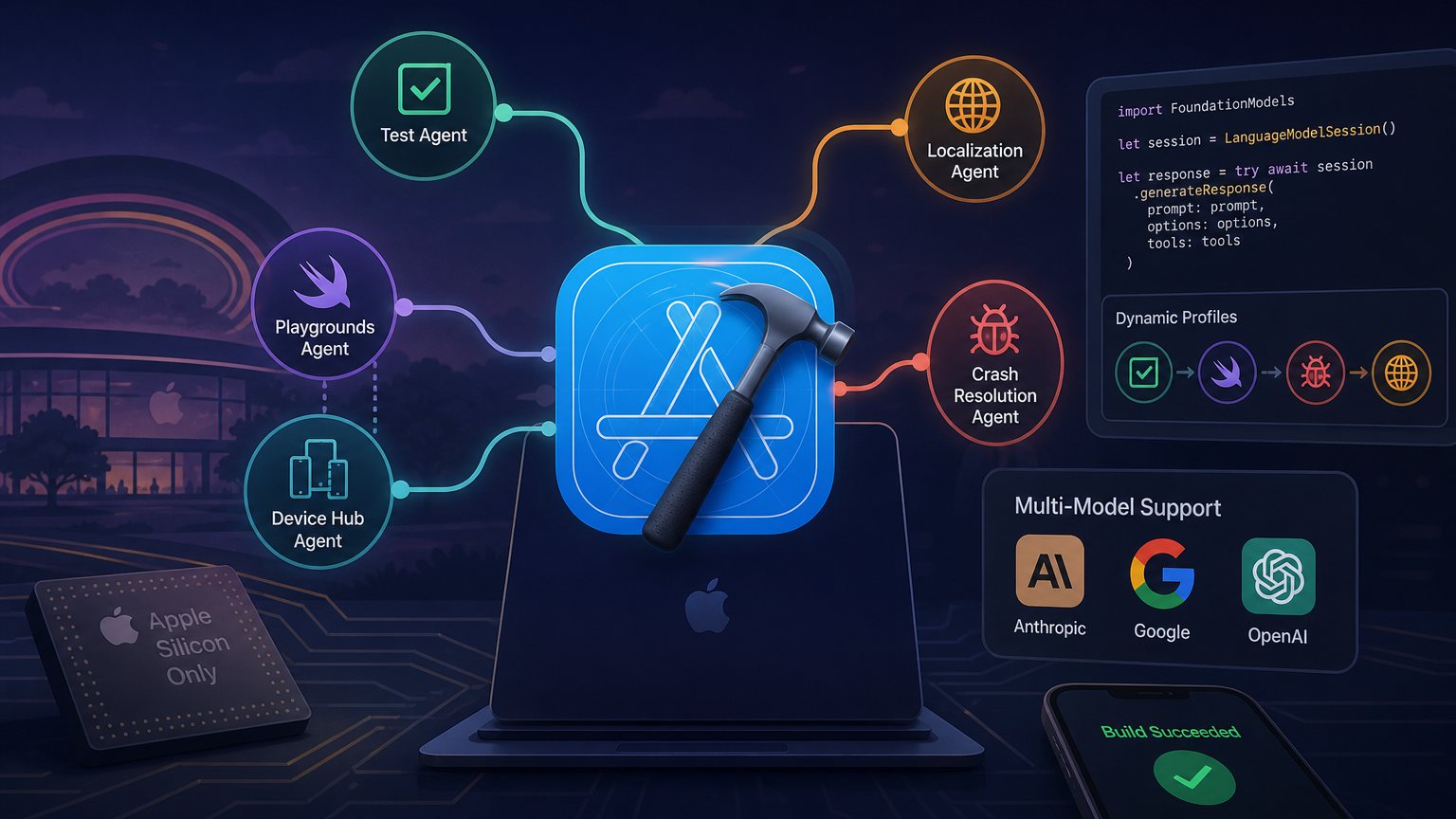
Xcode 27's agents cover several jobs that normally require repeated trips between source code, build tools, and diagnostic reports:
- Write and execute test suites autonomously against a codebase.
- Use Swift Playgrounds in isolation to explore and validate ideas before changing the main codebase.
- Run and inspect builds on physical devices and simulators through Device Hub, a unified interface that replaces the old Simulator manager.
- Pull string tables and generate translations for app localization inside the IDE.
- Read crash reports from Organizer, correlate logs with source locations, and propose fixes.
The feedback loop is the important distinction. A crash-resolution agent can read a crash log, identify the call stack, propose a patch, build the target, and check whether the crash still reproduces in the simulator. Its work includes testing the proposed change rather than stopping at a plausible-looking answer.
Apple has also avoided choosing one model provider. Xcode 27 supports models from Anthropic, Google, and OpenAI through the same agent interface. That gives teams alternatives when a provider's pricing, availability, or capabilities change, without requiring a different development environment.
Xcode 27 requires Apple silicon, ending Intel Mac support. The download is 30% smaller, build times are faster, and Xcode Cloud offers up to twice the compilation speed of the previous generation. The hardware cutoff is a concrete constraint for teams that still have Intel machines in their development fleets.
Foundation Models extends the AI options available to apps
The Foundation Models framework announcement reaches beyond tools that help write code. It gives developers more ways to add AI features to the apps themselves, with a high-level Swift interface covering on-device and server-side inference.
The announced capabilities include:
- Free Private Cloud Compute access for apps with fewer than two million first-time App Store downloads. Apple covers inference costs for apps below that threshold.
- Image input support, allowing visual context to pass directly from Swift to on-device models.
- Server-side model integration through a unified Swift API. Claude, Gemini, and other third-party models can be used without custom HTTP clients or API-key management outside the framework.
- Dynamic Profiles, structured building blocks for defining and combining multi-agent workflows in Swift.
Apple also scheduled an open-source release of parts of the framework for summer 2026. That could make the framework more attractive to contributors and developers working beyond the App Store ecosystem, though the scope of the released components will matter.
The free inference tier lowers the cost of experimenting with AI features for smaller developers. It also gives Apple a way to encourage adoption before an app reaches substantial scale. The platform bet is that developers who build around Foundation Models early will keep using it as their apps grow.
Core AI handles deployment of custom models
Apple also announced Core AI, a lower-level framework for teams that have their own trained models and need to run them efficiently on Apple silicon. Foundation Models provides the higher-level API; Core AI addresses more of the underlying deployment work.
Core AI includes ahead-of-time compilation for on-device inference, specialized debugging tools in Instruments.app, and Python tooling that converts PyTorch models into Apple silicon-optimized formats.
The PyTorch conversion path is particularly useful for teams already training models in that ecosystem. Taking a trained model to a production-ready, Neural Engine-optimized build without writing Metal shaders could reduce the amount of specialized deployment work required. A command-line workflow makes on-device deployment more practical for small teams that can't dedicate an ML platform engineer to repeated conversion and optimization work.
SiriKit deprecation creates a migration requirement
The rebuilt Siri drew attention partly because of its reported model arrangement. Apple reportedly licensed a custom 1.2-trillion-parameter version of Google Gemini for roughly $1 billion per year. That would be a substantial commitment to a competitor's infrastructure for a central Apple feature.
For app developers, the more immediate issue is SiriKit's formal deprecation at WWDC 2026. App Intents is now the required integration surface for Siri going forward.
The rebuilt assistant uses entity and intent schemas to understand app content and the actions an app supports. Apps need to expose that information through App Intents to participate in the new conversational capabilities. Apps that remain on SiriKit will miss those capabilities and eventually lose Siri integration entirely.
Apple also introduced a View Annotations API that allows conversational Siri interactions to target and act on content currently displayed on screen. That could be useful for accessibility and productivity apps, but it depends on App Intents as well.
Teams still using SiriKit should put the migration on their roadmap. The formal deprecation is a reason to start planning now, even without a specific removal deadline stated here.
Where the practical gains may appear first
Crash resolution and test writing are likely to deliver the strongest immediate return for many teams. Investigating Organizer crashes and building test coverage for edge cases take time every development cycle. Agents that can work through those loops could reduce that effort even when their output still needs correction.
Multi-model support could become more useful as providers specialize. Anthropic, Google, and OpenAI may continue to differ in code generation, long-context reasoning, and structured output. Over the next 18 months, switching models within the same workflow could become a more significant productivity advantage than it is today.
The planned Foundation Models open-source release remains a separate question. Releasing core framework components would be an unusual step for Apple and could attract interest beyond developers already committed to its platforms. As of June 10, 2026, the summer release is still a commitment to assess when the repositories become available.
Taken together, the WWDC 2026 developer announcements give Apple-platform teams several concrete decisions: whether their hardware can run Xcode 27, which agent workflows deserve evaluation, how to deploy AI features, and when to move existing Siri integrations to App Intents. The testing and debugging agents offer the clearest place to start evaluating benefits; the hardware cutoff and SiriKit deprecation require planning regardless.