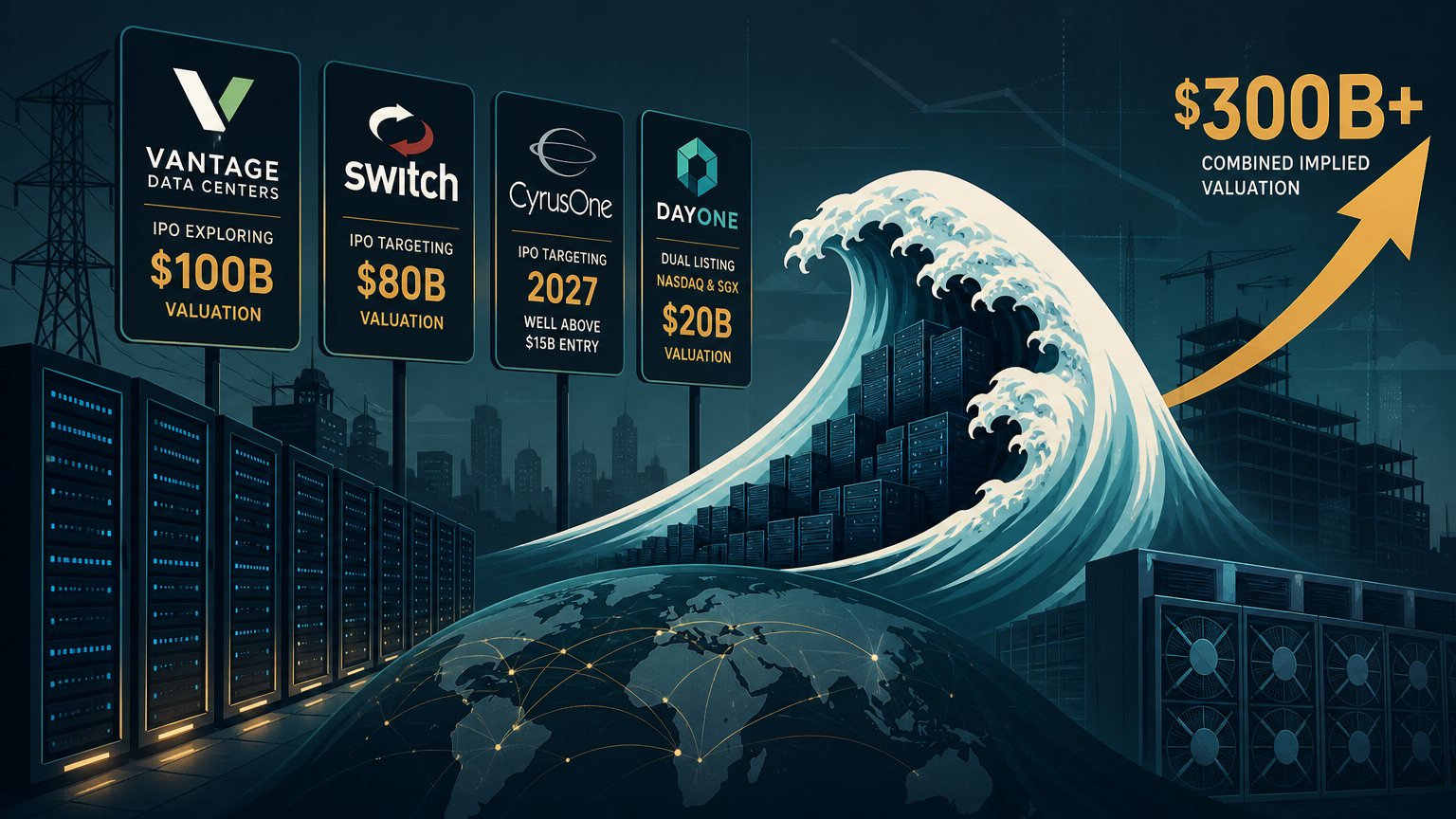
Four hyperscale data center operators signaled plans to go public in the week before August 17, 2026. Vantage Data Centers, Switch, CyrusOne and DayOne are seeking public investors as AI demand raises the value of facilities with enough power, cooling and connectivity to support large computing clusters.
The implied combined valuation is estimated at more than $300 billion. These are prospective valuations, however, rather than prices established by completed offerings. For infrastructure operators and colocation customers, the listing plans also offer a chance to learn more about a market where lease pricing and operating costs have often been difficult to compare.
Four operators prepare for public markets
Vantage is exploring an IPO at a valuation of roughly $100 billion. An offering at that valuation would be the largest in data center history. Switch has hired banks with an $80 billion valuation target.
CyrusOne is targeting a 2027 IPO. KKR and Global Infrastructure Partners bought the company for $15 billion in 2022, and analysts expect a listing to value it well above that purchase price. BlackRock later bought in. CyrusOne now operates more than 60 campuses globally.
Singapore-based DayOne operates 1.5 gigawatts across Asia Pacific and Europe. It closed a $4.5 billion Series C at a $20 billion valuation in June 2026 and is targeting a dual listing on Nasdaq and the Singapore Exchange.
The combined estimate exceeds the market capitalization of any single data center company. It also approaches a scale that was barely present across the sector as recently as 2022. Whether public investors accept those expectations is a separate question.
AI demand changes the economics
Data centers have always required substantial capital for power, cooling, physical security and connectivity. Historically, investors tended to value them more like real estate utilities than fast-growing technology companies. Long leases and dependable income were central to the investment case, and the large operators traded at relatively modest multiples of earnings before interest, taxes, depreciation and amortization, or EBITDA.
AI infrastructure spending has changed those expectations. Worldwide spending on AI-optimized Infrastructure as a Service is projected to grow 96 percent through 2026, reaching $42 billion. That forecast amounts to almost a doubling in a year.
The facilities needed for AI also differ from those built for conventional enterprise computing. Large training runs require dense GPU clusters, power demand that can exceed 100 megawatts per cluster, and very high bandwidth between machines inside the facility. A traditional enterprise data center can't simply be repurposed to meet those requirements. New capacity needs different specifications, and construction depends on permits and access to power.
Vantage has a direct connection to this spending. Through a Wisconsin campus partnership with Oracle and OpenAI, it is connected to the Stargate joint venture, SoftBank, OpenAI and Oracle's $500 billion AI infrastructure commitment.
Vantage also raised $9.2 billion in an equity round led by DigitalBridge and Silver Lake, bringing its total capital raised since late 2023 to approximately $11 billion. Those sums reflect the cost of building physical capacity for large AI deployments, before that capacity can produce years of lease income.
The appeal for private equity owners
CyrusOne shows how much the investment case has shifted. Its $15 billion acquisition in 2022 included a substantial premium, and many observers considered the deal expensive at the time. Roughly four years later, the expectation is that a return to public markets could value the company at several times that purchase price.
That would represent a substantial increase on a large initial investment. The basic assets remain power contracts, fiber connectivity and physical locations in strategic markets. Demand for access to those assets has changed sharply.
The timing of the four listing plans is consistent with owners responding to the same market conditions. When infrastructure businesses can attract growth-company valuations, public markets become an appealing source of capital and a potential exit for existing investors. Similar timing alone doesn't establish coordination between the companies.
Investors aren't accepting every valuation
Brookfield's Csquare went public only weeks before these announcements, priced below its target range and fell on its trading debut. That result suggests investors are still distinguishing between operators rather than buying every data center offering on the strength of AI demand.
Location, customer mix and power procurement all affect the value of a facility. A campus with reliable access to competitively priced electricity can have different prospects from one facing supply constraints, even if both serve growing markets.
A $100 billion valuation for Vantage would be very high relative to reasonable expectations for near-term cash flow. To support it, investors would need confidence in lasting pricing power, continued capacity expansion and demand that extends beyond the current AI investment cycle.
If the large cloud providers become more concerned about utilization and reduce facility orders, valuation multiples could fall quickly. A business can own useful, well-run assets and still be a poor investment at a price that assumes too much future growth. The question is how much of the proposed valuation rests on predictable lease income and how much depends on AI spending staying exceptionally strong.
The operating details still determine performance
Uptime, power reliability, redundant connectivity and physical security remain central to data center operations. Cooling failures and power interruptions have consequences that don't disappear because a company has attracted a higher valuation.
The operators pursuing listings have meaningful strengths. Vantage has built a reputation for large hyperscale deployments. CyrusOne has established customer relationships and geographic diversification. DayOne's Asia Pacific footprint gives it exposure to markets where AI infrastructure demand is growing faster than in the United States.
These advantages differ from those of a software business. Moving equipment and workloads between facilities is costly, and customers can't tolerate extended downtime. Those switching costs help retain tenants. Competition still depends heavily on location, available power and cost per kilowatt. New entrants can put pressure on established operators by building where electricity is cheaper and permits are available.
Several operating measures will help investors assess the businesses:
- Power usage effectiveness, or PUE: the ratio of total facility energy use to the energy used by IT equipment. It helps show how much energy goes to cooling and other supporting systems.
- Megawatts of critical IT load: the power capacity available to support computing equipment.
- Capacity utilization: how much available capacity is in use.
- Revenue per megawatt: a way to compare revenue with the capacity supporting it.
These measures provide information about facility efficiency and commercial performance that earnings per share alone can't supply. If the operators publish them consistently in quarterly filings, comparisons across companies should become more useful.
Public filings could help customers, too
Data center pricing has long been relatively opaque. Colocation customers often negotiate without a clear view of what comparable customers pay, while hyperscale lease rates are even more closely held.
S-1 registration statements could reveal more about campus revenue, lease terms, renewal rates and power costs. The usefulness of those disclosures will depend on how much detail each operator provides. A listing doesn't necessarily mean every campus-level figure or contract term will become public.
For smaller facility operators and colocation customers, better disclosure could provide pricing benchmarks and a clearer view of where the large operators are expanding or pulling back. It could also make the economics of a hyperscale lease easier to compare with those of a rack in a multi-tenant facility. Greater visibility may create competitive pressure, but it would also give customers more information for negotiations.
Cloud services have often kept the physical location of computing out of the developer's view. Serverless computing takes that abstraction further, allowing applications to run without developers managing the underlying servers. AI makes some of those physical details harder to ignore. Power availability, heat density, interconnect bandwidth and GPU supply now shape deployment decisions. Cooling efficiency and location can also affect the cost per token of running inference at scale.
The proposed listings will test how much investors will pay for operators that have secured suitable sites and reliable power. The financial filings and their footnotes should help show which valuation expectations are supported by existing leases and operating performance, and which depend on capacity and demand still to come.