The Dutch Ministry of the Interior is building a replacement for the Microsoft desktop across its government, and it picked NixOS as the base. The project is called DAWO, short for Digitaal Autonome Werkomgeving Overheid, or digitally autonomous government workplace. It hit the front page of Hacker News on September 25 with 946 points and 545 comments, most of which drifted into an argument about a Microsoft advertising patent. The project itself is more concrete than the thread.
What has shipped
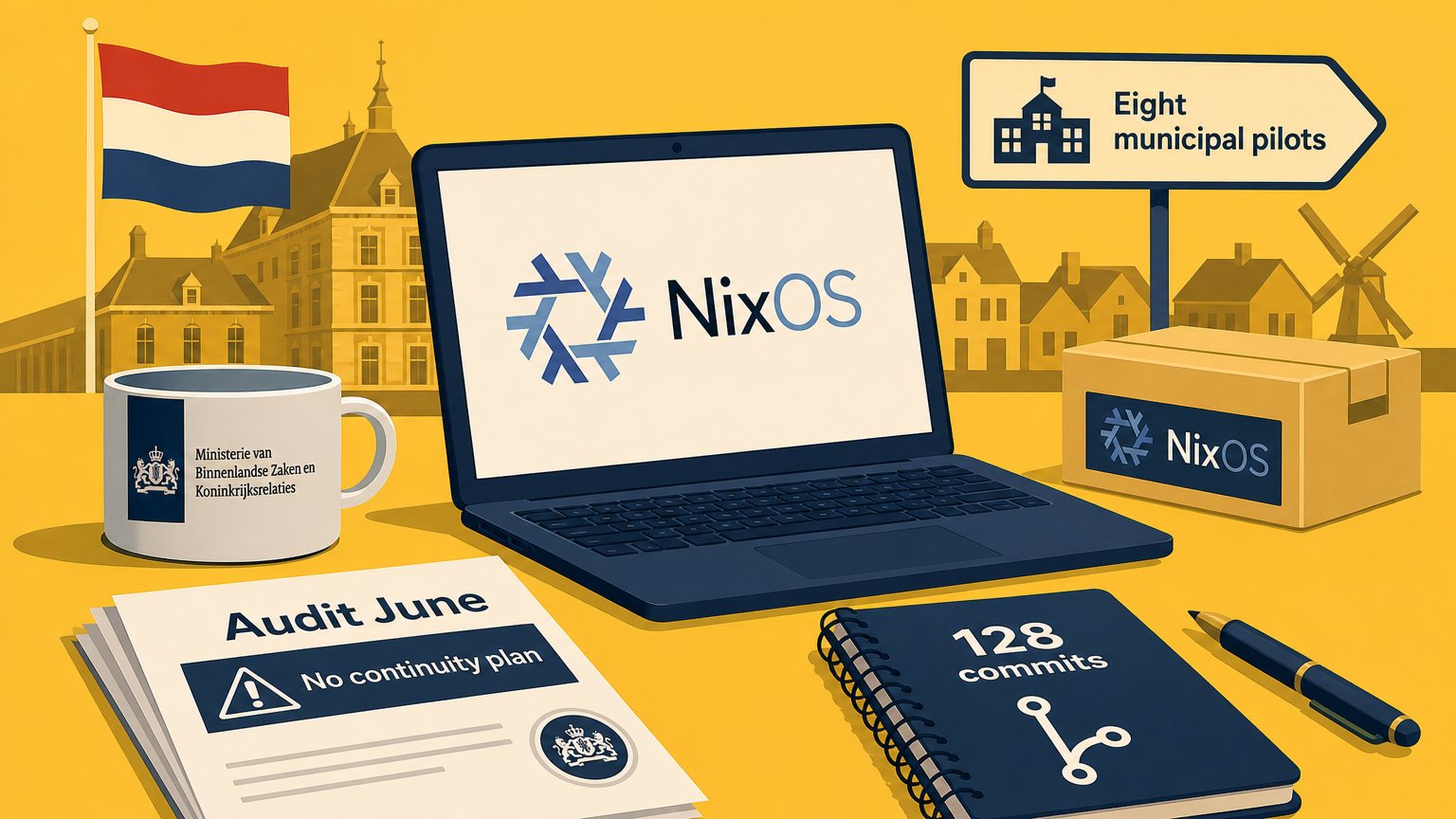
The code is public. The MinBZK/DAWO-NixOS repository holds the NixOS configurations, split into modules for boot and hardware, desktops, networking, hardening (with a rule register), services, programs, users and environment. It has 128 commits on main, 19 branches, and a last commit dated September 17, 2026. The ministry moved primary development to Codeberg and mirrors it on code.overheid.nl, the government's own Forgejo instance, and on GitHub. The whole thing is written in Nix and weighs 2.7 MiB.
That is a small repository. Small is fine at this stage. A Nix configuration for a fleet of laptops does not need to be large to be complete, and a hardening module with a numbered rule register is the kind of thing that normally lives in a PDF nobody opens. Here it lives in code that an auditor can diff.
Eight municipalities are testing it through the VNG, the association of Dutch municipalities. The first four, announced on April 3, were 's-Hertogenbosch, Zaanstad, Ede and Amsterdam. Those pilots run through the end of 2026 and pair a Linux laptop with MijnBureau, the Dutch collaboration suite. The pilot hardware is laptops the municipalities had retired because they could not run Windows 11. The April announcement gave no count of devices or users.
MijnBureau is the other half of the story. It is assembled from openDesk (built by Germany's ZenDiS for the German interior ministry), La Suite (from the French government's DINUM) and Nextcloud. It covers documents, spreadsheets, chat, video calls, files, email, calendar, a password manager and an AI assistant. DAWO is the operating system and device layer underneath. Neither one is a complete workplace without the other, and the two are run by different teams inside the same ministry.
Why NixOS
The mandate came in July 2025, when the Interdepartmental Commission for Government Business Operations told SSC-ICT, DICTU and DUO-ICT, the three shared IT providers for central government, to build a sovereign workplace. Nix is a Dutch project. Eelco Dolstra wrote the Nix package manager as PhD work at Utrecht University, and NixOS grew out of it. No company owns it. It's FOSS reports that openSUSE and Fedora were passed over because each is tied to a corporate sponsor, and a sponsor can be bought.
The technical argument is stronger than the political one. NixOS describes the whole machine in code: packages, services, users, firewall rules, kernel parameters. Two laptops built from the same expression are the same laptop. A bad update rolls back at the boot menu. The DAWO team says 80 to 90 percent of a configuration carries over from one deployment to the next, which is the number you want when you are supporting hundreds of municipalities that each have their own quirks.
I have run fleets with imaging tools and with configuration management, and the declarative model wins every time the fleet gets audited. The cost is the learning curve. Government IT staff know Group Policy and Intune. Nix expressions are a different language, with a small hiring pool and error messages that punish beginners. DAWO will live or die on whether SSC-ICT can train and retain people who can write Nix, and that is a staffing problem, which is harder than a software problem.
The prosecutor's mailbox
The trigger was February 6, 2025, when President Trump signed an executive order sanctioning Karim Khan, chief prosecutor of the International Criminal Court in The Hague. In May 2025 the Associated Press reported that Khan had lost access to his Microsoft email and moved to Proton Mail. Microsoft president Brad Smith said "at no point did Microsoft cease or suspend its services to the ICC." Both statements can be true. The court may have disabled the account itself to keep its vendor out of sanctions trouble. From the prosecutor's chair the distinction is small. The mailbox was gone, and no contract could bring it back. On October 31, 2025, the ICC confirmed to The Register it was dropping Microsoft Office for openDesk.
That episode is why Dutch members of parliament pushed ministers to reduce dependence on US cloud providers. It is also why I file this under infrastructure rather than desktops. The question a government is asking is who can turn its workplace off, and what the recovery time is if they do.
The audit nobody linked
The Netherlands Court of Audit reviewed the shared IT providers this year, and iBestuur reported the findings on June 23. There is no formal business continuity policy and no crisis plan for the government workplace. The only recovery commitment is 16 business hours for routine disruptions. Nobody has committed to a recovery time for a major incident. SSC-ICT and DICTU charge different prices for comparable services and cannot explain the gap. Seven ministries use SSC-ICT, two use DICTU, and three, including Defence and Education, run their own.
Read that list against the goal. The government wants to leave a vendor because the vendor might turn it off. It has not written down what happens when its own providers go down. Sovereignty is a recovery plan with a flag on it. Without the plan, the flag is decoration.
This is where I expect DAWO to be hard, and none of the Hacker News thread touched it. The desktop is solved. NixOS boots, the La Suite editor opens, Nextcloud syncs. The hard part is everything a Windows fleet gets from Active Directory, Intune and the Microsoft 365 tenant: identity, conditional access, device compliance, mail routing, retention, legal hold, the printer that only speaks to a Windows driver, and the Access database in the housing department that runs a permit process. Munich learned this. LiMux started in 2004, reached about 15,000 desktops, and the city council voted in 2017 to go back to Windows. The operating system was never the reason. The line of business applications and the politics were.
Two things will tell you whether DAWO is real by the end of 2027.
First, whether the hardening module gets a formal accreditation. A rule register in a git repository is a good start. A government workplace needs a security body to sign off on it, and that is where the declarative model pays: the assessor can read the rules instead of sampling machines and hoping the sample is representative.
Second, whether the eight pilots turn into production users with a number attached. The April announcement gave no device count. The June audit found no continuity plan. Until a few thousand civil servants log in to DAWO every morning, and there is a documented recovery time for the day it breaks, this is a promising repository with a good reason to exist.
My prediction: DAWO ships a 1.0 in 2027, the municipalities keep it for back office staff who live in a browser, and the central ministries stay on Windows past 2030 because of applications nobody wants to rewrite. The NixOS choice will outlast the political moment that created it. Reproducible fleet configuration is a good idea whoever is president.