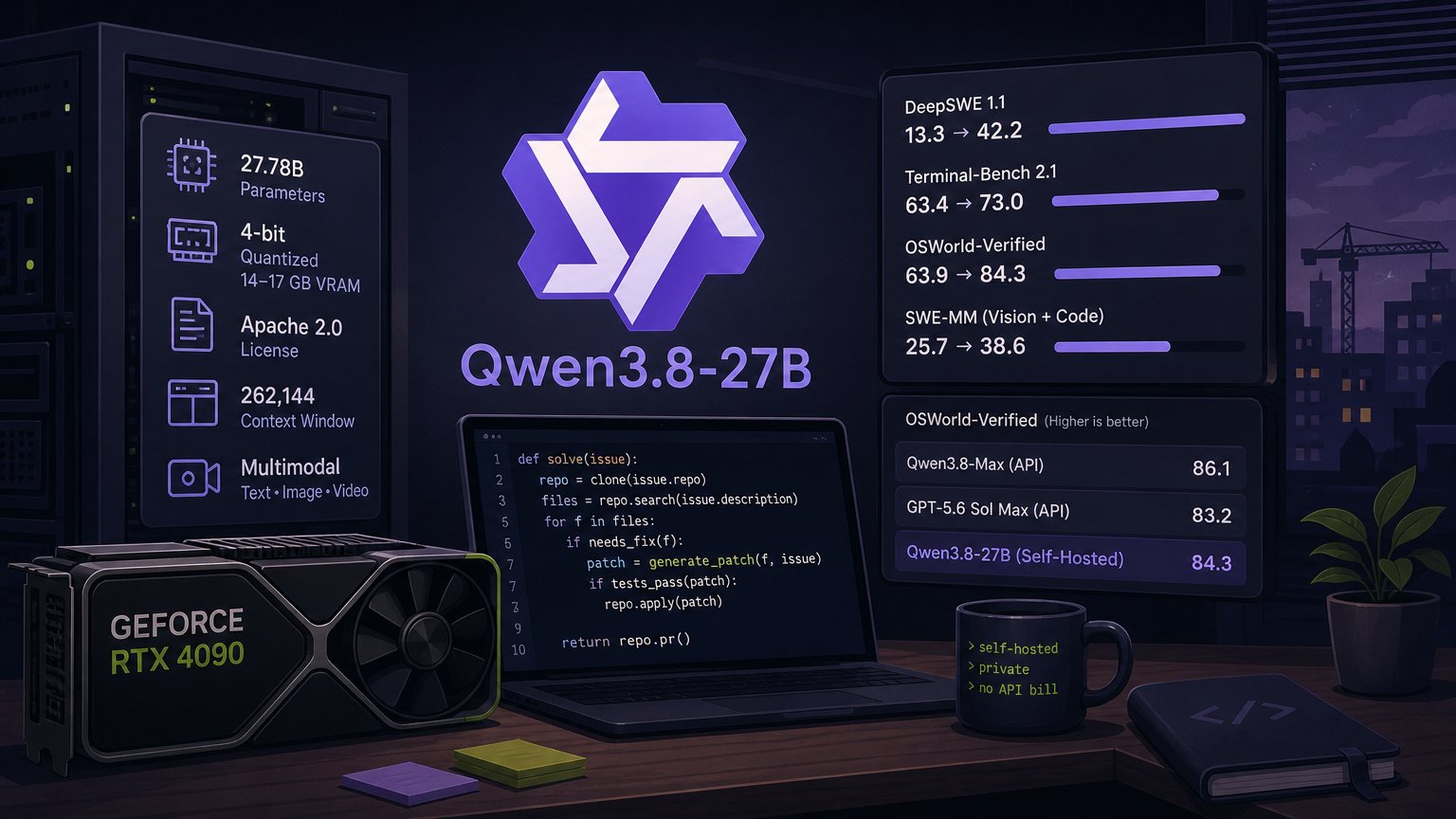
Alibaba released Qwen3.8-27B's weights at 15:00 UTC on August 14, 2026, under Apache 2.0. The model has 27.78 billion parameters, supports text, images and video, and offers a 262,144-token context window. Its reported agent benchmarks show substantial gains over Qwen3.6-27B.
The practical attraction is its size after quantization. At 4-bit precision, the weights take about 14 to 17 GB of VRAM, making a single 24 GB RTX 4090 a plausible deployment target. That doesn't mean the card can serve the full context window at high concurrency. It does mean local agent workloads may no longer require either a large GPU server or a paid model API.
What the benchmark gains show
Qwen's published evaluations compare Qwen3.8-27B with Qwen3.6-27B across software engineering, terminal use, desktop automation and visual coding tasks. Several evaluations use in-house or modified setups, so these are vendor-reported results rather than independently established performance.
| Benchmark | Qwen3.6-27B | Qwen3.8-27B |
|---|---|---|
| DeepSWE 1.1 | 13.3 | 42.2 |
| Terminal-Bench 2.1 | 63.4 | 73.0 |
| OSWorld-Verified | 63.9 | 84.3 |
| SWE-MM | 25.7 | 38.6 |
DeepSWE 1.1 tests software engineering agents on real-world GitHub issues. The increase from 13.3 to 42.2 is more than threefold on that benchmark. If independent evaluations reproduce much of that gain, it would support building coding workflows around the model rather than limiting it to small, tightly constrained tasks.
The other results broaden the case. Terminal-Bench 2.1 measures terminal-based work, OSWorld-Verified covers desktop GUI automation, and SWE-MM combines visual understanding with code. Improvements across all four suggest a broader capability gain, though the scores alone don't establish whether architecture changes or additional training caused it.
The comparison with closed models is also notable. The API-only Qwen3.8-Max reports 86.1 on OSWorld-Verified, compared with 83.2 for GPT-5.6 Sol Max and 85.0 for Fable 5. Qwen3.8-27B's reported 84.3 is within two points of Max. That is a close result on this particular evaluation, not evidence that the smaller model matches those APIs across every task.
A license suited to product development
Apache 2.0 removes several licensing concerns that can complicate an open-weights deployment. It permits commercial use, has no monthly active user caps or royalty obligations, includes an explicit patent grant, and allows fine-tuning and redistribution of derived weights, subject to the license's terms.
That differs from Meta's Llama community license, with its monthly active user provisions. Earlier Qwen releases also required attention to release-specific terms, even where their licenses were relatively permissive.
For Qwen3.8-27B, a business can embed the model in a product, white-label it or serve enterprise customers without seeking a separate commercial agreement from Alibaba under the published license. The license is a practical reason to consider the model as a long-term dependency, especially when a deployment will include domain-specific fine-tuning.
What fits on one GPU
The published hardware guide describes three deployment tiers. These figures are approximate memory requirements for the weights, not complete serving budgets:
- BF16 precision, about 56 GB VRAM: The guide places this in an 80 GB-class GPU tier and lists H100, H200 and RTX Pro 6000 hardware. This is the unquantized BF16 option for production inference.
- FP8 quantization, about 28 GB VRAM: Suggested hardware includes an L40S or RTX 5090. This tier reduces memory use while aiming to limit quality loss.
- 4-bit GGUF/AWQ, about 14 to 17 GB VRAM: A single 24 GB RTX 4090 has room for the weights and some additional runtime memory at moderate context lengths.
Quantization stores model weights at lower precision to reduce memory requirements. It makes smaller GPUs useful, but the published benchmark scores shouldn't automatically be assumed to describe every quantized build.
The main operational constraint is the KV cache, which stores attention information for tokens being processed. Its memory use grows with context length and concurrent requests. Serving several users near the full 262,144-token limit can require substantially more VRAM than the weight figures suggest.
For local development, internal tools and agent pipelines with controlled context budgets, a 4090 remains a credible target. A heavily used service with long conversations is a different capacity-planning problem.
As of August 15, 2026, reported serving support includes vLLM and SGLang with OpenAI-compatible endpoints. Community GGUF and AWQ builds reportedly appeared within hours of release, with support also reported for llama.cpp, LM Studio and Ollama. That gives developers several deployment paths, although compatibility still needs checking for the chosen format and runtime.
Where self-hosting could help
Closed model APIs add dependencies beyond the per-token price. Agent pipelines must account for rate limits, pricing changes, data residency requirements and the provider's availability. For tools that handle sensitive code, customer records or proprietary systems, those constraints can become legal or operational blockers.
Self-hosting gives an operator control over where inference runs and where its data is processed. It also removes the external model API's per-token bill. Continuous workloads such as code review bots, infrastructure monitors and documentation generators can instead be budgeted around hardware amortization and operating costs.
Those advantages have limited value if the model can't finish the work. Multi-step reasoning, tool use and computer interaction have been harder targets for open-weights models than structured tasks with narrow outputs. The reported DeepSWE gain suggests Qwen3.8-27B may solve a useful share of software engineering tasks that its predecessor couldn't handle.
The OSWorld-Verified result supports testing desktop workflows too. Potential uses include screenshot-driven automation, UI testing agents and bug reproduction pipelines that process screen recordings. These remain workload-specific possibilities. A benchmark result doesn't establish that any particular internal application is ready for unattended automation.
Multimodal support expands the test cases
Qwen3.8-27B accepts text, images and video natively. Its release description presents vision as part of the base architecture rather than a separate encoder added afterward. The SWE-MM increase from 25.7 to 38.6 is the relevant reported gain for tasks that combine visual information with code.
That combination could help an agent connect a screenshot of a broken interface with the code that produced it, or use recorded UI behavior while investigating a bug. Running the model at 4-bit precision on a local GPU makes those workflows easier to evaluate without sending visual inputs to an external model API. Their reliability and quantization sensitivity still need measurement.
What needs testing before production
Independent benchmark results are the first check. Community evaluations on unmodified setups are expected over the next week or two. Some decline from the vendor's published scores would be unsurprising. A DeepSWE result of 35 rather than 42.2, for example, would still represent a substantial improvement over 13.3, but that is a hypothetical outcome, not a measured result.
Long-context performance needs separate testing. Accepting 262,144 tokens doesn't establish reliable retrieval or reasoning across that entire window. Quality at longer contexts, together with cache memory and concurrency limits, will determine how much of the advertised capacity is useful in production.
Fine-tuning behavior also matters. Apache 2.0 allows domain-specific derivatives, and instruction-tuned variants and coding specialists are expected within weeks. Useful tests include whether those variants gain domain accuracy without losing broader capabilities, and whether their alignment holds after training.
Qwen3.8-27B makes a stronger case for evaluating self-hosted production agents, particularly where data residency rules make external APIs difficult to use. A bounded deployment trial requires a compatible quantized build and a serving endpoint such as vLLM, with representative tasks run under realistic context and concurrency limits. Completion rates, memory use and operating cost will determine whether the reported gains translate into a workable service.