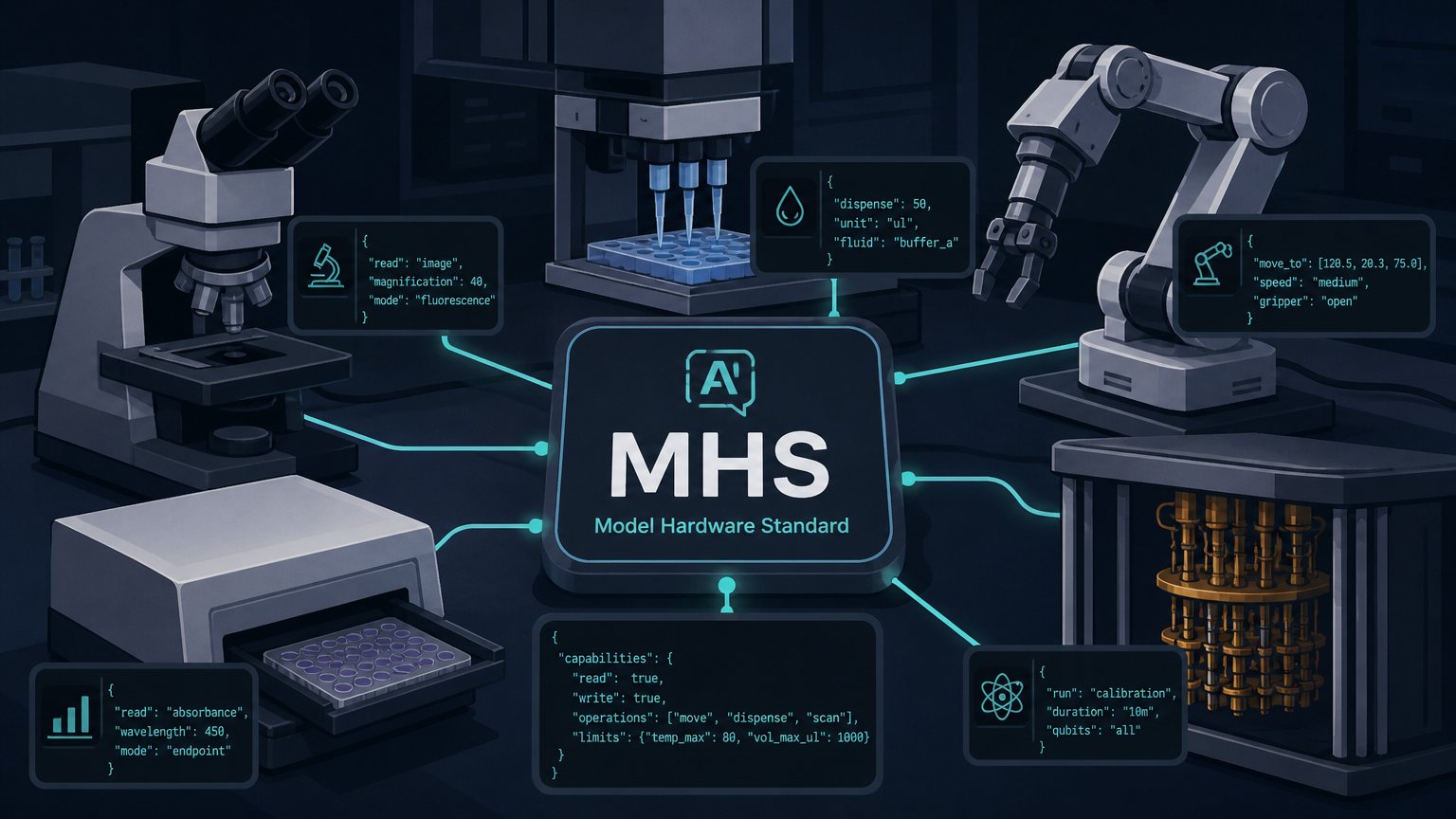
On August 27, 2026, Anthropic announced a research preview of the Model Hardware Standard (MHS), an open specification for connecting AI agents to programmable physical equipment. The proposed interface covers devices such as microscopes, robotic arms, liquid handlers, plate readers, and quantum instruments.
The problem it addresses is the integration work between an agent and a machine. Calling an API or querying a database is already routine for many agents. Adjusting a pipette or starting a spectrometer scan requires a connection to the equipment, an understanding of its commands, and some way to handle its operating limits. Those connections have often required custom engineering for each device.
MHS proposes a common driver layer for that work. Early partners report shorter setup times and faster experiments, though their results also expose problems that a standard interface alone won't solve. As of August 29, the project remains a research preview, with an open-source release planned after partner safety evaluations.
How the interface works
An MHS-compatible driver sits between an AI agent and a physical device. The equipment manufacturer supplies the driver, which exposes common commands such as read and write, along with device-specific operations. It also provides natural-language descriptions of the machine's capabilities, accepted parameters, and operating limits. The agent reads those descriptions and issues commands; the driver translates them into device operations.
Anthropic compares the approach to USB-C: a common connection that reduces the amount of device-specific integration. The useful part of that analogy is the division of responsibility. Equipment makers provide support for their machines, while software developers work against a shared interface. Anthropic doesn't have to write and maintain every instrument driver itself.
MHS is designed to be model-agnostic. Claude, GPT, Gemini, or a local Llama variant running on a Raspberry Pi could use it, provided the model can interpret the driver's capability description and issue JSON commands. Anthropic says the specification is compatible with the Model Context Protocol (MCP), command-line tools, and standard REST APIs.
For teams already using MCP to connect agents to databases, APIs, and file systems, that compatibility is important. MHS is intended to fit into the existing tool layer rather than require a separate agent architecture.
What the early partners reported
Three organizations participated in the research preview. Their reported results cover both integration time and the practical limits of agent-controlled equipment.
Genentech connected Claude through MHS to liquid handlers, robotic arms, and plate readers for protein assay workflows. The agent adjusted incubation times, flagged anomalies, and requested reruns. The team also reported that it struggled with physical edge cases, including liquid bubble formation that an experienced laboratory technician could catch by eye.
Carnegie Mellon University compared MHS setup time with vendor-provided integrations. Its MHS integration took eight hours from initial setup to running experiments, compared with weeks for its previous vendor integrations. The team reported that experiments ran approximately three times faster after automation. The explanation given was that the agent could run overnight sequences without human supervision and handle decision branches that would otherwise require a postdoctoral researcher to be present.
The University of Washington connected six instruments in under a week for remote experiment monitoring and automated sample transfers. The reported comparison was with workflows that previously would have required a resident technician or a custom middleware project.
An eight-hour integration instead of several weeks could change which experiments a lab can afford to automate. Still, these are early partner reports. The three-times-faster result belongs to Carnegie Mellon's workflow, not to every partner or every type of equipment. Genentech's bubble problem is equally relevant to judging what the system can do.
What the architecture buys
Compatibility with MCP is a sensible choice because it gives MHS a route into agent systems that already exist. Teams with MCP tooling should have less surrounding infrastructure to rebuild, assuming the preview's compatibility carries through to working implementations.
The driver model also puts device-specific knowledge with the manufacturer. A liquid handler and a quantum instrument don't need identical operations. They need a consistent way to describe the operations they support and accept commands for them. That lets the common interface cover different equipment without pretending the machines are interchangeable.
The natural-language capability description is central to this approach. Rather than requiring an agent to work through separate protocol documentation for each instrument, the driver describes what the machine does, which parameters it accepts, and what it will refuse. The design assumes that a capable model can use this information to produce valid commands without instrument-specific fine-tuning.
That is also the basis for the model-agnostic claim. Hardware support doesn't have to depend on a Claude-specific integration if another model can interpret the same description and use the same command interface.
Anthropic has committed to open-sourcing MHS after completing safety evaluations with its early partners. The stated purpose of the preview is to collect real deployment failures before finalizing the specification. Testing that way is a reasonable sequence for software that can move equipment and alter experiments.
Commands can have irreversible effects
A failed software request can sometimes be logged, retried, or escalated without changing anything outside the system. Physical commands carry different consequences. A robotic arm can break a sample. An agent that misreads a sensor and continues an experiment past a safe temperature can damage equipment or create a safety hazard. Retrying the command won't restore the previous state.
The liquid bubbles reported by Genentech illustrate the problem. A command can be valid for the instrument while still producing the wrong result because of conditions the agent hasn't recognized. Understanding the documented interface isn't the same as observing everything happening at the bench.
MHS addresses part of this through capability descriptions that include machine limits and specify what the device will or won't accept. Those descriptions give the agent information before it acts. They shouldn't be treated as evidence that every unsafe action is prevented. The partner evaluations are meant to test what happens beyond the documented operating path.
Mechanical tolerances, environmental conditions, wear, and undocumented failure modes will remain concerns even with a common protocol. A reasonable prediction is that production deployments will encounter more varied edge cases than a research preview can capture.
Teams adopting MHS will therefore need the operational controls expected of other physical automation systems: runbooks, clear escalation paths, and human review for actions that can't easily be undone. A simpler integration doesn't reduce the consequences of a bad command.
Possible uses beyond the laboratory
Scientific research and advanced manufacturing are the most immediate applications described for MHS. Data center infrastructure is another plausible use if the standard becomes generally available and enough manufacturers supply drivers.
Data centers already contain programmable physical equipment, including power distribution units (PDUs), keyboard-video-mouse switches (KVMs), serial console servers, out-of-band management systems, environmental sensors, and smart rack equipment. Much of it exposes an API, but automation often depends on vendor-specific software development kits, inconsistent authentication, and custom scripts that are difficult for anyone other than their author to maintain.
A shared interface could make it easier for an agent to power-cycle a server, adjust cooling thresholds, or inventory rack contents across several vendors. Those are possible applications, not capabilities demonstrated by the three preview partners. Their usefulness would depend on driver coverage and the controls around each operation.
Manufacturing presents a related integration problem. Industrial Internet of Things systems have pursued unified device communication for a decade. OPC-UA serves industrial communication needs, but the assessment here is that its adoption in AI agent workflows remains nearly zero. MHS makes a different integration bet: natural-language capability descriptions and a simple command interface may be easier for agents to use without device-specific training data.
Model independence could help adoption. Anthropic can influence the specification without requiring every participating organization to use Claude. That gives hardware manufacturers a reason to support the interface across customers using different models, rather than treating it as a feature for a single vendor's product.
The surrounding protocol work
The announcement arrived in a week when Nvidia's earnings reportedly showed $96 billion in quarterly revenue, alongside continued spending on AI infrastructure. For physical automation, however, more compute doesn't remove the need to connect an agent to the equipment. Bespoke integrations that take months can still hold up deployment. MHS targets that cost directly.
Other agent protocol work is also being consolidated. Google's A2A protocol formally joined the Agentic AI Foundation on August 20 alongside MCP. In that framing, MCP covers agent-to-tool communication, A2A covers agent-to-agent communication, and MHS adds a draft interface for agent-to-hardware communication.
Having specifications for those interfaces doesn't establish which will dominate or how quickly adoption will follow. MHS could become widely used or be replaced by another approach. The expectation behind the preview is that more agents will control physical systems, and that shared interfaces will reduce the engineering required to connect them.
What to watch during the preview
- Driver availability. The specification's practical reach depends on which machines support it. Published drivers from laboratory and industrial equipment vendors will matter more than a broad compatibility claim.
- Safety findings. Anthropic plans to release MHS as open source after partner evaluations. The useful details will be the failures found and the resulting changes to the specification.
- MCP implementation support. Existing MCP server implementations need usable MHS support for compatibility to save teams meaningful work.
- Competing approaches. Microsoft, Google, and AWS have reasons to participate in physical AI integration. A hardware extension to A2A or an industrial offering from AWS remains a possibility, not an announced outcome in this preview.
For infrastructure teams evaluating the MHS announcement, a useful starting point is the device inventory. Which equipment is programmable, which vendors could supply drivers, and which actions require human approval? Those answers will determine whether a shared interface removes substantial work or leaves the hardest integration problems in place.