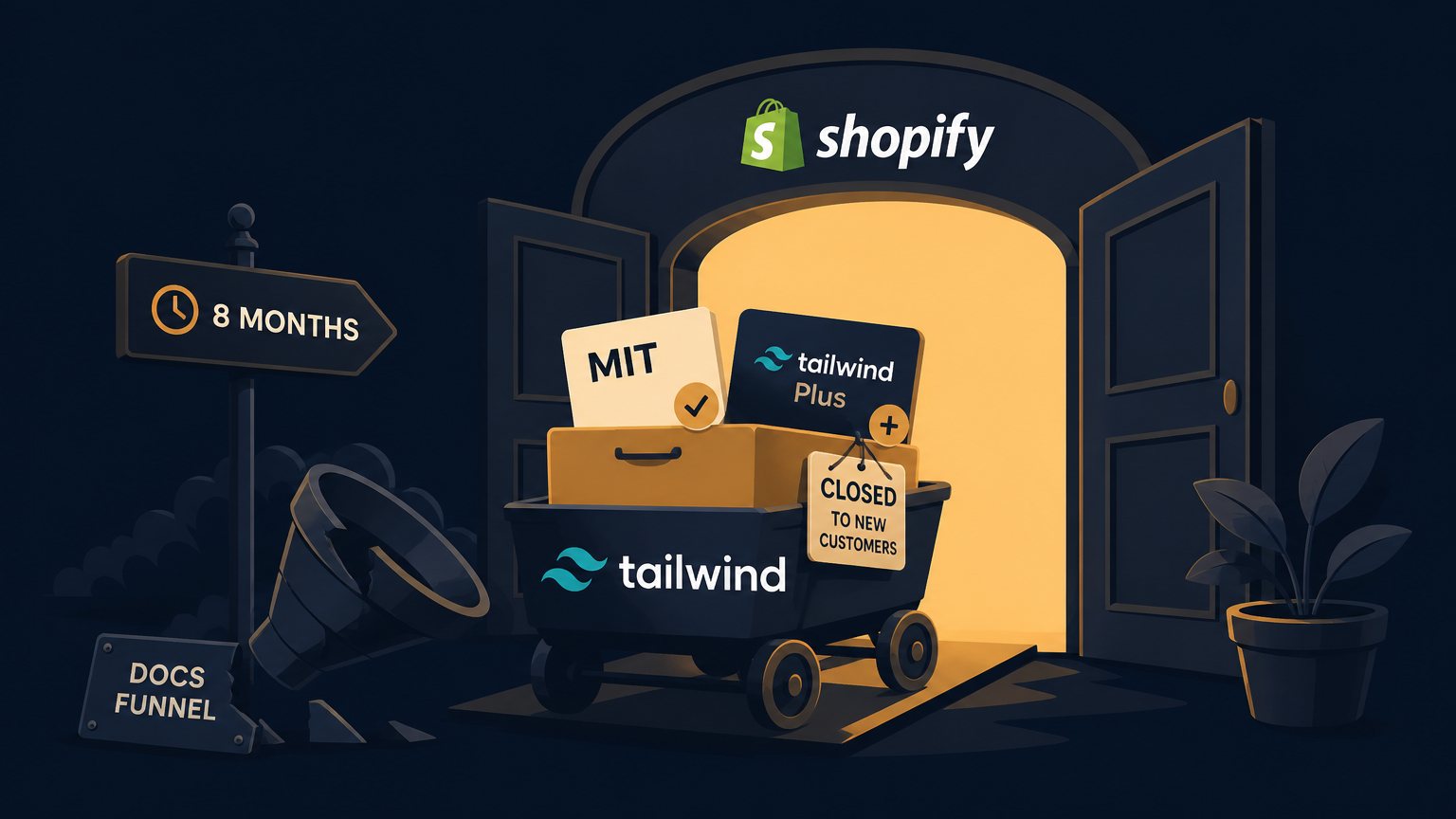
Tailwind Labs is joining Shopify. Adam Wathan announced the deal on September 9, and the price was not disclosed. Tailwind CSS stays MIT licensed. The team keeps maintaining it. Tailwind Plus and ui.sh, the paid products that funded the whole operation, stop taking new customers.
Tailwind Plus paid the salaries. Without it, the framework that 51% of respondents to the 2025 State of CSS survey said they use, the one installed 110 million times a week, is no longer a business. It is a team inside an ecommerce company.
Eight months from layoffs to exit
In January, Wathan wrote that three of his four engineers had lost their jobs. Revenue was down about 80%. Traffic to the documentation site had fallen 40% since 2023, and by his own estimate the company had around six months of payroll left if nothing changed. Devclass covered the numbers at the time. What remained was three cofounders, Robin Malfait, and Peter Suhm part time.
Usage grew through all of this. Wathan said it was growing faster than it ever had. Documentation traffic is what collapsed, and the docs were where developers found out Tailwind Plus existed. An LLM that emits correct Tailwind classes on demand removes the page view, and with it the sale. One commenter on the Hacker News thread, tessierashpool, put it in one line: the funnel depended on SEO, and LLMs took SEO out of the equation.
Vercel, Google AI Studio, Lovable, Gumroad and Macroscope announced sponsorships within two days of the layoff post. None of them disclosed an amount. The sponsorships bought eight months.
The thread hit 1,030 points and 394 comments in a day, and a fair share of it argued that the business should never have existed, that selling components on top of a free framework was a temporary inefficiency. I don't buy that. The company ran for six years on component sales, bootstrapped, and employed a team of engineers who shipped a framework half the web uses. A model that pays salaries for six years is a model. It stopped working because the discovery channel disappeared, and that is a different failure than the product being worthless.
What Shopify gets
Shopify President Harley Finkelstein said the company was one of the first to bet on Tailwind at scale and that it now has a permanent home. Wathan's post lists the surfaces the team will work on: merchant storefronts, the admin, checkout, the Shop app, and what he calls agentic commerce.
Shopify has been building on Tailwind for years, so the acquisition converts a dependency into staff. That's a rational purchase. Shopify runs storefronts for millions of merchants, and the cost of a five-person team is small next to the cost of the framework under its UI going unmaintained.
Wathan also says he always wanted the framework developed in service of a real product, one where the team hits the same problems its users do. I believe him. Frameworks built by people who ship product tend to age better than frameworks built by people who ship frameworks. But the product is now one product. The problems Shopify has are the problems Tailwind will solve first, and the problems Shopify doesn't have will wait.
The MIT license is the least of it
Every acquisition of an open source company comes with the same sentence, and this one has it too: nothing changes, everything stays MIT. That sentence is true and it does not answer the question people are asking. A license tells you what you can do with the code that exists. It tells you nothing about who writes the next version, or whether anyone does.
AWS said the same thing about DuckDB two weeks ago when it agreed to buy DuckLabs. Same structure. The creators stay, the license stays, and the roadmap now runs through a company whose revenue comes from somewhere else. Two of the most widely used open source projects of the decade changed owners in fifteen days, and in both cases the buyer was the largest downstream consumer.
I maintain an open source project myself, and I've watched this pattern from the outside for twenty years. Acquisition by your biggest user is the good outcome. The bad outcome is the one Wathan named in January: abandonware. Between those two there was supposed to be a third option, an independent company that sells something adjacent and uses the margin to fund the commons. Tailwind was the best example of that option working. Then the discovery channel went away and the model went with it.
Nothing about that is specific to CSS. Any project whose funding depends on a human reading a page is exposed. Documentation sites, tutorial sites, the newsletter that sells a course, the blog that leads to a consulting call. If an agent can answer the question without loading your page, the page stops paying for the code. The sponsorship route that Vercel and Google tried in January is the only replacement anyone has offered so far, and in this case it lasted two quarters.
What I'd do if I depended on Tailwind Plus
Existing customers keep access. New signups are closed. Wathan says the team will no longer try to grow the business around Tailwind, which I read as: the catalog you have is the catalog you'll get. Some things follow from that.
- Download everything you've paid for now. Access promises made at acquisition time are honored until a reorg, and reorgs are not announced in advance.
- Assume the component library and templates go stale against future Tailwind releases. Budget time to port them yourself.
- Headless UI and the other open source pieces are covered by the MIT promise. Fork what you use anyway. Nobody said they'd stop, and nobody said they'd keep the same priority either.
- If you're picking a framework for a new project, ask whether Shopify needs the feature you need. If yes, it will ship. If no, plan to write it.
The framework itself is safer today than it was on Monday. Five people with months of runway are a worse bet than five people on Shopify's payroll. The prediction I'll put my name on: Tailwind CSS keeps shipping for as long as Shopify's storefront stack runs on it, and the first release shaped by Shopify's needs over everyone else's lands within a year. Tailwind Plus gets no new components after this quarter. And the next open source project to sell to its biggest customer will do it for the same reason, with the same sentence about the license, before the end of the year.