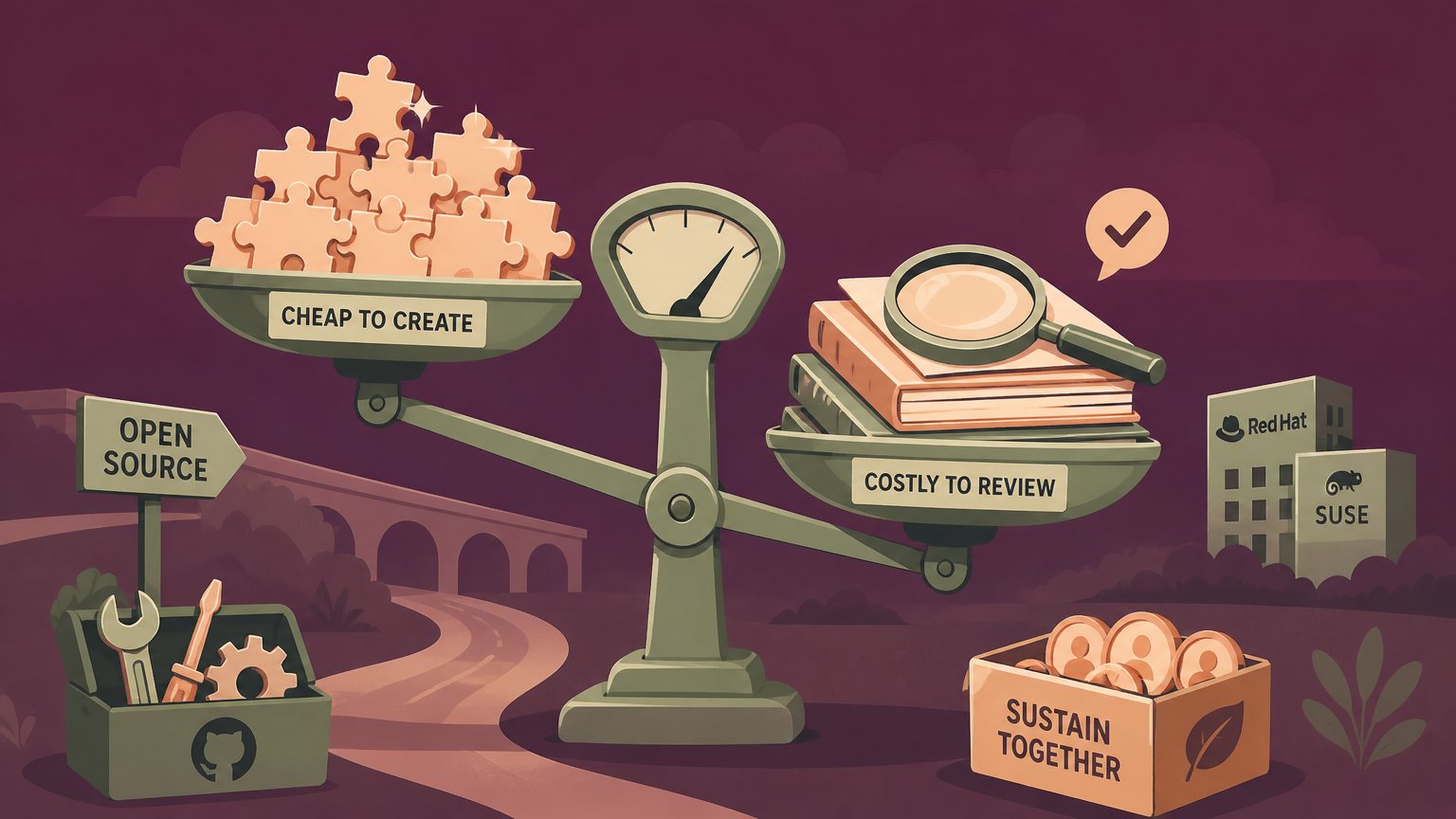
AI coding tools can make a patch cheap to produce. A maintainer still has to read it, test it and decide whether the project should carry it for years. When contributors skip that judgment before submitting, they move the work into someone else's review queue.
A patch can be syntactically valid and still conflict with the project's architecture. A broad cleanup can reformat files that already have an established formatter, making the behavior change harder to find. Passing tests doesn't settle whether a change belongs in the project. Someone still has to decide and explain the decision. For engineering and platform leaders at smaller companies, the time saved generating code needs to be weighed against the review work sent to a project the business depends on.
The volume of collaboration is growing. GitHub's Q1 2026 Innovation Graph update, published July 7, reported 16% quarter-over-quarter growth in outbound cross-economy collaboration from Q4 2025 to Q1 2026. That was the second-highest rate since 2020. The measure combines git pushes and pull requests to public repositories in other economies. It measures activity, not submission quality, burnout or the effects of AI.
By August 31, 2026, GitHub had shipped several controls for managing incoming contributions. Its February 12 announcement used the Eternal September analogy to describe a continuing influx of newcomers unfamiliar with community norms. The controls described then included restricting pull request creation to collaborators or disabling pull requests, pinning comments on issues to keep information visible, and temporary interaction limits for public repositories.
GitHub's June 18 article on pull request limits described caps on concurrently open pull requests for users without write access. These caps limit how much work one contributor can put into the queue at once. They don't remove the need to judge each patch. Restricting submissions is a reasonable protection when a project needs to keep releases and security work moving.
DevOps.com's coverage of GitHub's maintainer controls provides related reporting.
Validate the contribution before opening a pull request
Companies adopting AI coding tools need to teach upstream contribution norms explicitly. Contributors should read the contributing guide, search existing issues and pull requests, and run the required tests. Anyone submitting a generated patch needs to understand it well enough to explain and defend the change. AI assistance can be useful when that validation happens before submission.
Substantial changes need an earlier conversation. Follow the project's proposal process, which may require discussing scope in an issue before writing code. A completed rewrite is an expensive way to discover that the project wanted a smaller fix. Keep the diff focused on the agreed problem and leave unrelated formatting out.
Engineering managers need to allocate time for this preparation and for responding to review afterward. A schedule that ends when the pull request is submitted leaves part of the work unaccounted for.
Sometimes a reproducible bug report is more useful than a speculative patch. Include the affected version, a minimal reproduction, expected and observed behavior, and relevant diagnostic output. That gives a maintainer a way to investigate without reconstructing an entire application.
Missing documentation also deserves attention. A tested configuration example or an explanation of an upgrade constraint can prevent repeated support questions. When code is needed, investigating the problem first gives the contributor a basis for explaining the fix's constraints and tradeoffs. Keep the change focused, include an appropriate regression test and remain available to revise it.
The project's AI policy applies throughout, including any disclosure requirements. Respect projects that prohibit AI-generated submissions. Where assistance is permitted, the pull request description should explain how it was used and what the contributor reviewed and validated. That includes tests run and known limitations. Naming the tool doesn't transfer responsibility to the maintainer. The submitter still has to explain the code, respond to review and correct defects.
Put maintenance in the infrastructure budget
A production stack can depend on a web server, database client, TLS library, serialization library and observability agent maintained outside the company. An SMTP library, YAML parser or JWT implementation may be easy to overlook during budget discussions and painful to replace.
When maintenance stalls, the company may have to carry security patches, investigate compatibility failures or choose a fork. That takes engineering hours away from the product. Cosmetic refactors sent upstream do little to reduce this exposure and give maintainers more work to sort through.
Maintainer retention was a concern before the current discussion of AI-assisted contributions. Tidelift's September 17, 2024 survey release reported that 60% of responding maintainers had quit or considered quitting maintenance work. That signals retention risk among respondents. It isn't a 60% burnout rate or a measure of AI-caused departures.
Companies benefiting from these dependencies should help pay for their maintenance. GitHub Sponsors and Open Collective provide ways to contribute funding. Those costs belong in the infrastructure budget, with funding decisions reflecting how costly a dependency would be to maintain or replace. Sponsorship can pay for triage, releases, security fixes and compatibility work that the company relies on but doesn't staff itself.
Sponsorship carries no service-level agreement, or SLA, and no guarantee of support. A company that needs response-time commitments has to arrange a separate support contract with explicit obligations. Recurring funding still has value without priority treatment. It helps pay for maintenance of a dependency already running in production.