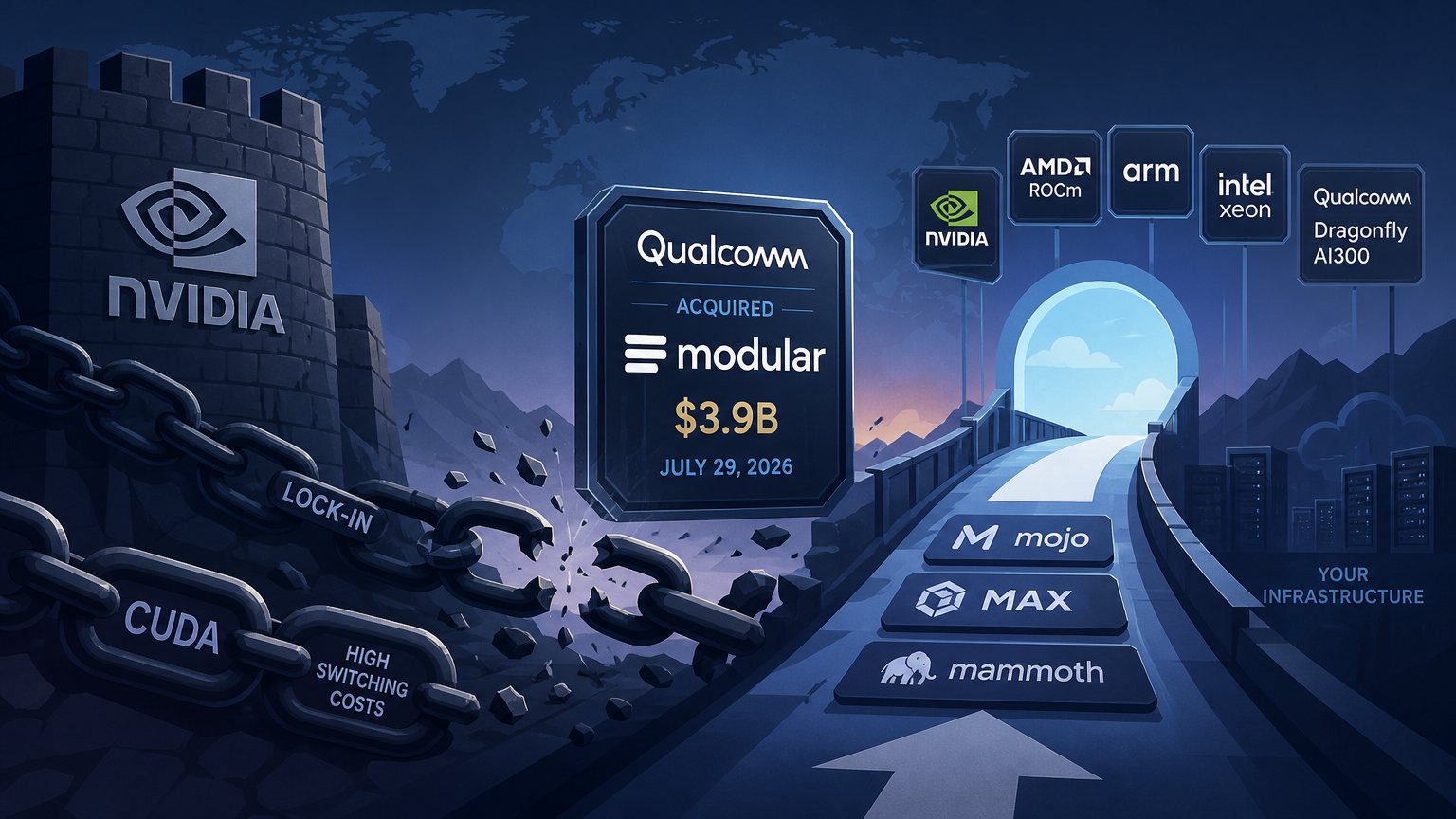
Qualcomm closed its $3.9 billion acquisition of Modular on July 29, 2026, adding an AI software stack designed to run across competing hardware platforms. For teams trying to move inference workloads beyond NVIDIA, the deal provides a better-funded alternative. It also puts that alternative under the control of another chip supplier.
CUDA's hold on AI infrastructure comes from more than GPU performance. Its ecosystem includes 4 million registered developers and more than 40,000 organizations. Machine-learning frameworks, tuned kernels, distributed training configurations, and continuous integration pipelines have accumulated around NVIDIA hardware. Each dependency makes switching more expensive, which limits how much flexibility buyers have when negotiating their next GPU purchase.
Modular was built to reduce those switching costs. Qualcomm is betting that its software can make competing hardware practical to deploy without requiring teams to rebuild their infrastructure around each chip vendor.
The software Qualcomm bought
Modular was founded in 2022 by Chris Lattner and Tim Davis. Lattner created LLVM, Clang, and Swift, giving the company substantial experience in compiler infrastructure. That background is relevant to the central problem: translating software into efficient code for different processors.
The stack has three main pieces:
- Mojo is a programming language with Python-compatible syntax. It compiles through MLIR, a compiler infrastructure, to native kernels for NVIDIA GPUs through PTX, AMD ROCm through AMDGPU IR, and Apple silicon through Metal shaders. Mojo 1.0 beta shipped in May 2026. Its standard library is already open-source, and the compiler is targeted for an open-source release before the end of 2026.
- MAX is an inference engine. It takes models, produces optimized deployment packages, and serves them through OpenAI-compatible HTTP endpoints. Its stated out-of-the-box support covers NVIDIA, AMD, Intel, Arm, and custom ASIC architectures, including NVIDIA Blackwell, Grace, and AMD MI355X.
- Mammoth handles orchestration for distributed inference at scale. It is less publicly documented than MAX, but addresses the coordination needed as deployments grow beyond a handful of endpoints.
The reported performance claims include 4.5x higher throughput than PyTorch plus HuggingFace for a 7B model at batch size 64 on a single H100, along with improvements of 20 to 50% over vLLM and SGLang on next-generation hardware. These are benchmark claims, not evidence that every workload will see the same gain. The H100 result at least identifies a model size, batch size, and hardware target that operators can use when planning a comparison.
A software stack alongside Qualcomm silicon
Qualcomm acquired the full stack and brought both founders into the company. Lattner becomes Executive Vice President of Advanced AI Software and Platforms. Modular's 150-person team joins Qualcomm's engineering organization, while Mojo, MAX, and Modular Cloud continue under their existing brands.
Qualcomm also unveiled its Dragonfly AI300 inference accelerator when the acquisition closed. Together, the announcements give Qualcomm a combined hardware and software offering, with software that is also intended to run on competitors' processors.
That could give Qualcomm a stronger competitive position than a chip offering alone. AMD's ROCm provides a comparison: it has a technically capable software stack, but this deal's competitive argument rests partly on the judgment that ROCm has been under-resourced and too slow to support new model architectures. Qualcomm now has the opportunity to fund a broader software effort, though the acquisition itself doesn't establish how well that effort will perform.
The pricing structure offers several ways to use Modular's products:
- The self-hosted Community edition is free for development, research, and production workloads on x86/ARM CPUs or NVIDIA GPUs.
- Enterprise licenses add on-premises service-level agreements.
- Modular Cloud charges per token or per minute.
- A Bring Your Own Cloud, or BYOC, option targets teams that need reserved GPU capacity with guaranteed latency.
Access to more than 1,000 pre-configured Hugging Face models comes standard. The distinction between supported hardware and the hardware covered by the free Community edition matters when evaluating deployment costs.
Hardware neutrality now depends on Qualcomm's priorities
Modular's appeal depends on serious optimization work for every supported hardware target. Broad compatibility is less useful if the best kernels, newest model support, and engineering attention consistently go to Qualcomm processors.
Qualcomm's 2021 acquisition of Nuvia for $1.4 billion offers a reason for caution. An independent Arm CPU effort became part of Qualcomm's CPU plans. The engineering talent remained, but decisions about optimization and release priorities moved under Qualcomm's product planning. Modular faces the same organizational pressure, even if its cross-hardware strategy continues.
Before the deal closed, Lattner said joining Qualcomm would provide the scale and platform reach to accelerate Modular's mission. The funding argument is reasonable. A 150-person company couldn't match NVIDIA's SDK investment. Qualcomm, with 50,000 employees, has the resources to support a much larger effort. Its incentive to sell its own silicon, however, creates a tension that Modular didn't previously have.
One useful signal will be the handling of third-party hardware contributions on Modular's GitHub. Over the next twelve months, comparable release attention for AMD MI355X kernel improvements and Qualcomm Dragonfly improvements would support the hardware-neutrality claim. A widening gap would raise concerns that MAX is becoming a Qualcomm-first inference engine with compatibility elsewhere. Pull request merge rates can help track that direction, though they aren't a complete measure of engineering priorities.
What inference teams can test now
The deal makes a technical evaluation worthwhile. It doesn't justify an immediate production migration.
- Benchmark MAX on available non-NVIDIA hardware. The current product reflects Modular's pre-acquisition development priorities. The next twelve months could provide a useful baseline before Qualcomm's roadmap has more influence. Compare MAX with vLLM on accessible AMD or Arm hardware and document results for the models intended for deployment.
- Keep CUDA training migrations separate. MAX is an inference tool, so the acquisition doesn't by itself change the training decision. Mojo's compiler is still estimated to be months away from production-grade stability. The near-term opportunity is model serving, and even there, workload-specific benchmarks should come before infrastructure changes.
- Track the Mojo compiler's open-source release. Lattner has committed to releasing it by the end of 2026. A delay after the acquisition would raise questions about the new priorities. An on-time release would reduce vendor dependence by allowing teams to fork and maintain the toolchain, although taking on that maintenance would still require engineering resources.
- Keep the serving interface portable. MAX's OpenAI-compatible API allows it to sit behind the same abstraction used for other compatible endpoints. Where a deployment relies only on that shared interface, switching providers can be a configuration change rather than an application rewrite. The broader performance and operational requirements still need testing.
The investment case still needs operational evidence
The case for Modular rests on the view that NVIDIA's advantage in inference is heavily tied to software. NVIDIA has real silicon strengths, but the argument is that those strengths don't amount to an eight- to tenfold advantage over AMD at inference. Developer experience, framework support, and production tooling help explain why purchasing decisions remain concentrated on NVIDIA.
Qualcomm's $3.9 billion investment aims to reduce that software barrier through hardware-agnostic compiler infrastructure. It's a defensible strategy, but validating it could take five years. Funding a capable team is easier than sustaining competitive performance, model support, and release quality across several hardware families.
As of July 30, 2026, MAX warrants evaluation on real serving workloads, alongside scrutiny of Qualcomm's treatment of competing hardware. Production commitments should depend on measured results and acceptable maintenance costs rather than the acquisition price or a headline throughput claim.