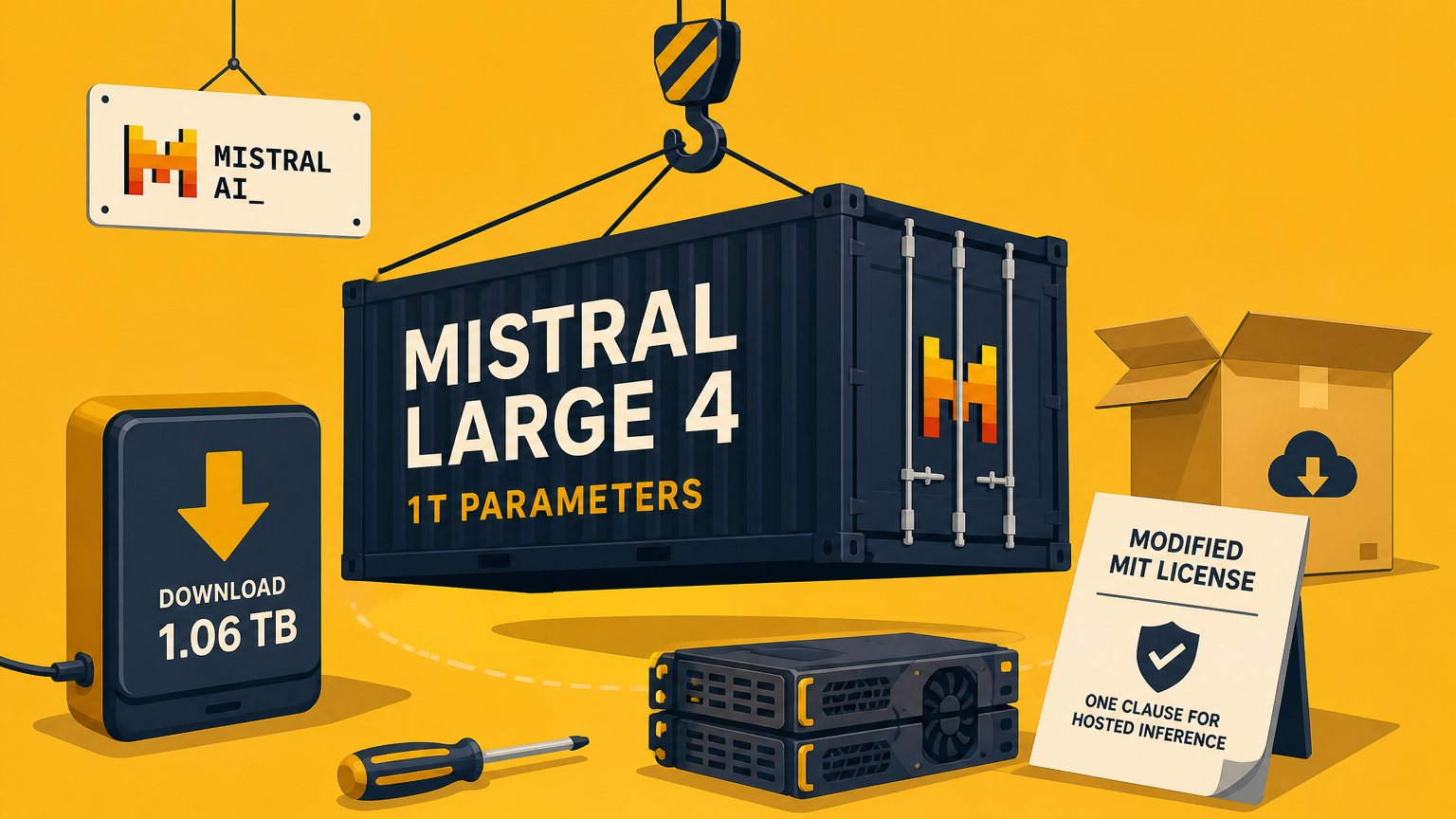
Mistral published the weights of Mistral Large 4 on October 29, and the Hugging Face repository is 1.06 TB spread across 54 safetensors shards. The model has about 1 trillion parameters, 52 billion of them active per token, a 1 million token context window, and a license that Mistral calls a modified MIT. The Hacker News thread hit 1,463 points and 395 comments in a day, and most of the argument was about the license, not the model.
The architecture is a mixture of experts with 128 routed experts, four active per token, plus one shared expert. It takes text and images in and produces text. Mistral put it on its API as a preview on October 6, then spent three weeks running reinforcement learning on coding and defensive security work before cutting the weights loose. The company's own numbers say Terminal-Bench 4.0 went from 28% to 41% across those three weeks, with 30% fewer output tokens. Those are vendor numbers. Nobody outside Mistral has reproduced them yet.
What it takes to run it
The model card ships vLLM and SGLang recipes, and both use tensor parallelism across eight GPUs. The full checkpoint is about a byte per parameter, so an eight H200 node with 1,128 GB of memory holds the weights with little room left for KV cache at long context. The NVFP4 checkpoint halves that and targets Blackwell. The Next Web reports the quantized version runs on four B200 or B300 cards. There are GGUF builds from ggml-org and Unsloth for llama.cpp, and a user on the thread, citing Unsloth, put the smallest usable quant at around 256 GB of memory.
So the people running this at home are people with a 512 GB Mac Studio or an eight GPU rig in the garage. Everyone else is renting a node or using the API.
Mistral also baked a speculative decoding draft head into the model, three dense layers in BF16 that propose three tokens at a time. They call it DSpark and claim up to 1.9x throughput. You turn it on with a flag in vLLM or SGLang. That detail only matters if you're paying for the GPUs yourself, which is the audience for this release.
Pulling the weights down is its own job. At a full gigabit, 1.06 TB is about two and a half hours if Hugging Face gives you the whole pipe, and it won't.
The license clause that hosting providers should read twice
The Mistral Ecosystem Open-Weight License grants the right to run, deploy, train and modify the model, for commercial or personal use, with one condition. Section 2 says that if you or an affiliate operates a Model as a Service business, you must sign a separate commercial license with Mistral before using the model or its derivatives for any commercial purpose.
The definition is the part that matters. Model as a Service means giving a third party access to the model "for inference or post-training by any means" in a way that lets them "exercise meaningful control over the inputs, parameters, or training data." Two things are carved out: products where the model sits behind a specific feature, and plain relaying of requests to models someone else hosts. Section 3 exempts internal use outright, defined as anything that doesn't make the model available to third parties.
For most companies this changes nothing. You run it on your own hardware for your own staff, or you put it behind a summarize button in your product, and you're fine. The clause lands on exactly one kind of business: anyone selling an endpoint where the customer writes the prompt and sets the parameters. That's OpenRouter, Together, Fireworks, the hyperscalers, and any GPU host that offers "bring your own model" with a hosted API in front of it. Microsoft Foundry has it on day one, so Microsoft either signed the commercial license or is covered by the partnership. One commenter on the thread suggested the obvious workaround, where the customer supplies the model files and the host provides bare metal. I'd expect that to sit in the gray zone until Mistral's lawyers say otherwise.
The complaints on Hacker News were about the word "open." Several people pointed to the OSI definition, which requires use for any purpose without asking permission, and this license fails that test. Mistral never says open source. It says open weight, every time. I don't have a problem with the clause itself. Meta's Llama license has an exception for companies above 700 million monthly users, and that was accepted as the price of getting the weights. Mistral's version is narrower and aimed at a clearer target: companies that would resell the thing Mistral is also selling.
The price cut and the sovereignty pitch
The API price dropped with the open release. Large 4 is now $0.70 per million input tokens, $0.07 for cached input, and $2.10 per million output tokens. Someone on the thread tracked the preview at $1.36 and $4.18, after a brief stretch at nearly the same price as today, so the number has moved three times in three weeks. Mistral's regional inference, which keeps requests inside the EU, adds 10% on top, per a user on the thread. If you're running coding agents, the cached rate is the one that matters. A developer in the thread said their coding sessions run above 97% cache hits.
Mistral's VP of Science, Pierre Stock, told TechCrunch that access "can't be cut off by definition because the model is open-weighted." That's the sovereignty pitch, and it's aimed at European governments and banks. The partner quotes on the launch page include La Banque Postale, ABN AMRO, Crédit Agricole, and ENISA. Mistral says it trained the model from scratch on 3,800 Grace Blackwell GPUs in Europe, and that the reinforcement learning phase ran on about 10 megawatts of its own compute in France. CEO Arthur Mensch put the company's total fundraising at roughly $6 billion over three years, against the hundreds of billions raised by the closed labs.
The sovereignty is in the weights, not the API. If you buy Large 4 through Mistral's endpoint or through Foundry, you have a vendor, and vendors change prices three times in three weeks. The weights are the exit. Most customers will never download them, the same way most people never restore from backup. But the difference between a vendor you can leave and a vendor you can't is the entire negotiation. I maintain a backup server project on nights and weekends, and I'll say the same thing here I say about restores: an exit you've never tested is a hope, not a plan. If the weights matter to you, run them once on rented hardware and confirm your serving stack works.
Benchmarks and guardrails
Against other open models, Mistral's Terminal-Bench 4.0 number of 41% sits just above GLM-5.3 at 40%, with DeepSeek V4.1 Flash at 31% and Kimi K3 at 21%. On the Artificial Analysis Coding Agent Index it scores 48%, tied with GLM-5.3, while using 47% fewer tokens per task. On the Artificial Analysis Cyber Index it scores 51%, and on CyberGym-E2E, which measures finding, reproducing, and patching memory safety bugs in C and C++, it scores 79%. Mistral says it is the best open model on code and ranked behind only Claude Opus 5.5 in blind pairwise human evaluations run by Surge.
The thread was not convinced. Several people called the Artificial Analysis index unreliable and said its formula changed recently. One person who ran agents on the preview said it felt like going back six months. Another pointed at the cost per task chart and said Large 4 doesn't compete. The fair reading is that Large 4 is a credible peer of GLM-5.3 with a lower token bill, and nowhere near the closed frontier. Mistral's own chart says the same thing if you look at where Opus sits on it.
The cybersecurity framing deserves a plain description. Mistral reports a 96.6% refusal rate on malicious cyber requests across JailbreakBench, StrongREJECT, and AgentHarm. It also says that after the preview it saw the model refusing black box attacks against live targets and that there is "potential for uplift" for real attacks, so it is adjusting the guardrails. A separate variant for penetration testing and red teaming is in preview with vetted design partners including Orange Cyberdefense, under contracts that limit use to systems the tester owns or has authorization for.
Guardrails on an open weight model are a courtesy, not a control. Two commenters pointed out that prefilling the response bypasses them, and anyone with the weights and a few GPU hours can fine tune the refusals away. Mistral knows this. The open release is the funnel and the vetted variant is the product, and the refusal number is there so that the funnel doesn't embarrass anyone in the first week.
Distilled versions are promised for the coming months, including one that fits on a laptop, with no dates. That's the model most readers of this post will run. The trillion parameter checkpoint will be downloaded a few thousand times and served in anger by a few hundred organizations, and I expect the Model as a Service clause to be tested by a GPU hosting company before the end of 2027.