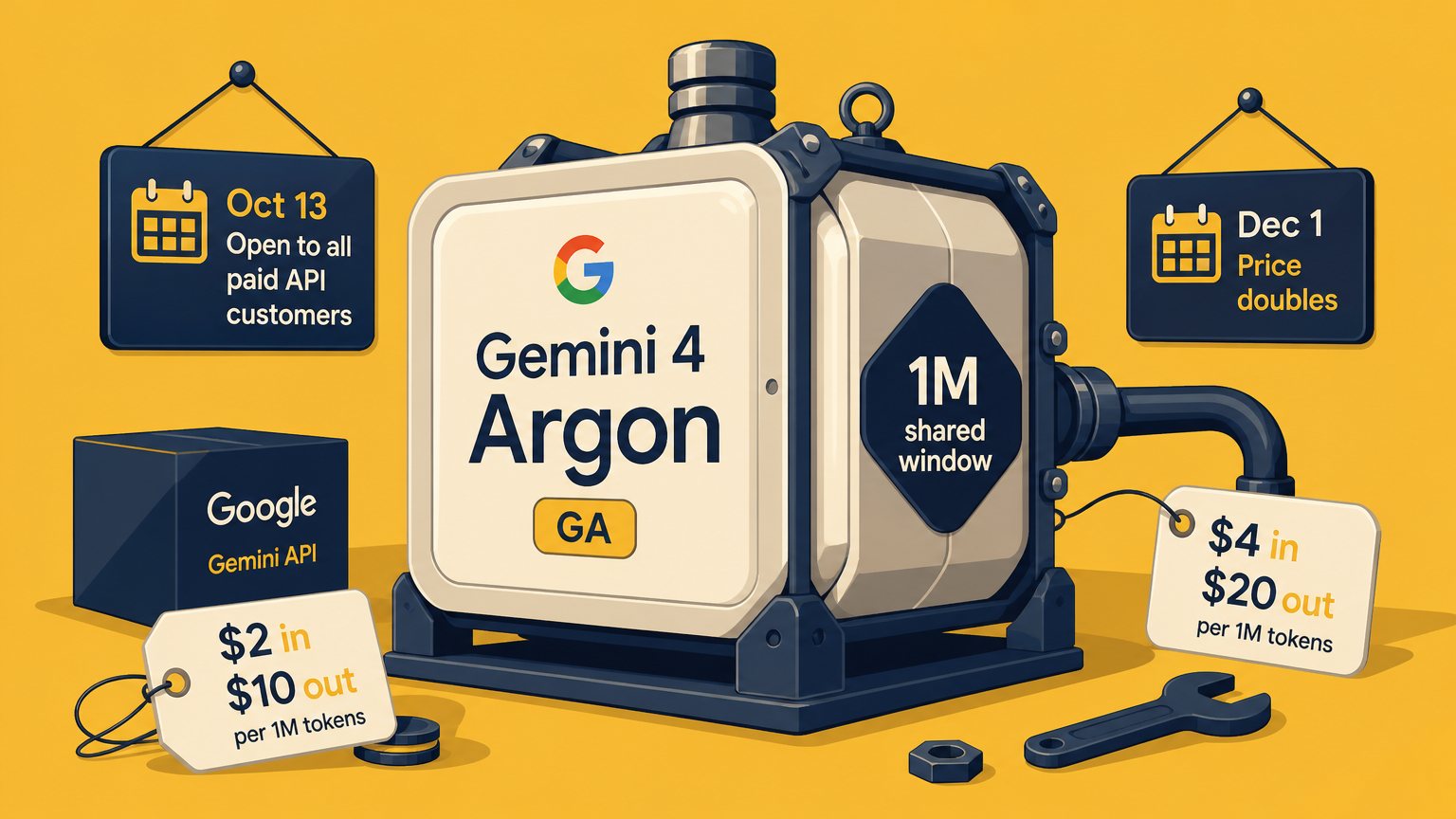
Google made Gemini 4 Argon available to every paid Gemini API customer on October 13, two weeks after announcing it on September 30. The intro price is $2 per million input tokens and $10 per million output. On December 1 both numbers double.
The first two weeks were a restricted release. Google shipped Argon to cyber defenders in its Fairwind Program first, a program it launched on September 2 with more than 650 partners, and held everyone else until yesterday. Now it's in AI Studio, the Gemini API, Gemini for business, Google Antigravity for AI Ultra subscribers, and the Gemini app for Ultra and Pro subscribers. The model ID is gemini-4-argon. There is no free tier.
The Hacker News thread on the release had 1,301 points and 907 comments by evening. Most of the complaints were about access. The price schedule, the context window, the benchmark table, and the split between two builds of the model are what I care about, so that's what this post covers.
The price has an expiry date
Google's pricing page lists two columns for Argon: through November 30, 2026, and from December 1. Standard input goes from $2 to $4 per million tokens. Output, which includes thinking tokens, goes from $10 to $20. Cached input goes from $0.10 to $0.20. Batch and Flex are half the standard rate in both columns. Priority inference is $3.60 in and $18 out now, and $7.20 and $36 after the cutoff.
That is seven weeks of introductory pricing. Anyone who builds a budget around $10 output in October will be paying $20 for the same workload before the year is out. I have watched hosting vendors do this with promotional rates for twenty years, and the pattern is always the same. The customer who read the fine print migrates or renegotiates. The customer who didn't gets a surprise invoice. Google put the date on the page, which is more than most vendors do. Read it anyway.
For comparison, Gemini 3.1 Pro Preview is $2 in and $12 out for prompts up to 200K tokens, and $4 in and $18 out above that. So Argon's December price is what 3.1 Pro charges for prompts above 200K, plus $2 on output, with no context tiers at all. Google is charging the long prompt rate for every request, including the short ones.
Caching is implicit only. The model page says explicit caching isn't supported. If your agent loop relies on pinning a large system prompt or a repo snapshot with an explicit cache and a TTL, you don't get that here. You get whatever Google's implicit cache decides to keep, and a 95% discount on the tokens it happens to hit.
One window, shared between input and output
The headline number is 1M output tokens. The model card describes the context window as a combined input and output window of up to 1M. The API docs give the exact figure, 1,048,576 tokens, and label it a unified input and output limit.
So the 1M output is real, but it's the same pool as the input. A request that sends 800K tokens of context has about 248K tokens left for the answer. A request that wants a 1M response has to start nearly empty. The default output cap for a synchronous request is 65,536 tokens, same as the earlier Gemini models, and you have to opt into long decode to go past it.
Google's own GraphWalks numbers show what happens as the window fills. BFS F1 is 99.7% up to 128K tokens. From 256K to 1M it drops to 84.2%. That is a 15 point drop on a retrieval task Google chose to publish, and it's the same shape every model with a long window has shown since the first 1M context announcements in 2024. The window is addressable. Accuracy falls off past 256K.
Do the cost math on a full decode. One million output tokens at $10 per million is $10 per response today, and $20 after December 1. A code migration that takes an hour of generation and produces 400K tokens is $4 now and $8 later, before the input. Those are fine numbers for a one-off. They're a different conversation at a thousand runs a day.
The model card lists occasional slowness and timeout issues under known limitations. Long decodes and timeouts are a bad pair. If you're going to use the 1M output, use the Batch API, which is half price and doesn't hold a connection open for the duration.
Where it loses
Google leads with the Vals Index, where Argon scores 68.9% against 67.0% for Claude Opus 5.5, 65.8% for Claude Fable 5.1, and 63.1% for GPT-6 Astra. Vals is an aggregate across finance, legal, tax and coding tasks, and Argon is first on it. Fine.
The same table, on DeepMind's own model page, has Argon behind on the benchmarks that matter to people who run infrastructure:
- Terminal-bench 4.0: Argon 57.4%, Claude Opus 5.5 66.4%.
- FrontierSWE v2: Argon 55.0%, GPT-6 Astra 65.5%.
- Terminal-Bench Science 0.1: Argon 57.6%, GPT-6 Astra 68.1%.
- OSWorld-2.0 offline subset: Argon 69.2%, GPT-6 Astra 72.6%.
Nine to eleven points behind on terminal and software engineering agent tasks. Google published these numbers, which I respect. But the launch post names no benchmark Argon loses, and the eval table lives on a separate page. If you pay for a model to drive a terminal, the table is the page you want.
The Hacker News reports line up with the table. A commenter posting as gertlabs ran Argon across 100 coding environments and placed it between Claude Fable 5 and 5.1, roughly two months behind the frontier, and wrote that it was "the first near-frontier model we've caught in infinite reasoning loops in a long time." Several commenters reported the opposite experience on explanation and research questions and said they'd switch for everything but code. That split, strong on knowledge work and weaker on agentic coding, matches what Google's own numbers say.
The knowledge cutoff is March 2026, per the model card. That's seven months old at launch. For a model Google pitches at software engineering, seven months of missing library releases is a gap, and the card says some domains are staler than that.
Two models with one name
The public Argon blocks offensive security tasks. Google Cloud's post says the cyber mitigations block pentesting and exploitation, and that defensive use goes through CodeMender or your own tooling. The version without cyber guardrails goes only to vetted Fairwind partners, on a rolling basis, and Google said yesterday it's expanding that to "hundreds of additional" partners without giving a total.
That makes the CWE-bench score Google cites (68%, tied with GPT-6 Astra on vulnerability remediation) hard to interpret. Google doesn't say which build produced it. If you are a security team outside Fairwind, you're buying a model that refuses the exploitation half of the job, and you can't measure how much that costs you until you've paid for it.
The access rollout was rough for a launch Google described as global. Ultra subscribers on the thread reported seeing an ad for Gemini 4 in the app with only 3.1 Pro and the Flash models in the picker. A commenter identifying as a Google employee blamed compute allocation. That's a plausible answer, and it's also the answer I'd expect from any vendor on day one.
My read: Argon is a good knowledge model with an expensive output ceiling and a weaker terminal than the two models it's priced against. The 1M output limit is the feature Google wants you to notice. The December 1 price doubling is the one to put in your calendar. If you're evaluating it this month, run your numbers with $4 and $20, because that's the model you'll be paying for by the time the eval is done.