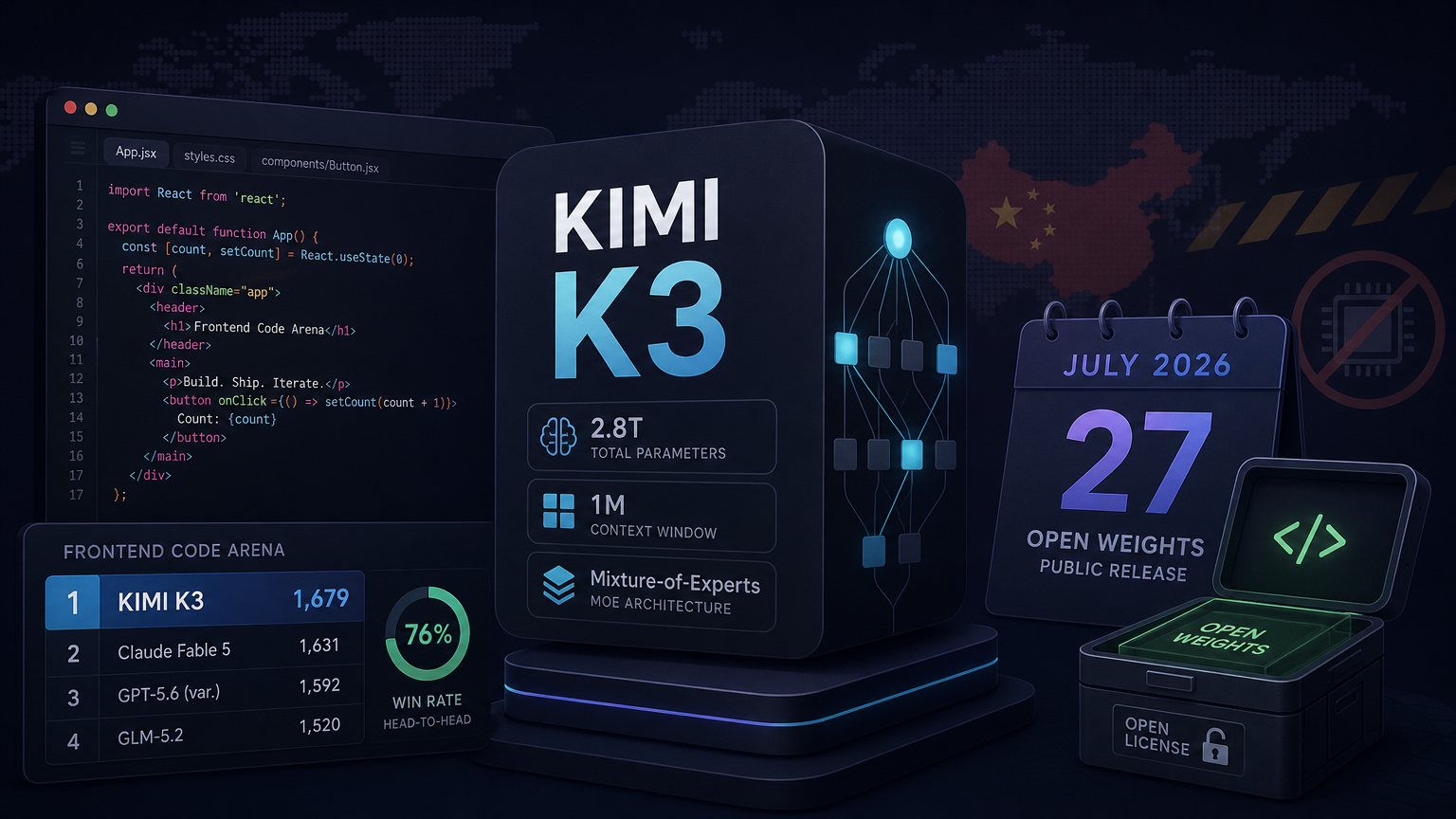
Moonshot AI's Kimi K3 reached first place on Arena.ai's Frontend Code Arena on July 16, 2026. It scored 1,679, ahead of Anthropic's Claude Fable 5 at 1,631, GPT-5.6 variants, and Z.ai's GLM-5.2. The reported head-to-head win rate against Claude Fable 5 was 76 percent.
The Frontend Code Arena result gives teams a reason to test the model. Moonshot's plan to release the full weights publicly on July 27 gives them another: the possibility of running that capability on their own infrastructure. As of July 19, the weights release is still ahead, and the exact license terms haven't been confirmed.
At 2.8 trillion total parameters, Kimi K3 is being presented as the largest open-weight AI model to date. That scale makes the missing operational details important. A strong benchmark result doesn't establish how much hardware the model needs or whether it performs as well on production codebases.
What the architecture provides
Kimi K3 is a Mixture-of-Experts, or MoE, model with a 1 million token context window. Moonshot released two variants. K3 Max targets chat, reasoning, and agentic tasks, where a model carries out a sequence of actions. K3 Swarm Max targets multi-agent orchestration, coordinating work across multiple agents. Both support native multimodal input.
An MoE model routes each token through a subset of specialized expert networks rather than using the entire model for every token. That reduces the computation needed during inference, when the model generates an answer. The 2.8 trillion parameter count describes the whole model, not the portion used for each token.
Moonshot hasn't published the active-parameter count. That leaves a major gap for anyone estimating the cost of running Kimi K3. Even a relatively small active subset doesn't remove the need to store and move the model's weights.
Moonshot identifies two architectural changes behind its efficiency claims. Kimi Delta Attention combines linear and standard attention, the mechanisms that let a model use information from different parts of its input. Standard attention has quadratic cost relative to sequence length, which becomes expensive at a million tokens. Moonshot says its hybrid approach delivers up to 6.3x faster decoding at that context length.
Attention Residuals is a separate architectural change that Moonshot says improves training efficiency by roughly 25%, with less than 2% additional cost. Together, the changes deliver a claimed 2.5x improvement in scaling efficiency over the K2 family. These are Moonshot's figures, not independently established results from production deployments.
What the leaderboard measures
Frontend Code Arena compares models generating real, runnable frontend implementations. Evaluators, whether human or model-based, choose the output they prefer. That makes the result useful for judging a specific kind of coding work, rather than relying only on a synthetic test score.
A 76 percent pairwise win rate against Claude Fable 5 across a broad set of frontend tasks is a substantial result. Kimi K2.6, the predecessor, scored 1,515 and ranked 18th. Moving to 1,679 and first place suggests a meaningful improvement on the tasks this benchmark measures.
The scope still matters. Preference between frontend implementations doesn't establish performance on backend systems, infrastructure tooling, domain-specific codebases, or complex agentic workflows. It also leaves questions about code whose correctness can't be judged from its visible behavior or appearance.
Benchmarks can reward optimization for the test rather than the capability a team needs. This result is a good reason to evaluate Kimi K3, but it isn't a deployment recommendation. Public API access began on July 16, leaving little time for broader testing by July 19.
TechCrunch reported expectations that Kimi K3 would close the gap with Anthropic's Opus 4.8 more broadly. Evidence for backend work and complex reasoning across multiple files remains a separate question. The reported 76 percent win rate applies specifically to frontend tasks.
Efficiency under export restrictions
Moonshot is an Alibaba-backed company based in China. US export restrictions limit its ability to purchase NVIDIA H100s, Blackwells, and other advanced data center GPUs at scale. Fortune described Kimi K3's arrival as evidence of Chinese AI moving into Claude Fable-level capability territory despite those hardware constraints.
One premise behind chip restrictions is that limiting access to compute will limit AI capability development. Kimi K3 doesn't settle whether that approach is working. Moonshot's training hardware and the full efficiency of its training process aren't publicly clear. A model can achieve a strong result while still being slowed or made more expensive by restrictions.
The architectural claims do offer a possible explanation for continued progress. If the reported training gains hold, they would reduce the compute needed for a given level of capability. Faster decoding would also reduce some inference costs. Such improvements could make compute restrictions less limiting, although they don't show that the restrictions have no effect.
The reasonable interpretation is that export controls may be slowing development without stopping it. The leaderboard alone can't establish how large that effect is.
What access to the weights could change
Public weights would let organizations evaluate deployment options that a proprietary API doesn't offer. The practical value depends on the license, available hardware, and performance on the intended workload.
- Self-hosted code generation. For teams able to operate a large MoE model, Kimi K3 could provide a competitive alternative to paying a closed provider per token. The frontend result supports testing that option. It doesn't establish parity across all coding tasks or show that self-hosting will cost less.
- Keeping code within an organization's systems. Financial services firms, defense contractors, and regulated healthcare organizations may face strict limits on sending code to outside providers. A strong self-hosted model could reduce the capability tradeoff or the need for complex workarounds, provided its deployment meets those requirements.
- Fine-tuning on internal code and data. Access to the weights would allow customization beyond what a proprietary API permits. Fine-tuning can reduce a model's general capability while improving performance on a narrower task. Kimi K3's stronger starting point could make that tradeoff more acceptable, but results from fine-tuned versions are still needed.
- Dedicated multi-agent evaluation. K3 Swarm Max is intended for agent coordination. That is a distinct design choice worth testing separately from K3 Max. Success in frontend generation doesn't demonstrate that the orchestration variant handles long, interdependent workflows reliably.
Hardware and licensing remain open questions
The first practical question is what an inference cluster needs to run the model. Until the weights are public and independent teams test them, Moonshot's efficiency claims provide an incomplete basis for capacity planning.
MoE compute savings don't translate directly into equivalent memory savings. Expert routing, the KV cache that stores attention information during generation, and communication between experts all add overhead. A million-token context can put additional pressure on the system. The claimed 6.3x decoding improvement needs testing on real hardware and workloads before it becomes a dependable planning assumption.
The second question is whether the frontend advantage survives broader evaluation. Backend services, infrastructure changes, and multi-file reasoning can fail in ways a frontend preference test won't expose. Those results would do more to establish suitability for software teams than another small movement in the same leaderboard.
The third question is the license. Moonshot plans a public release under an open license, but hasn't confirmed the terms. Apache 2.0 or a similarly permissive license would allow broad commercial use subject to its conditions. Restrictions on commercial use or redistribution would materially change the options for enterprise adoption. Access to weights alone doesn't answer those questions.
The managed API decision
Kimi K3's launch follows Thinking Machines' July 15 release of Inkling, a 975 billion parameter multimodal model from Mira Murati's lab under Apache 2.0. Two large releases in the same week add to the options available outside closed-model APIs.
As open-weight models become competitive on more tasks, capability becomes a less decisive argument for using a managed API. Operational simplicity and support still have value. Running an inference cluster means owning the hardware requirements, deployment work, and ongoing operation, even when the weights are freely available.
Kimi K3 needs workload-specific evaluation once the July 27 release makes self-hosted testing possible. Hardware measurements, license terms, and results on representative code will determine whether its frontend benchmark lead translates into a practical infrastructure choice.