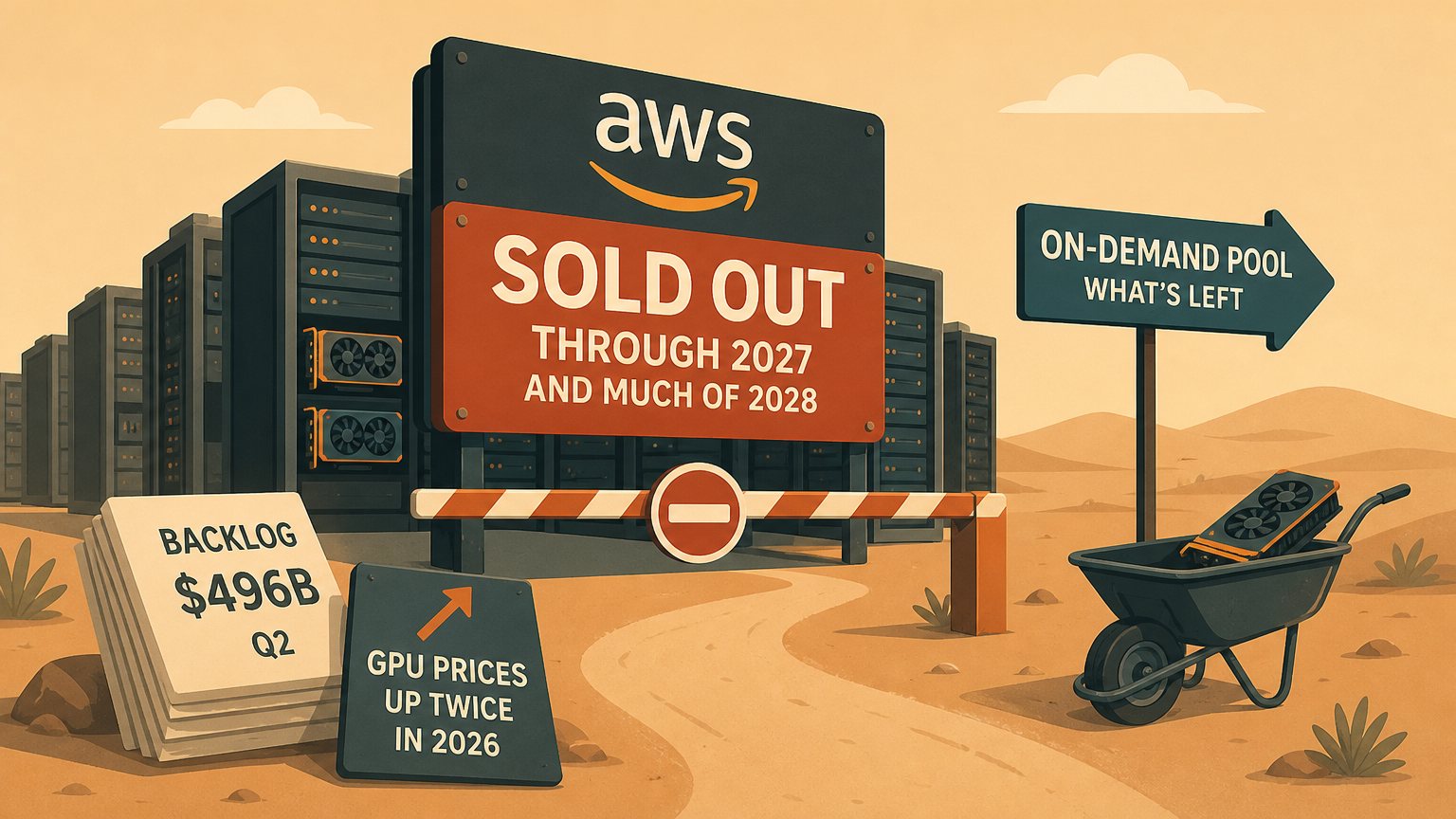
Andy Jassy said on October 23 that AWS compute capacity is sold out through 2027, and "a good chunk of 2028" is gone too. He said it on a video podcast with Ben Horowitz and Erik Torenberg of Andreessen Horowitz, and Reuters picked it up the same day. Amazon reports third quarter results on October 29, so the number behind that sentence will be public within a day of this post.
The sentence needs a qualifier, and Jassy gave one. "We always leave a certain amount for on demand and our inference service Bedrock, or EC2." So the sold out part is the committed, contracted, reserved capacity that AI labs and large enterprises sign for years in advance. The pool you and I draw from when we launch an instance still exists. It's just not growing at the rate the demand is.
The numbers behind the sentence
The July earnings call already said most of this, and nobody outside the analyst crowd paid attention. AWS revenue in the second quarter was $42.2 billion, up 37% year over year, the fastest growth in 18 quarters. Backlog, meaning contracted commitments customers have signed but not yet consumed, went from $364 billion to $496 billion in a single quarter. That is $132 billion of new commitments in 90 days, per TechTimes' summary of the call.
Jassy said then: "We will still not have enough capacity to meet all the demand we have in 2026. And I believe this dynamic will also be true in 2027, too." He added that the demand Amazon already had for 2028 was "striking." The October podcast repeated the July call with less hedging.
Amazon also raised its 2026 capital spending guidance from about $200 billion to about $220 billion, and the reason given was memory. Contract prices for DRAM rose through 2026 as memory makers shifted wafers to high bandwidth memory for accelerators, which pays more per wafer. The extra $20 billion is the same servers at higher prices, not more servers. That matters when you're trying to figure out whether the shortage eases next year. It doesn't ease if the money buys less hardware.
Jassy's constraints are power and memory, plus the buildings to put them in. Amazon says it will double its 2025 power capacity by the end of 2027. If demand grows faster than two times in that window, and the backlog says it will, doubling doesn't close the gap.
What sold out looks like from the console
Nobody at AWS is going to email you that capacity is tight. You find out when a launch fails with InsufficientInstanceCapacity, or when the price goes up.
The price has gone up twice this year. AWS raised EC2 Capacity Blocks for ML pricing by about 15% in January and about 20% on July 1, per Tech Insider's compilation of the pricing pages. The July change hit the P6-B300, P6-B200, P5, P5e, P5en and P4de families. A p5e.48xlarge in Ohio went from $34.61 an hour to $39.80 in January alone. AWS called it a "periodic pricing update based on supply and demand," and the pricing page schedules the next one for January 2027. Cloud prices used to go in one direction. Reserved GPU capacity now has an annual repricing cycle, and the direction is up.
The on demand pool is where the shortage shows up for everyone else. Forum threads on AWS re:Post this year cover p5.4xlarge in us-west-2 failing with quota to spare, and g6e instances across eu-central-1 unavailable because the L40S is in demand. AWS does not publish how many of a given instance type exist in an availability zone, so the error is the only signal you get. The standard advice still holds: don't pin a zone, use capacity reservations for anything that has to launch, and keep a fallback instance family in your launch templates. Twenty years of autoscaling assumed the cloud had infinite depth. It had deep pockets, which is a different thing, and the pockets are spoken for.
Plain CPU instances aren't in that state. Jassy's on demand reserve is real, and an m7i still launches. But the AI commitments and the general purpose fleet share the same buildings and the same power contracts. Every rack that goes to a committed GPU customer is a rack that doesn't go to the general pool. When the two compete for a power allocation, the customer with a $10 billion contract wins.
Who is paying for the buildout
The capital structure changed in the same week. On October 26, Reuters reported that Bank of America, Citi, Morgan Stanley and Blackstone lined up $63 billion to finance Broadcom AI chips for Anthropic. The structure is a special purpose vehicle that buys the accelerators and networking gear, then leases them to Anthropic. The banks hold about $43.5 billion of first lien debt, Blackstone holds the second lien, and Broadcom backstops the residual value of the chips up to the first lien amount. Deliveries begin in 2027. Benzinga reported that some lenders weighed walking away and that Broadcom's Hock Tan agreed to higher rates to keep them in.
Nvidia put $3 billion into Meta's $97.5 billion equity offering the same day. Microsoft offered buyouts to about 60,000 employees, and CNBC tied it to the cost of AI and data center spending.
Read those together. The hyperscalers can't fund the buildout from operating cash alone anymore. Amazon's trailing twelve month free cash flow was negative $7.6 billion as of the second quarter, with property and equipment purchases up $66.1 billion year over year. The chips are being bought with bank debt secured by the chips themselves, with the chip vendor guaranteeing the collateral won't fall below the loan. That is how airlines buy planes. Planes hold value for 25 years. A GPU is obsolete in three to five.
If the residual value assumption is wrong, the lenders find out in 2029 or 2030, and the capacity those chips represent will have been sold to someone at a price that assumed they'd be worth something at the end.
What I'd do about it this quarter
I've run infrastructure through two previous cycles where the hosting market was supply constrained, and both ended the same way: prices went up, then capacity arrived in a wave, then prices fell for years. The AI cycle may not follow that pattern, because the constraint is power as much as hardware, and power takes a decade to permit and build. But some of the old moves still apply.
- Treat capacity errors as a planning input, not an incident. Log every InsufficientInstanceCapacity response by family and zone. After a month you'll know which families are tight in your regions, and you can move workloads before the error becomes an outage.
- Buy reservations for anything that has to launch. On demand capacity reservations cost nothing beyond the instance price if you use them. If your disaster recovery plan assumes you can launch 200 instances in a second region on short notice, test it, because that assumption is five years old.
- Price the GPU line separately in your budget, and budget for the January repricing. Two increases in one year is a trend, and AWS has told you the date of the next one.
- Keep the option to leave. Not for the AI work, where the frontier models live in one or two clouds and that's that. For the ordinary compute, the Postgres replicas and the web tier, bare metal and the second tier providers have capacity and are hungry. The gap between an AWS on demand price and a Hetzner dedicated server is wider than it was in 2020.
My prediction: Amazon's October 29 call will raise 2027 capital spending guidance again, the Capacity Blocks price goes up again in January, and sometime in 2027 a hyperscaler starts charging a premium for on demand CPU capacity in its busiest regions. The cloud was sold on elasticity. The next few years will be sold on who has a contract.