GitLab published fixes for a critical GraphQL vulnerability on August 17, 2026. Exploitation on honeypots was observed within hours. For teams running affected self-managed instances, waiting until the next scheduled maintenance window could leave the service exposed while attacks were already underway.
Three days later, Microsoft disclosed a maximum-severity flaw in Entra ID and said no customer action was required. Microsoft had patched the service centrally before disclosure. As of August 22, these two reports show how much the responsibility for responding to a vulnerability depends on who operates the affected infrastructure.
What the GitLab flaw allows
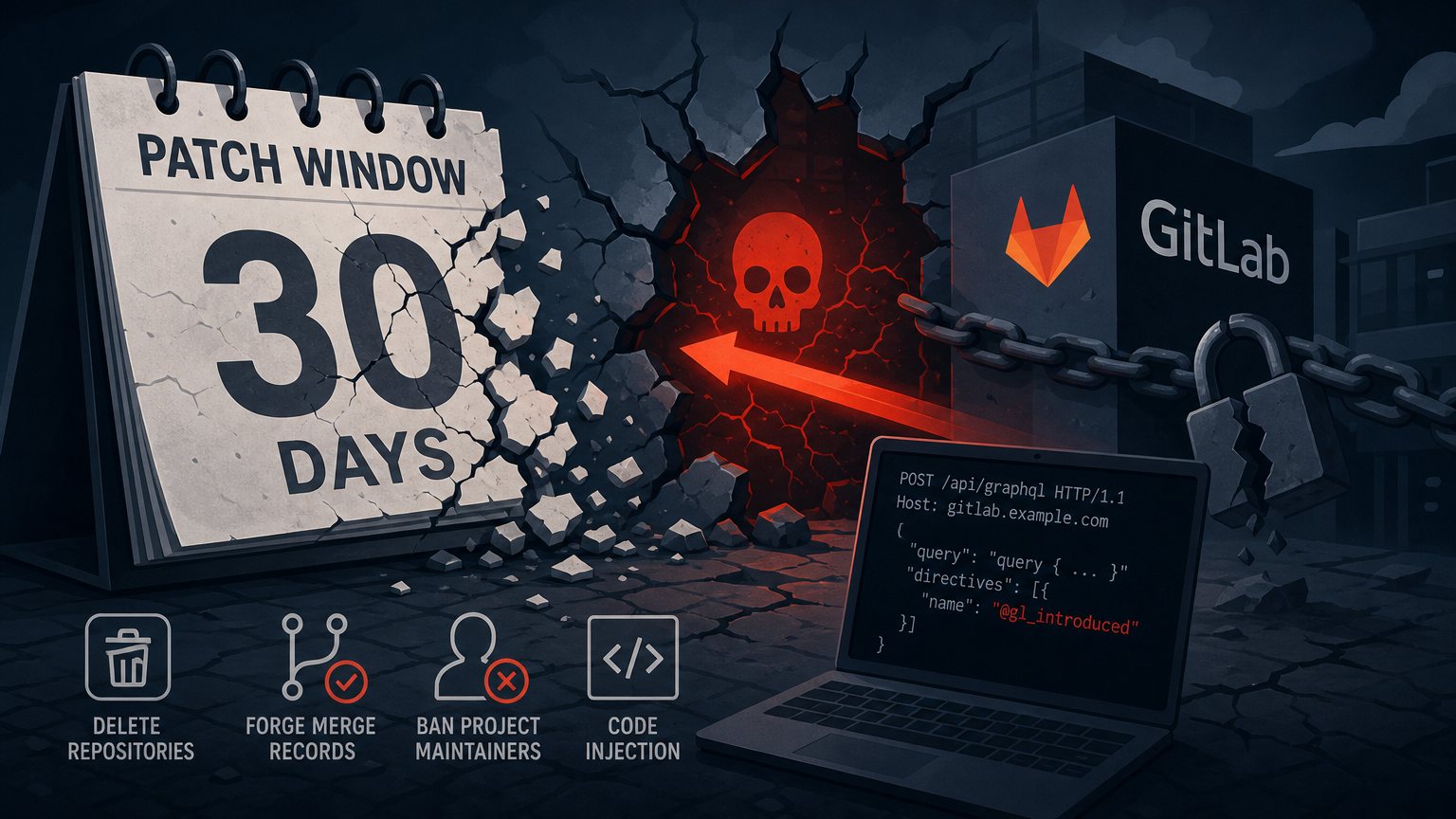
CVE-2026-19478 is a code injection vulnerability with a CVSS score of 9.4. It affects the GraphQL @gl_introduced directive. An unauthenticated remote attacker can exploit it with a single crafted HTTP POST request to /api/graphql. No credentials or user interaction are required, only network access to the endpoint.
The reported capabilities go well beyond disrupting a web service. Attackers can delete repositories, modify repository state, forge merge records to make code appear to have completed review, and ban project maintainers. Removing maintainers can also interfere with the people responsible for noticing and responding to the attack.
For an organization that uses GitLab to run its continuous integration and delivery pipeline, those consequences can be as disruptive as a maximum-severity incident. The formal CVSS score remains 9.4, but the operational risk includes both lost source code and damaged trust in the review process.
The patched versions are 19.2.4, 19.1.6, 19.0.8, and 18.11.11. The reported affected range covers versions 18.2 through 19.2 without the applicable fixes. Updating an affected self-managed instance should be an immediate priority.
The published detection signal is @gl_introduced in requests to /api/graphql. Teams should check available web and request logs for that pattern and investigate matching activity. Its usefulness depends on whether the logging system captures the relevant request content.
The response window was shorter than a business day
GitLab disclosed the flaw and released patches on August 17. The security firm watchTowr reproduced the vulnerability within minutes of public disclosure, and exploitation on honeypots followed within hours. Security researcher Jake Knott attributed the shorter timeline to AI-enabled attackers' ability to compress the time between disclosure and exploitation.
A patch process built around a 30-day deadline assumes there will be enough time to assess severity, test in staging, coordinate a rollout, and wait for maintenance. That assumption fails for a publicly reachable service when exploitation begins on the day of disclosure.
The concern about AI-assisted exploit development is practical. Tools that help analyze an advisory, reproduce a flaw, generate exploit variants, and scan for vulnerable instances could shorten the work between each stage. For CVE-2026-19478, the reported disclosure-to-exploitation interval was already shorter than a business day.
That timeline doesn't make scheduled maintenance useless. It does mean that scheduled maintenance cannot be the only route for deploying a critical security fix. An emergency process has to work while the service is under potential attack, rather than begin with several days of planning.
Entra ID put the patching responsibility elsewhere
On August 20, Microsoft disclosed CVE-2026-69836, a deserialization-of-untrusted-data vulnerability in Microsoft Entra ID, formerly Azure AD. This class of flaw involves software processing attacker-controlled serialized data unsafely. The reported result was remote code execution over the network without authentication or user interaction.
The vulnerability received a CVSS score of 10.0, higher than the GitLab flaw. Microsoft's advisory nevertheless said that no customer action was required.
Because Microsoft operates the underlying Entra ID infrastructure, it deployed the fix centrally before public disclosure. According to the report, the vulnerable code had been removed from production by the time the CVE number was assigned and the bulletin became public. Customers didn't need to deploy a patch or arrange an emergency maintenance window.
Microsoft later clarified that the vulnerability had not been exploited, despite initial advisory language suggesting exploitation in the wild. The company said its internal detection had identified the issue during remediation review. That clarification is important: the account describes a centrally remediated vulnerability without reported exploitation, rather than a customer patching race.
Self-managed infrastructure requires a fast response team
There are sound reasons to operate GitLab directly. Data sovereignty requirements, air-gapped environments, and compliance rules may prevent third-party hosting of source code. At sufficient scale, the cost of self-managed infrastructure may also be favorable. Those constraints don't disappear because a managed service can patch centrally.
Self-management does, however, assign the security operations work to the organization running the service. Someone must monitor advisories, assess exposure, maintain tested rollback procedures, and deploy urgent fixes. For a flaw like CVE-2026-19478, that commitment is measured in hours.
The useful comparison between self-managed and managed services therefore includes response capacity. A team may have good reasons to retain control of its source hosting while still lacking a reliable way to patch it on short notice. That gap needs to be addressed as part of the operating model and its cost.
The Entra ID example shows one advantage of a managed service: the operator can fix the shared infrastructure without waiting for each customer to act. It doesn't establish that managed services are always more secure. It shows where the patching responsibility sits and how that can change customer exposure after disclosure.
Changes that help self-managed teams respond
The same operational questions apply to GitLab, Gitea, Kubernetes clusters, identity providers, and other self-managed components. Several parts of the response need to be ready before an advisory arrives:
- Receive vendor advisories directly. Critical services such as source control, CI/CD, identity, and secrets management need same-day alerts. GitLab's security release page, GitHub's security advisories, and Linux vendor errata feeds are examples. A weekly digest is too slow for a vulnerability being exploited within hours.
- Keep an emergency patching route separate from routine maintenance. A critical CVSS 9+ advisory needs prompt assessment and, where applicable, same-day patching. The procedure should be rehearsed and automated enough to run without waiting for a full change board meeting. Tested rollback steps should be part of that preparation.
- Prepare network restrictions that can be applied quickly. For the GitLab flaw, restricting unauthenticated access to
/api/graphqlis described as an immediate mitigation while patches are staged. Such controls provide another way to limit exposure when a software deployment takes longer. They should support patching rather than become a reason to defer it. - Make advisory-based detection routine. The
@gl_introduceddetection pattern was reportedly published alongside disclosure. A useful operational target is to turn an advisory's indicator into a working rule in log analysis tooling within an hour. That requires suitable logs, access to the tooling, and a known deployment process. - Review the self-managed inventory regularly. A six-month review can check whether each component still justifies its operating burden. Some services will remain self-managed for strong technical or regulatory reasons. Others may be retained mainly because of an old decision whose justification no longer applies.
Affected GitLab operators need to install the applicable fix and investigate requests containing @gl_introduced. After that response, patch planning needs to allow for exploitation of an exposed critical service to begin before the next business day.