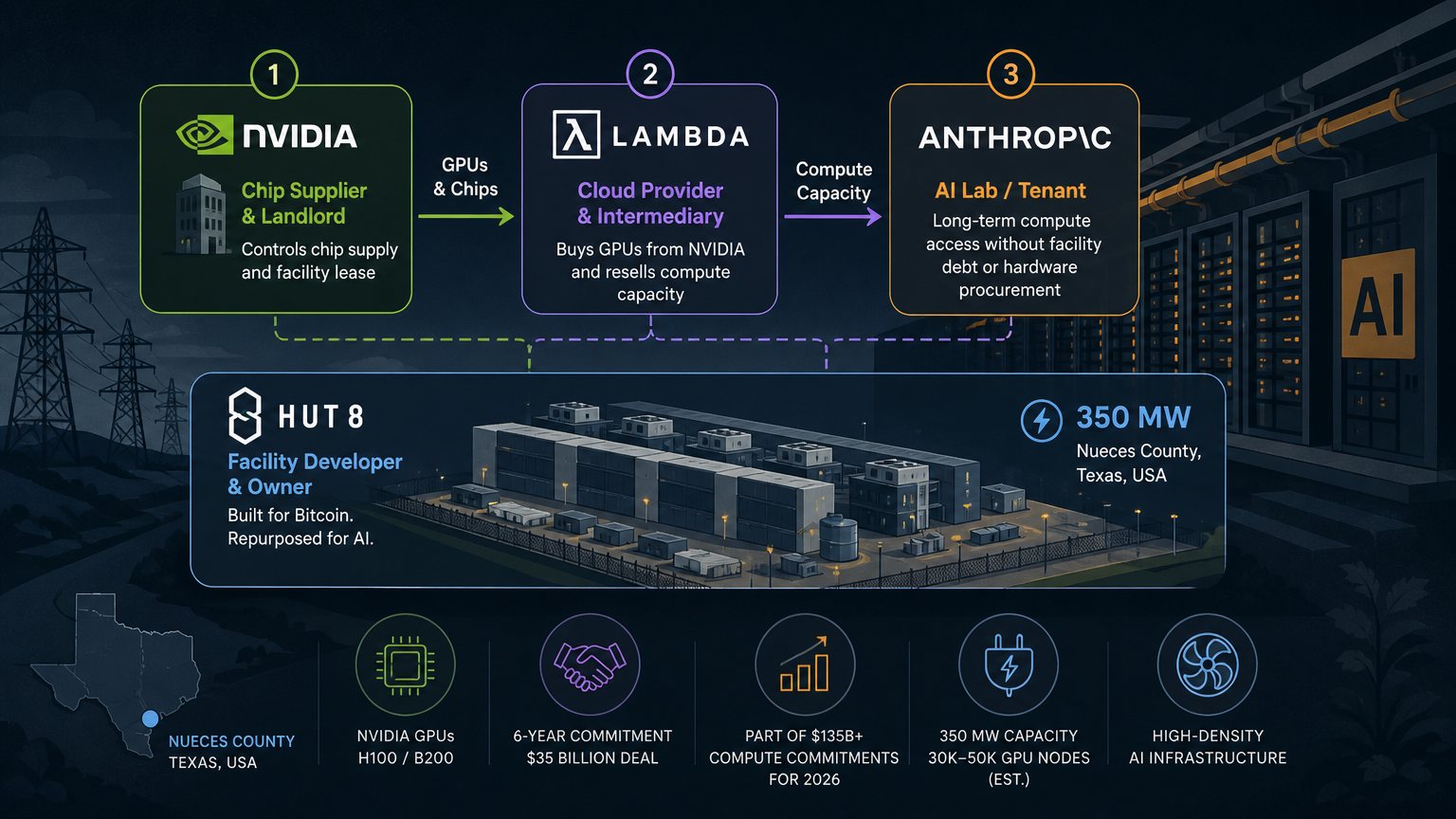
Anthropic signed a six-year, $35 billion contract with Lambda on September 1, 2026, for GPU capacity in Texas. According to Bloomberg and CNBC, Nvidia holds the facility lease and controls the chip supply. Lambda, a cloud provider backed by Nvidia, buys the GPUs and sells access to Anthropic.
The arrangement gives Nvidia a role beyond selling hardware. It also connects the facility’s credit structure to the company supplying the chips. Anthropic gets a long-term compute commitment without taking on facility debt or managing hardware procurement.
How the contract divides responsibility
The three companies occupy different positions:
- Nvidia holds the facility lease and supplies the GPUs.
- Lambda purchases the hardware from Nvidia and provides cloud capacity to Anthropic.
- Anthropic commits to buying compute for six years while leaving the facility and procurement work to the other parties.
The site is in Nueces County, Texas, with about 350 megawatts of data center capacity built by Hut 8. The company started as a Bitcoin miner and now converts that infrastructure for AI workloads. The building was already there; the economics of renting AI capacity made refitting it worthwhile.
Bloomberg described the structure as one that “minimizes risks for Anthropic, which has yet to achieve an investment-grade rating, by linking credit and chip supply to Nvidia.” An investment-grade rating signals a relatively low risk of default to lenders. Without that rating, financing a facility of this size can be harder or more expensive.
Nvidia’s position resembles that of a cosigner, although that is an analogy rather than a description of a disclosed legal guarantee. The hardware vendor is also supporting the credit structure behind the cloud provider and holding the building’s lease.
A larger set of compute commitments
The Lambda contract wasn't Anthropic’s largest agreement that day. It also signed a $45 billion deal with Nscale, a London-based GPU cloud operator. Including agreements made earlier in the year, Reuters put Anthropic’s compute commitments above $135 billion for 2026.
That is an enormous amount of capacity for a single AI lab to reserve. Microsoft, Google and Meta have each committed hundreds of billions over similar timeframes.
Long contracts can affect customers far outside the frontier labs. Reserving capacity six years ahead can leave fewer GPUs available for short-term rental and give smaller providers less room to secure chip allocations. Teams waiting for prices to fall may find that the capacity they need is already committed.
Why former Bitcoin sites are being converted
Hut 8’s role helps explain where some of this capacity comes from. Reusing an existing industrial site avoids starting every part of a project from scratch, particularly when a large power connection is already in place.
Large Bitcoin mines need substantial electrical feeds, dense equipment installations and heavy cooling. GPU clusters have demanding power and cooling requirements too. As renting GPUs became more attractive than proof-of-work mining, some miners found another use for their sites.
Hut 8’s Texas conversion is one example. Former mining sites across the US and Canada are also being refitted for AI workloads. That makes powered industrial property part of the GPU expansion, alongside purpose-built data centers. Operators such as Lambda can provide the cloud service while another company develops or converts the facility.
What 350 MW means for the hardware
For comparison, a typical enterprise data center draws roughly 1 to 10 MW. Large hyperscale sites are often described in the 100 to 200 MW range. A 350 MW complex is a substantial power commitment even against those figures.
The estimated hardware capacity is between 30,000 and 50,000 nodes, depending on the GPU generation and system configuration. That estimate shouldn't be read as a disclosed equipment count. Training a frontier model can occupy a cluster of that size for months. The capacity described here is dedicated to one type of workload rather than spread across thousands of unrelated cloud customers.
The rack-level demands are also high. AI clusters can run at 80 to 100 kW per rack and are pushing toward 200 kW with liquid cooling, compared with the 10 kW racks common in an earlier generation of hosting. At this scale, power delivery, heat removal and arrangements with the grid become major constraints alongside the software.
The effect on GPU availability and prices
Lambda needs tens of thousands of Nvidia GPUs to fulfill the contract. That demand draws on production that could otherwise serve CoreWeave, AWS, short-term GPU rental providers or other inference services. H100s and B200s are examples of the Nvidia hardware competing for that broader demand, rather than a confirmed inventory for this site.
Large commitments can push prices and availability in different directions. Predictable demand helps a provider forecast utilization and recover its fixed costs. That can leave room to offer spare capacity at lower prices. Inference API prices have fallen an estimated 90 to 97 percent over two years, depending on the model tier. Competition contributes to those declines; committed utilization may also help providers price unused capacity more cheaply.
But a long-term contract also removes capacity from the pool available on short notice. Teams that depend on temporary GPU access for training or batch jobs can end up waiting. Shortages in 2023 and 2024 showed that risk. The current commitments suggest another period of tight availability is possible, though they don't establish when or where it would occur.
A financing structure with hardware risk
The deal resembles commercial real estate finance. Hut 8 develops the facility, Lambda operates the service, and Anthropic signs a long commitment. Nvidia holds the lease and supplies the equipment. In that analogy, Nvidia takes a position similar to a senior financing party, though holding a lease alone doesn't establish that it is a senior lender or owns the collateral.
The economic pressures are familiar: large upfront costs, long payback periods and assets that may be difficult to sell if demand disappears. GPUs add a further problem because they depreciate quickly as newer generations arrive.
For Nvidia, the structure secures chip demand while extending its involvement into the facility and credit arrangements. The argument is that companies controlling chip supply and access to facilities could capture a growing share of AI infrastructure spending. That remains a judgment about where the market is heading, rather than an outcome established by this contract.
Several developments will test it. Anthropic could move toward owning facilities if it achieves an investment-grade rating, following the broader path from tenancy to ownership taken by Microsoft and Google. Lambda and Nscale will also have to manage their exposure if demand growth stalls for even a year while their hardware continues to lose value. Other labs may copy the arrangement or find ways to own their GPUs without taking on facility debt.
A plausible prediction is that Anthropic will own a site of this size outright before the six-year Lambda contract is halfway through. Until then, the lease and chip supply leave Nvidia with an unusually broad role in delivering Anthropic’s compute.