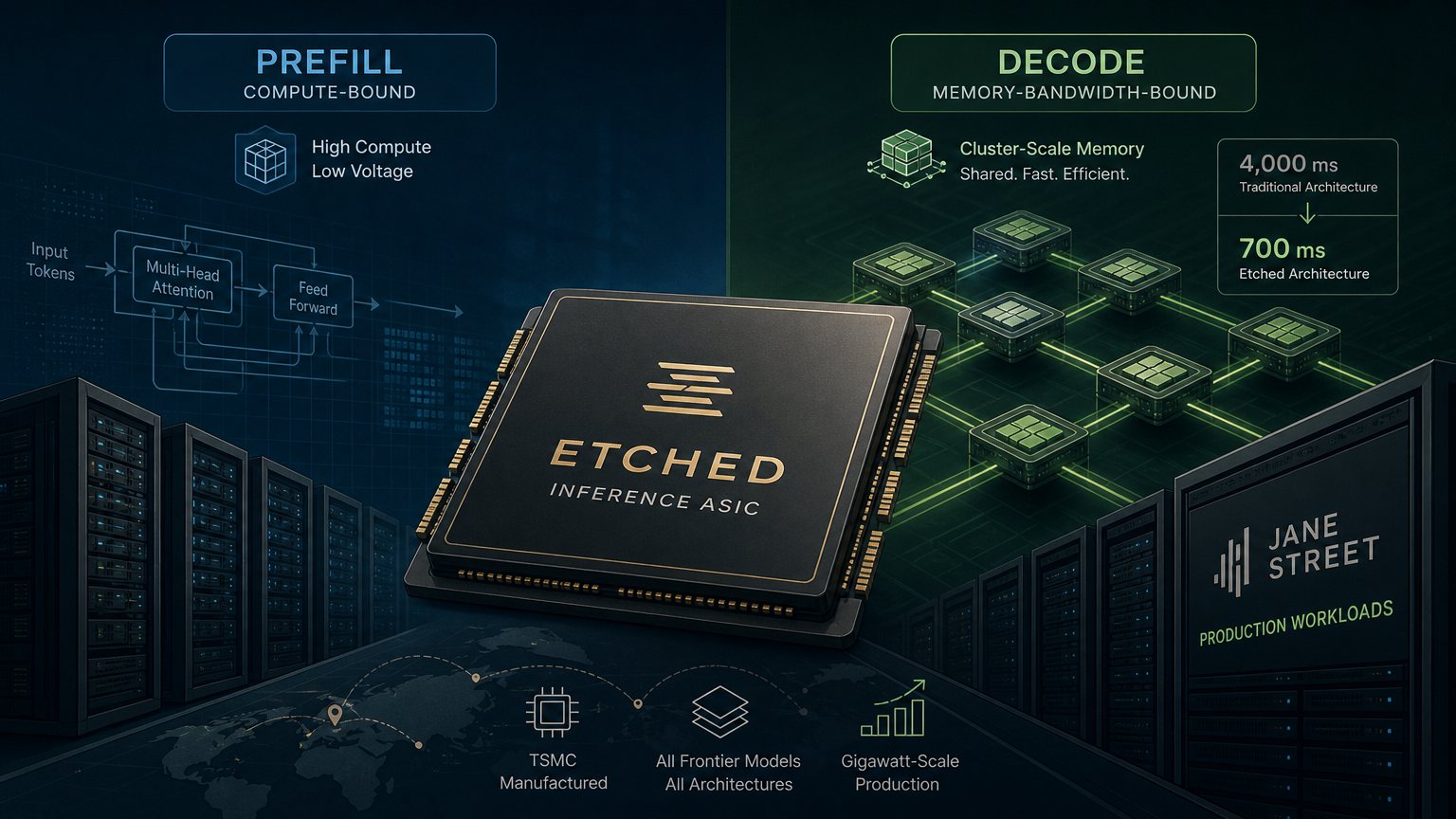
Etched announced on August 18, 2026, that it had raised $700 million at a $21 billion valuation and delivered its first rack to Jane Street. According to the announcement, the rack was already running production workloads in the trading firm's own data center.
For the four-year-old chip startup, the deployment is more useful evidence than the valuation. It puts Etched's purpose-built inference hardware into a customer environment, beyond a benchmark lab. Jane Street is also the round's lead investor, so the deployment and financing are closely connected.
The case for Etched is that inference has enough different requirements from training to justify dedicated silicon. Its application-specific integrated circuits, or ASICs, give up the flexibility of a general-purpose accelerator in exchange for a design focused on serving models. Whether that trade pays off depends on more than chip performance. Customers also need workable software and racks that can be delivered in volume.
Why inference needs a different balance
Training and inference both involve large amounts of matrix computation, which helps explain why Nvidia's H100, H200 and Blackwell accelerators serve both workloads. But the performance constraints differ.
During training, a system processes large datasets and updates a model's parameters over days or weeks. Keeping its arithmetic units busy, measured in floating-point operations per second, is a major concern. Memory bandwidth matters too, but the system generally isn't trying to return an answer to an interactive user within a tight response window.
Inference has to serve requests repeatedly. For an interactive application, the delay before the first token and the speed of subsequent tokens both affect the experience. Batching requests can improve throughput, but it doesn't remove the need to respond promptly to each user. Quantization, which uses lower-precision representations to reduce computation and memory use, can help without eliminating the underlying memory constraints.
The economic distinction is recurring cost. Training produces a model through a large upfront computation; serving that model adds cost with every request. That makes inference efficiency a continuing constraint on which features can be offered and at what price.
Etched's design separates inference into two stages, prefill and decode, and addresses their different hardware requirements.
Compute for prefill, memory for decode
Prefill processes the prompt and builds the key-value cache, usually shortened to KV cache. This cache stores intermediate attention data that the model can reuse while generating its response. Prefill is generally compute-heavy and resembles training more closely than the generation stage does.
Etched says its math blocks run at under half the voltage of most AI accelerators. Its stated aim is to fit more computation into the available power, thermal and die-area budgets. That is the compute side of its inference design.
Decode is the autoregressive stage, where a model generates one token at a time. In conventional full-attention serving, each step reads the cached keys and values for the active sequences. This repeated access can make memory bandwidth the main limit on performance.
Etched calls its approach cluster-scale memory. The design uses an interconnect that lets multiple chips pool and share memory at low latency. A report on the announcement describes communications tasks taking 700 milliseconds on Etched's hardware, compared with 4,000 milliseconds on competing chips. That is a substantial reported difference for those tasks, though it doesn't by itself establish an equivalent improvement in end-to-end model serving.
TSMC fabricates the chips, and Etched's first prototypes came back in June 2026. The company also claims support across frontier model architectures, including standard transformers, Mixture of Experts models such as DeepSeek and Qwen, and non-transformer designs such as Mamba.
That breadth matters because an inference deployment may need to serve different model families over its lifetime. Hardware tied too closely to one architecture can become an expensive constraint when a better model requires a different execution pattern. Claimed model support still needs to translate into practical deployment support.
What Jane Street establishes
The company announcement says Jane Street's rack was running production workloads in its own data center before the fundraising announcement. That sequence gives the hardware a concrete commercial milestone: a customer had received it and put it to work.
Jane Street's automated trading business makes latency, reliability and predictable hardware behavior particularly relevant. Its participation is a meaningful early signal for Etched. Still, the reported deployment doesn't identify the workloads or provide enough operational detail to judge how the hardware would perform across other customers' serving systems.
The financing moved quickly. Etched closed a $300 million Series C at a $10.3 billion valuation on July 23, 2026. The August 18 announcement came exactly 26 days later, with a valuation more than twice as high.
Alongside lead investor Jane Street, the new round included Kleiner Perkins, Sequoia, Andreessen Horowitz, Tiger Global and Blackstone. Etched's total funding is now approximately $2 billion.
The company reports more than $1 billion in signed customer contracts across frontier AI companies and cloud providers. Those contracts represent backlog rather than an installed base. They give Etched a reason to fund a production ramp, but delivering and supporting the contracted systems remains a separate task.
The software cost of leaving GPUs
Other AI chip companies have shown how difficult it is to turn hardware performance into broad adoption. Graphcore struggled to challenge Nvidia. Cerebras has posted strong speed results while remaining a niche supplier, and Intel Gaudi has faced software ecosystem friction despite its enterprise backing. A good benchmark doesn't remove the work of moving a production system.
Etched's argument is that a design focused on inference can create a large enough performance and efficiency advantage to justify that work. This is a credible architectural bet. It is also a demanding commercial threshold: customers need savings that exceed the cost and risk of switching.
Google's TPUs offer a useful comparison. Google built hardware around the operations its workloads needed rather than reproducing a GPU's full flexibility. It developed TPUs for its own infrastructure rather than selling them as merchant silicon. Etched is attempting to sell specialized inference hardware to outside customers, whose software and operating requirements will vary.
Nvidia's advantage includes years of CUDA tooling, optimized kernels and developer familiarity. Supporting a model's architecture is only the starting point for competing with that ecosystem. Deployment teams also need an integration layer that fits their existing serving workflows without extensive rewrites.
Over the next six months, support for stacks such as vLLM, TGI and Triton deserves close attention. A team that can direct an existing workload to an Etched cluster faces a very different decision from one that needs a six-month porting project. Ease of integration could determine how much of the hardware advantage reaches customers.
Costs and production capacity
If Etched can deliver its claimed efficiency at production scale, the effects would reach application design. Lower inference costs could make longer context windows affordable, reduce pressure to use smaller models and allow features that otherwise cost too much to serve. Those benefits depend on the cost of the complete deployed system, including software and operations.
A credible alternative could also put pressure on Nvidia's inference pricing. A customer with measured rack costs, throughput and power consumption has a stronger basis for comparing an Etched deployment with H200 hardware. Software optimization can reduce GPU costs, but an alternative hardware supplier adds another option to that purchasing decision.
Etched says the new funding will support gigawatt-scale production ambitions, global supply chains and manufacturing capacity. TSMC has produced the initial chips, but moving from prototypes and a first customer rack to dependable volume delivery is a much larger undertaking. Fabrication relationships and supply-chain capacity will matter as much as the architecture during that ramp.
The Jane Street deployment supports the case that purpose-built inference hardware can find a production customer. The next tests are broader: delivering the contracted systems, showing repeatable performance across workloads and making the software practical enough that customers can use the chips without rebuilding their serving infrastructure.