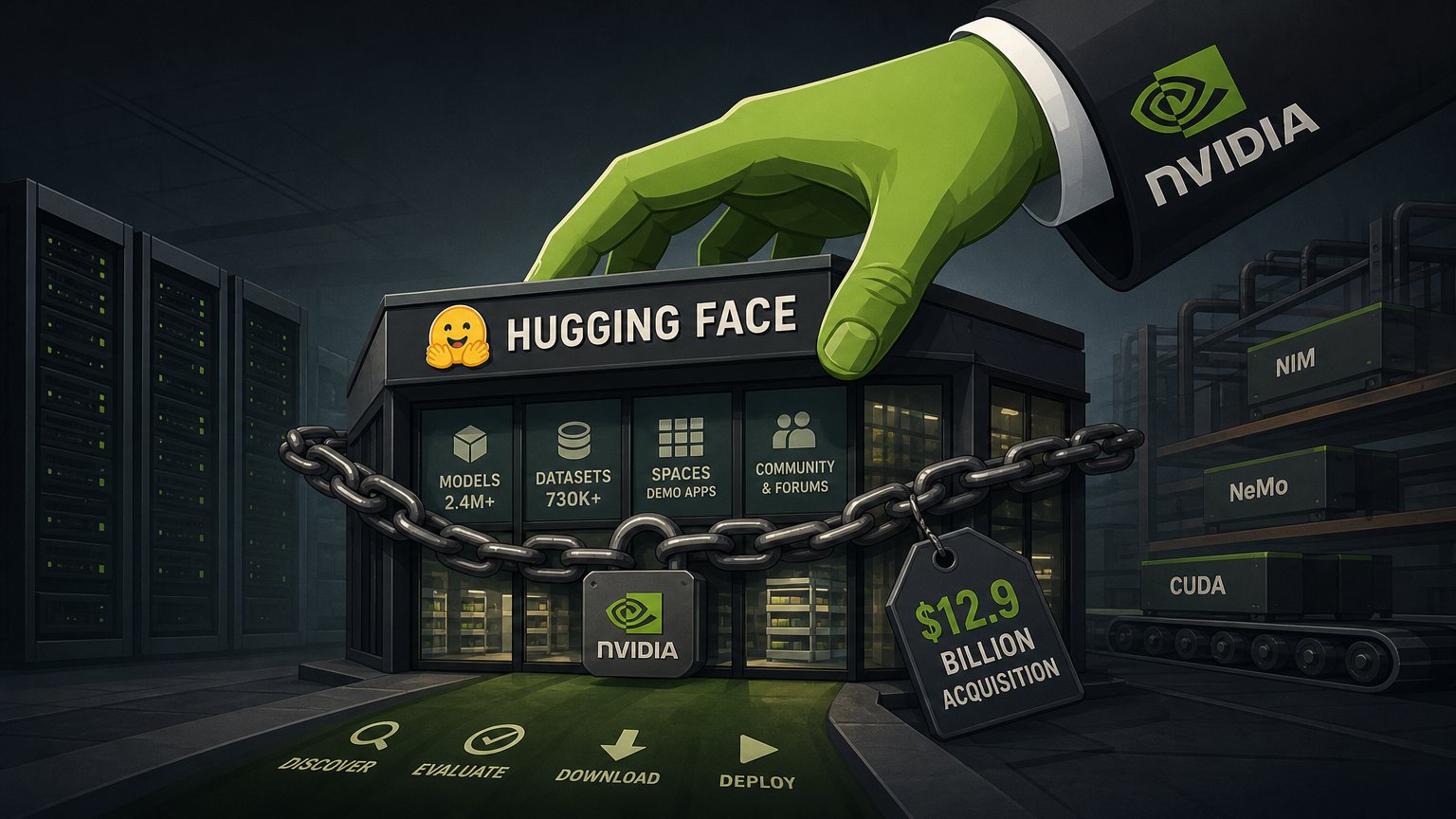
Reports published late on August 27 said Nvidia had largely agreed to acquire Hugging Face for $12.9 billion. As of August 28, neither company had officially confirmed the transaction, both had declined to comment, and a signed agreement was reportedly still pending.
The Information broke the story first, followed by reports from CNBC, Bloomberg, and Reuters. Sources described as having direct knowledge of the terms said the transaction was largely agreed upon.
If it closes, Nvidia would own a platform that many AI teams use to discover, evaluate, and download models. The company supplying their GPUs would also control an important part of their software distribution infrastructure. That creates practical questions about platform independence, pricing, and how much of a production pipeline should depend on one supplier.
Where Hugging Face fits in a production pipeline
Hugging Face is more than a website for browsing model cards. As of January 2026, its Hub held over 2.4 million models and 730,000 datasets. Teams use it to find models, read evaluation benchmarks and community notes, and download weights directly into training and inference pipelines. Weights are the learned parameters needed to run a model.
The platform also hosts Spaces, small applications that researchers use for demos and evaluators use for side-by-side comparisons. Its role covers both distributing software and helping people decide which software to use.
The transformers library treats Hugging Face as a first-class distribution mechanism. A call such as from_pretrained("mistralai/Mistral-7B-v0.3") can download weights from Hugging Face’s content delivery network. Continuous integration jobs, evaluations, and deployment processes can all depend on that access.
In that sense, Hugging Face combines parts of the roles served by pip, npm, and Docker Hub elsewhere in software development. For a pipeline that fetches models from the Hub at runtime or during deployment, an outage or degraded service can become a production problem.
What the reported price suggests
Hugging Face was valued at $4.5 billion in a 2023 funding round. The reported $12.9 billion acquisition price is nearly three times that valuation.
According to TechCrunch’s reporting, Nvidia approached Hugging Face in late 2025 with a proposed $500 million investment that would have valued the company at roughly $7 billion. Hugging Face’s leadership rejected that proposal. The reporting doesn't establish what changed between that rejection and the current talks.
At annualized revenue of around $150 million, the reported acquisition price would be roughly 86 times revenue. That multiple suggests Nvidia would be paying primarily for Hugging Face’s strategic position rather than its current revenue. Control of a widely used model distribution platform could help Nvidia strengthen its existing hardware and software business while keeping the platform out of a competitor’s hands.
Ownership would change the incentives
Nvidia already has a commercial interest in which models succeed. Owning Hugging Face would give it a more direct role in how those models reach developers.
A platform under Nvidia’s control could give more prominent placement to models optimized for CUDA, suited to H100s and B200s, or showcased at GTC. Community models tuned for AMD ROCm, Intel Gaudi, Arm, or specialized hardware from Cerebras and Groq would be distributed through a platform owned by a hardware competitor.
That is a potential conflict of interest, not evidence of a plan to disadvantage competing hardware. No such plan is established by the acquisition reports. The concern is that ownership would create incentives that could influence search results, featured models, integrations, and product investment over time.
Microsoft’s acquisition of GitHub in 2018 offers a useful comparison. It alarmed parts of the open-source community, but eight years later GitHub remains in operation and has grown. Microsoft made commitments to independence, and many of the initial fears didn't materialize. Even so, the acquisition changed the commercial interests behind a critical developer dependency.
The same distinction applies here. Hugging Face could continue to operate well under Nvidia while gradually making choices that favor its parent company. Teams would need to watch changes in terms, pricing, and hardware support alongside ordinary measures such as uptime.
Model licenses would remain separate from the platform
Buying Hugging Face would not give Nvidia ownership of all the models hosted there. Llama, Mistral, Qwen, and Gemma are released by their respective organizations under their own licenses. A model released under Apache 2.0 would remain under Apache 2.0. Ownership of the hosting platform doesn't itself change those rights.
Nvidia would instead acquire the distribution, discovery, and community services around those models. Those include model cards, forums, trending rankings, featured sections, Inference Endpoints, and Spaces hosting.
These services influence where researchers publish their work and which implementations other developers adopt. A license may permit a model to be hosted elsewhere, but moving its surrounding discussions, evaluations, and audience is a separate problem.
PyPI offers another comparison. It doesn't own the Python packages it distributes, yet its availability and governance matter to the teams that depend on it. Model licensing and distribution independence deserve separate attention for the same reason.
Practical precautions for teams using the Hub
An unconfirmed deal doesn't call for an emergency migration. Clément Delangue and his co-founders have built Hugging Face around a commitment to open science. There is a reasonable case that Nvidia would preserve that positioning because the community’s trust accounts for a substantial part of the platform’s value.
Teams with Hugging Face in their production path can still reduce their exposure without abandoning the platform.
- Mirror model weights where the license permits it. Production systems can load approved copies from S3, GCS, or a MinIO cluster rather than depending on a fresh Hub download. The
huggingface_hublibrary’ssnapshot_download()function can create a complete local copy of a model repository. Keeping a licensed copy available is useful protection against ordinary service failures as well as ownership changes. - Evaluate alternative download sources. ModelScope, Ollama’s model library, and direct downloads from model publishers offer alternatives for popular models. Teams should establish which sources cover their dependencies before an interruption forces a switch.
- Watch Inference Endpoints pricing. Hugging Face’s hosted inference has been competitively priced. Under Nvidia ownership, pricing decisions would sit within a company that also sells the underlying GPUs. Those interests could favor Nvidia without necessarily producing better terms for customers.
- Keep non-Nvidia optimization work independently accessible. Teams fine-tuning or quantizing models for AMD or Intel hardware should retain weights and configurations somewhere other than the Hub. Access to that work shouldn't depend entirely on a competing hardware supplier’s platform policies.
How the Hub would fit Nvidia’s software business
The reported acquisition fits Nvidia’s expansion across the AI stack. Alongside its chips, Nvidia offers NIM microservices and the NeMo framework. CUDA already ties much of the inference optimization ecosystem to Nvidia tooling. Hugging Face would add a major platform for finding and distributing the models that run on that infrastructure.
The commercial logic is straightforward. Nvidia hardware works with CUDA, CUDA connects to Nvidia’s deployment tools, and those tools can run models discovered and downloaded through the Hub. Closer integration could reduce setup work and make Nvidia the easiest option at more stages of development.
That convenience has value. It can also make alternatives progressively more expensive to adopt as a team’s workflows accumulate dependencies on one vendor. The competitive strategy doesn't require misconduct to increase switching costs.
The agreement and regulatory review remain unresolved
The transaction reportedly has not yet produced a signed agreement and could still fall apart. Until the companies confirm the terms, claims that Nvidia already owns the Hub are premature.
Regulatory review would be another uncertainty. Nvidia is already under antitrust scrutiny in the EU, the UK, and the US over its position in AI chips. An acquisition combining a leading model repository with a dominant AI training hardware supplier would likely draw close attention. The potential effect on competing hardware vendors deserves that scrutiny.
Teams using Hugging Face need to identify which production processes require live Hub access, which models can be retrieved elsewhere, and which platform services would be difficult to replace. Knowing those dependencies remains useful even if the deal never closes.