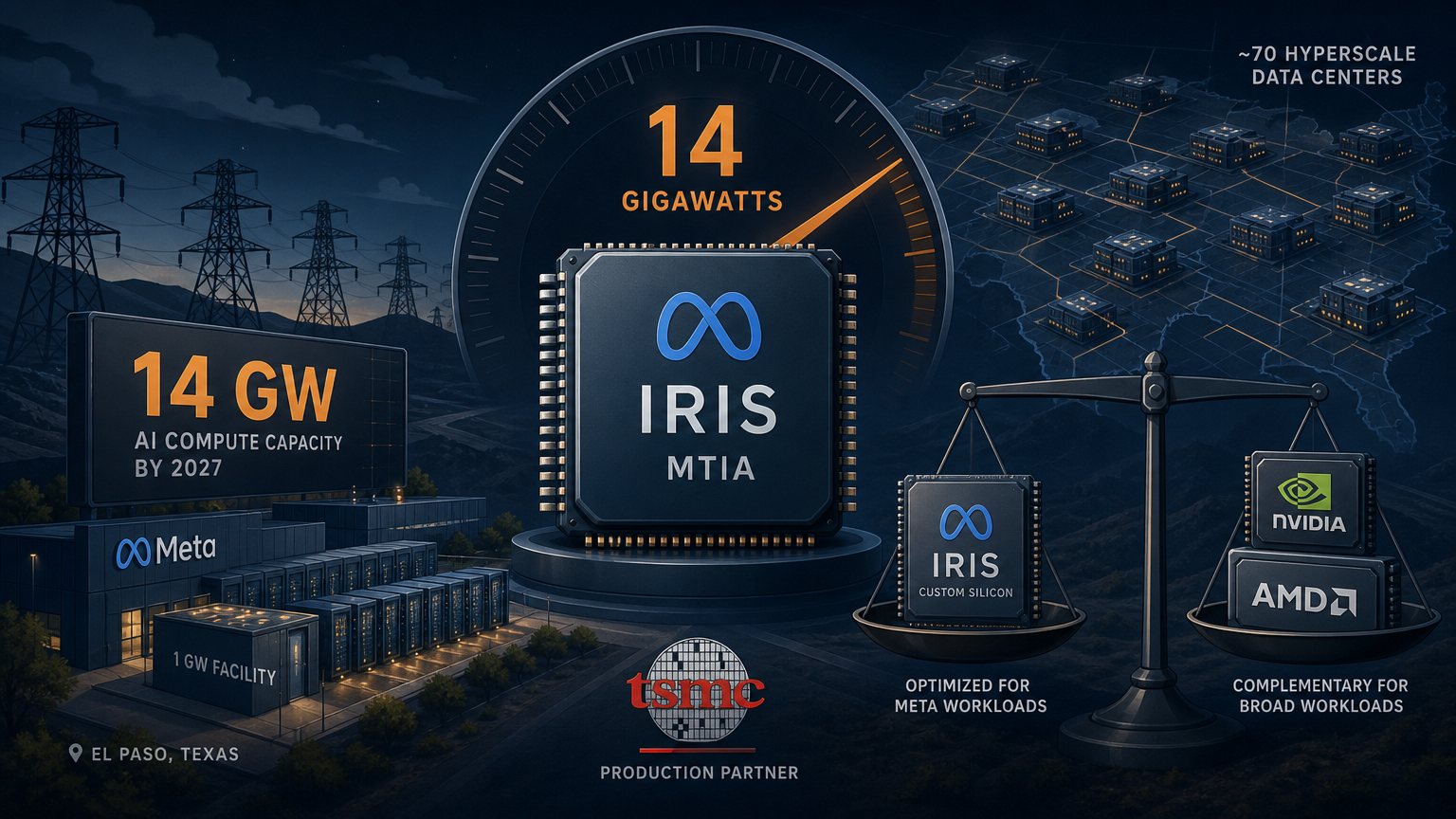
Meta plans to put its custom AI chip, code-named Iris, into mass production at TSMC in September, according to an internal memo obtained by Reuters on July 9, 2026. Iris is the fourth generation of MTIA, short for Meta Training and Inference Accelerators. Its validation cycle took six weeks, with no major issues reported.
The same memo set out a much larger infrastructure target. Meta plans to reach 14 gigawatts of total AI compute capacity by 2027, up from 7 GW planned for 2026. At that scale, even a modest improvement in computing efficiency can justify substantial spending on chip design. It also makes access to electricity a major constraint on whether the plan can be delivered.
The scale behind the chip investment
A large hyperscale data center can run between 100 and 300 megawatts. Using 200 MW as a reference, 14 GW is equivalent to 70 such facilities operating at once. Meta's target puts that scale of capacity roughly 18 months away, rather than at the end of a decade-long construction program.
The company added 1 GW of capacity in the first half of 2026 and plans to add approximately another 5.5 GW by December 31. That would mean moving from an average of 0.5 GW per quarter in the first half to more than 1.8 GW per quarter as a year-end pace. The precise timing of those additions matters, because the second-half total calls for a much faster average buildout.
Meta's projected capital expenditure for AI infrastructure in 2026 runs as high as $145 billion. Big Tech collectively is on track to spend more than $700 billion on AI compute this year. Construction at this scale affects transmission planning, utility investment and the availability of suitable sites, well beyond the hardware purchase itself.
How scale changes the economics
Custom silicon has a large upfront cost. A company needs chip designers, software support, validation and a manufacturing partner before it can put the hardware to work. For an operator buying GPU clusters measured in fractions of a gigawatt, those costs can outweigh the potential savings over commercial hardware such as NVIDIA's H100s or B200s.
Buying GPUs also means accepting the supplier's prices, thermal requirements and interconnect design, which determines how chips exchange data. Those constraints can be worth accepting when the alternative is funding an entire hardware program.
At Meta's planned scale, the calculation looks different. A 10% improvement in compute per watt across a 7 GW deployment would provide additional computing work equivalent to what 700 MW of baseline hardware could deliver. At 14 GW, that rises to 1.4 GW, roughly the continuous generating capacity of a large nuclear plant. This is a comparison of useful work at the same power draw, not a claim that the chips produce electricity or eliminate all the costs associated with that capacity.
A custom chip therefore doesn't have to outperform a commercial GPU by a huge margin to be worth developing. A measurable gain, repeated across a sufficiently large deployment, can pay for considerable engineering work. The exact break-even point still depends on development costs, utilization and how much of the workload the chip can handle.
Meta has said Iris isn't intended to replace all GPU purchases. Its strategy is complementary: custom chips serve workloads whose training and inference patterns are understood well enough to optimize, while NVIDIA and AMD hardware serves other needs. Frontier training remains a particularly strong use case for NVIDIA because CUDA, its software platform, has roughly a decade of accumulated tooling that a new architecture cannot reproduce in one generation.
A new chip generation every six months
Meta plans to release a new MTIA generation approximately every six months through 2027. That is an aggressive release schedule. A standard semiconductor design-to-production process takes two to four years, consumer CPU generations commonly arrive annually, and NVIDIA GPU generations have historically been 18 to 24 months apart.
A six-month release cadence doesn't necessarily mean that each chip takes only six months to develop. It can involve overlapping generations. The useful capability is a shorter interval between learning something from production workloads and putting an updated design into service.
Hardware-software co-design means adapting chips and software together for the work they need to perform. Relevant details can include memory access patterns in Llama training, the shapes of attention operations in recommendation systems, and mixture-of-experts routing in production inference. That routing determines which parts of a model process a given input. These are examples of workload characteristics that can guide chip design, rather than evidence that Iris is optimized for every one of them.
Google offers the longer-running comparison. It has used TPUs since 2016 and is now on its seventh generation. Industry analysis places Google several years ahead of Meta. A decade of co-design supports the argument that TPUs can be especially efficient for Google's internal workloads, even with NVIDIA's Blackwell Ultra available. A blanket efficiency ranking against every third-party option, however, would require workload-specific evidence.
Meta's planned cadence appears intended to shorten that learning process. More frequent generations create more opportunities to apply production experience, provided the company can validate and deploy them without losing the expected gains to added complexity.
What changes for GPU buyers
Iris-based systems are expected to handle only part of Meta's planned 14 GW, likely where workloads are predictable and well characterized. Meta will continue buying GPUs in the near term. Even a partial alternative, though, can change a large customer's negotiating position.
Other hyperscalers are making similar investments. AWS has Trainium and Inferentia, Google has TPUs, and Microsoft has Maia. Meta is reaching production with its fourth MTIA generation and planning further six-month iterations. These programs show a broader move toward custom silicon among operators large enough to support the development costs.
If Meta can shift more workloads from GPUs to Iris in a future design cycle, NVIDIA has to account for that option when negotiating prices. No hyperscaler needs to stop buying GPUs altogether for custom hardware to put pressure on supplier margins.
Broadcom, Meta's design partner for Iris, occupies another important position. Helping customers develop custom application-specific integrated circuits, or ASICs, gives it both a commercial role in these projects and insight into their hardware requirements. That makes the choice of design partner part of the competitive calculation.
For organizations modeling AI compute costs over three to five years, these programs suggest pressure on NVIDIA's margins from several large buyers at once. That is an infrastructure-market judgment, not a stock forecast or a guarantee that smaller buyers will receive lower prices.
Power can take longer than silicon
The schedule depends on more than chip availability. A chip design might take 18 months, and construction on a data center shell might begin within six. A gigawatt-scale grid connection generally cannot be arranged on either schedule.
Utility permitting, transmission upgrades, substations and interconnection queues in the United States can take years. More capital can help fund construction, but it cannot remove every approval, equipment or scheduling constraint.
Meta's 14 GW target would therefore require substantial advance work on power commitments, land, easements and utility agreements. The target alone doesn't establish that all of those arrangements are secured.
The El Paso, Texas campus shows the scale of an individual project. Reuters reporting on the infrastructure memo said Meta had increased its planned investment there from $1.5 billion to more than $10 billion, targeting 1 GW of capacity by 2028. That is a roughly two-year horizon for one campus, with a capacity date later than the company's 2027 target.
Efficiency improvements help make better use of whatever power becomes available. They don't replace the utility work needed to bring that power to the site. The economics of Iris and the feasibility of the 14 GW plan are closely connected, but they remain separate execution tasks.
The decision for smaller operators
Large infrastructure operators have brought more design work in-house before. Storage became software-defined, whitebox switches could run open firmware, and commodity servers supported virtualization without requiring a tightly bundled hardware platform. Custom AI chips follow a similar economic pattern where scale can justify taking responsibility for another layer of infrastructure.
That doesn't establish a universal cutoff at a few hundred megawatts, or make 14 GW a precise threshold. Below the scale needed to recover development costs, custom silicon can be an expensive distraction. Above it, relying entirely on commercial GPUs can mean passing up substantial savings on suitable workloads.
Most organizations won't reach that chip-design decision. Their choices concern GPU contracts, software dependencies and how much effort it would take to move a workload to another platform. A software abstraction layer can make that move easier, but may also limit access to hardware-specific performance features.
Those tradeoffs deserve attention in long-term purchasing plans. Meta's approach preserves access to NVIDIA and AMD hardware while building an alternative for selected workloads. Smaller buyers may not be able to design that alternative themselves, but they can assess whether their contracts and software leave room to use one.