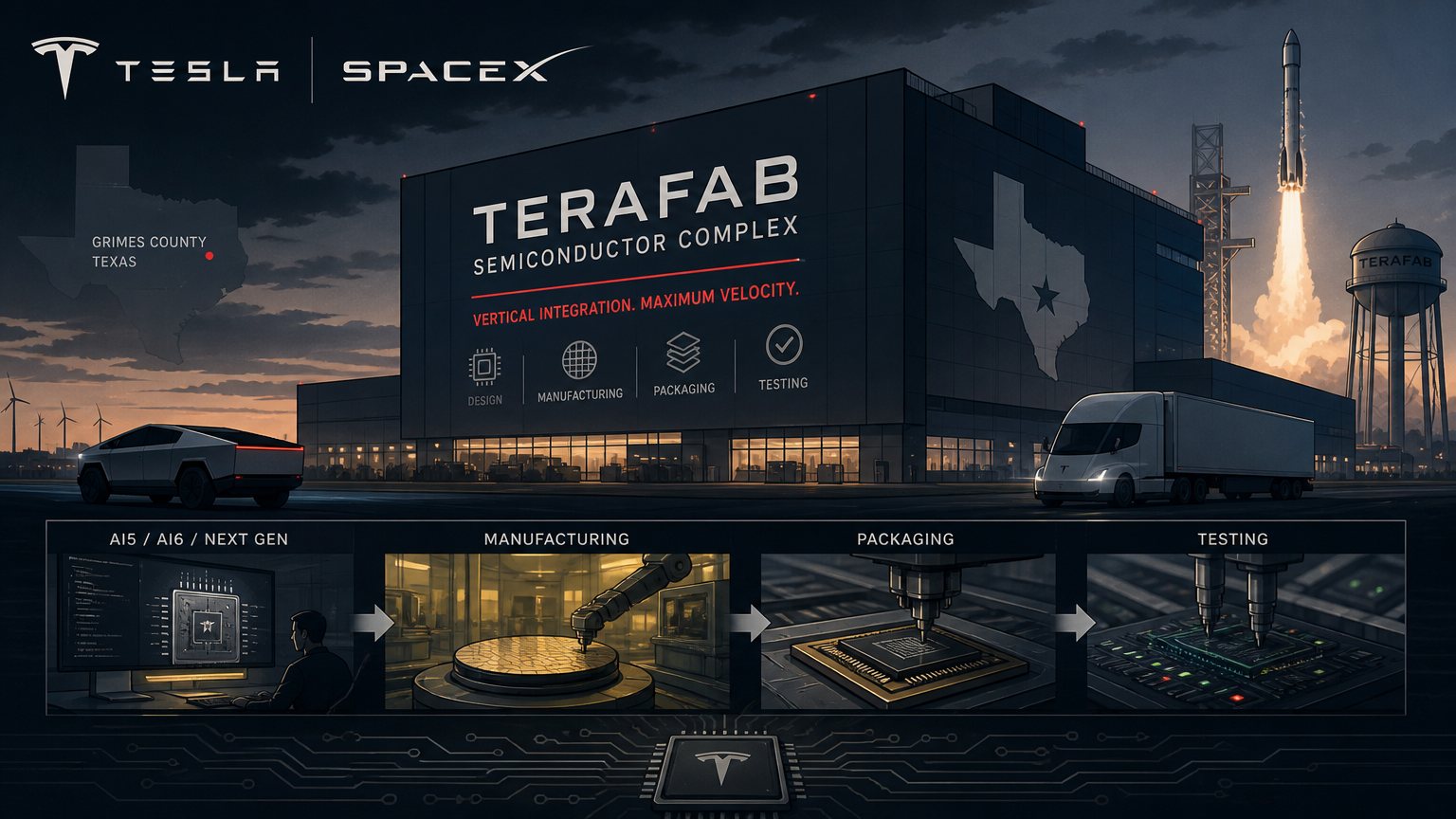
Tesla and SpaceX announced on August 6, 2026, that they would jointly invest $16.8 billion in the first phase of Terafab, a semiconductor manufacturing complex in Grimes County, Texas, north of Houston. The companies want more control over the chips needed for Tesla's Optimus robots, its self-driving Cybercab platform, and SpaceX's planned space-based data centers.
The proposed semiconductor foundry would bring logic manufacturing, memory production, packaging, and testing under one roof. This is a plan to make chips, rather than another announcement about a data center that uses them.
Elon Musk described Terafab as the largest and most valuable building on Earth by far. The practical case is narrower: owning more of the manufacturing process could give Tesla and SpaceX greater control over supply and chip development. Whether they can build and operate the facility at the proposed scale remains open.
The supply problem behind the investment
Chip shortages became especially severe during 2021 and 2022, but the underlying coordination problem extends beyond that period. A chip design might go to TSMC in Taiwan for fabrication, then to a facility in Malaysia or South Korea for packaging, with testing handled elsewhere. Each stage adds another schedule and another dependency.
For a new design moving through that chain, nine months can be an optimistic turnaround and eighteen months a common one. Those waits are painful for consumer electronics businesses. They can become a direct limit on deployment for a company planning millions of autonomous robots or a large self-driving fleet.
Tesla already relies on outside manufacturing for its own chip designs. Samsung's Taylor, Texas fab is reported to be producing Tesla's AI5 chip, and Tesla has contracted for its next-generation AI6 design through the same facility. Reducing international shipping was likely part of the appeal of the Texas location. Local production still leaves Tesla dependent on Samsung's available capacity and yield performance, meaning the share of manufactured chips that work as intended. It also leaves exposure to disruptions elsewhere in the global semiconductor supply chain.
The Terafab announcement argues that both Tesla and SpaceX will need far more chips than current and future global production can supply. That is the companies' assessment of their future needs, rather than an independently established capacity shortfall. The operational concern is credible: millions of Optimus robots running inference continuously would require a large, dependable supply of chips tailored to that workload. Inference is the process of using a trained AI model to make decisions or produce outputs.
If deployments reach the scale the companies envision over the next decade, competing for capacity at outside foundries could become a serious constraint. Terafab is an attempt to secure manufacturing capacity around those plans.
What owning the manufacturing process could change
Most chip companies are fabless. They design chips and hire a foundry to manufacture them. Packaging, which connects and protects the chips, and testing are often handled by other specialized contractors. Even Apple, despite its influence over its supply chain and its extensive in-house chip design work, uses TSMC for fabrication.
Terafab would bring those activities into one complex. Its potential benefit goes beyond manufacturing cost. Closer coordination between design, fabrication, packaging, and testing could make it easier to run small batches, examine defects and performance, and feed the results into the next revision.
The proposed advantage is an iteration cycle measured in weeks rather than quarters for some development work. That remains an ambition, not a demonstrated capability. Owning the equipment doesn't remove the technical work needed to develop a reliable manufacturing process.
Faster feedback could be particularly useful for edge inference, where AI runs on a robot or vehicle rather than in a remote data center. Those chips have specific power and performance requirements, and the requirements can change as the software improves. Better coordination between hardware and software can help avoid spending power or chip area on capabilities the product doesn't need.
Apple's custom silicon shows the value of designing hardware around known software requirements. It doesn't establish that owning a foundry is necessary to get that benefit. Terafab adds a separate bet: that control over manufacturing will provide enough additional speed and supply security to justify its cost and complexity.
Intel's role is still unclear
Intel is involved in Terafab, although its exact responsibilities remain unclear as of August 8, 2026. Reporting in April suggested Intel could handle manufacturing operations, rather than Tesla or SpaceX running the fab floor directly.
That distinction matters. A project operated with Intel's manufacturing staff and process expertise would be different from Tesla and SpaceX trying to develop those capabilities largely on their own. Intel could gain an anchor customer for its foundry services, while the two companies could gain access to experience that takes years to build.
There are reasons for caution about that arrangement too. Intel has spent years trying to recover its manufacturing position after falling behind TSMC on process nodes, the generations of technology used to fabricate chips. Its recent record of complex fab partnerships and delays at announced manufacturing projects adds uncertainty to Terafab's schedule.
The commitment has grown faster than the evidence of production
SpaceX broke ground on what was described as a research fab in April 2026. In May, its IPO filing still described Terafab as a general framework with no binding commitments. By August, the companies were announcing a $16.8 billion first phase, with plans for 100 million square feet of manufacturing space. SpaceX has put the projected investment across multiple phases at $119 billion.
That is a large change in the stated commitment over a few months. The distinction between a research facility, a funded construction phase, and a working high-volume fab needs to stay visible. The announcement establishes the companies' intentions. It doesn't yet establish that the manufacturing plan will work.
Experienced chipmakers have struggled with comparable construction and production challenges. Intel's Ohio fab, announced in 2022, was already years behind its original schedule in 2025. TSMC's Arizona facilities took longer and cost more than projected. Starting a new fab is difficult even with decades of manufacturing experience.
Tesla and SpaceX do have a direct reason to persist. Terafab is intended to supply their own products, rather than primarily sell foundry services to other companies. If it fails to produce viable chips at scale, the robot and vehicle businesses remain dependent on outside suppliers. That gives the project a strong commercial incentive, although an incentive cannot substitute for working manufacturing processes.
Evidence to watch as construction proceeds
Construction progress will provide some evidence of commitment, but production milestones will say more about whether Terafab can solve the supply problem. Several signals deserve attention:
- First test wafers. Engineering runs should begin before full production. Late 2028 is a useful benchmark for initial silicon, though it is an analytical expectation rather than a confirmed company deadline. A slip beyond 2030 would weaken the case that Terafab can address the companies' near-term supply needs.
- Yield improvement. Poor early yields are normal at a new fab. The important question is whether they improve steadily. A rise from 30% toward 80% over the first two years of production would illustrate meaningful progress. Those figures are a benchmark, not reported Terafab results or a universal target for every chip. Flat yields, or updates that replace yield information with vague references to production milestones, would be more concerning.
- Intel's on-site work. If Intel is responsible for manufacturing operations, its engineering presence in Grimes County during 2027 should help clarify the depth of that commitment. A staffed manufacturing operation would provide stronger evidence than a licensing arrangement alone.
- Tesla's next chip allocation. AI6 is already contracted with Samsung. If Terafab is producing Tesla silicon by 2029, a decision to target AI7 for the new facility would support the plan. Continued reliance on Samsung or TSMC as Terafab opens would raise questions about its readiness, though outside contracts alone wouldn't establish that the project had failed.
A larger step than custom chip design
Large technology companies have already taken more responsibility for the chips they use. Amazon has expanded its custom silicon business, with reported internal chip revenue above $20 billion annually. Google has designed its own tensor processing units, or TPUs, for more than a decade. Apple moved its product line off Intel processors in favor of its own designs.
Those moves support the case for tailoring chips to a company's workloads. Terafab goes further by proposing ownership of manufacturing itself. Success in chip design doesn't automatically carry over to fabrication, where process control, equipment, staffing, and yield determine whether a design can become an affordable product at scale.
The case for Terafab in Grimes County depends on whether that additional control produces reliable supply and faster development at an acceptable cost. If it does, other large chip buyers would have a concrete example to assess when deciding how much manufacturing responsibility to take on. Until then, test wafers, improving yields, and production chip commitments will be more useful evidence than the size of the proposed building.