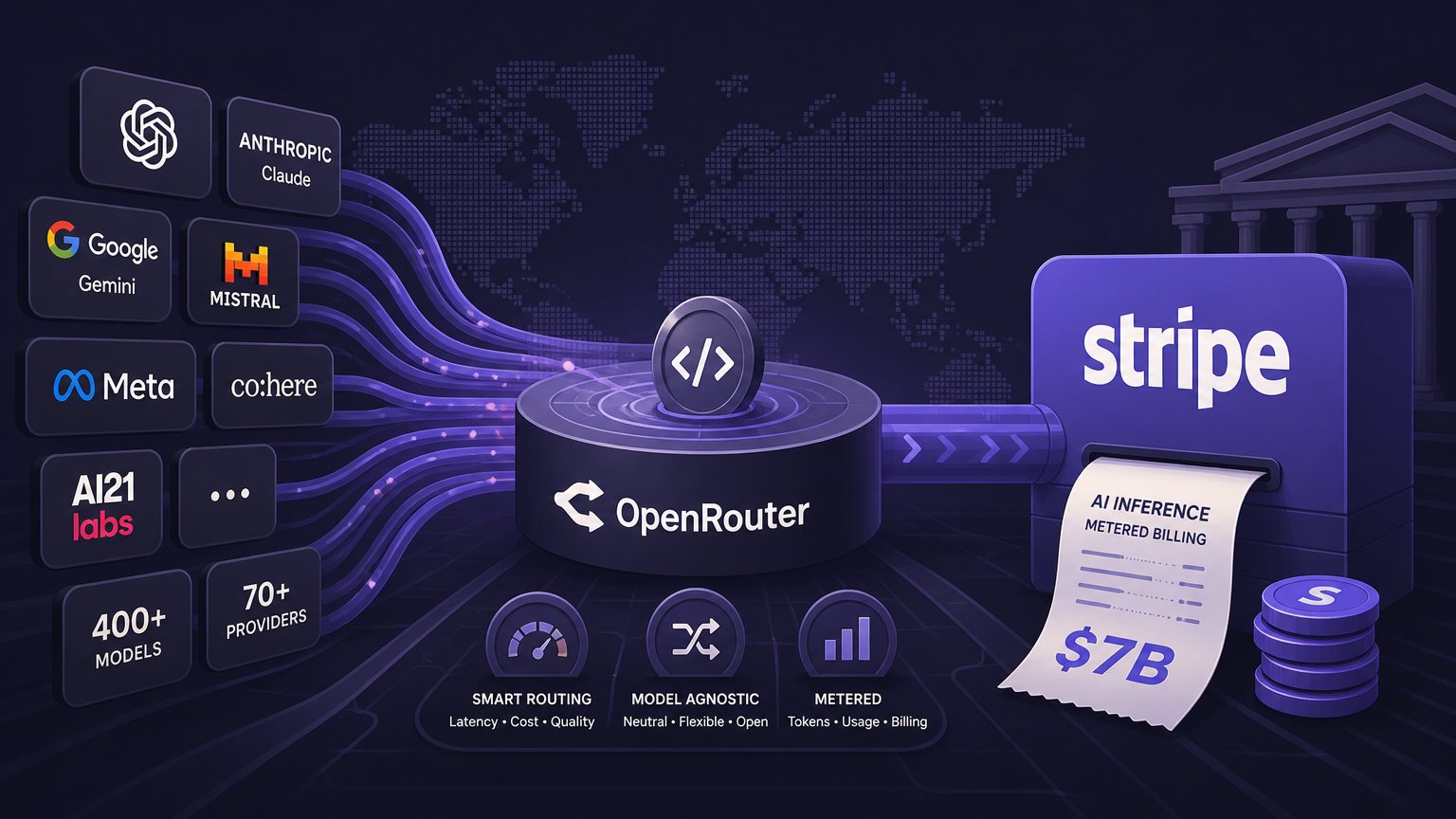
Stripe is reportedly buying AI gateway OpenRouter for more than $7 billion. As of August 18, 2026, the reported price is more than five times the $1.3 billion valuation OpenRouter received when it raised a $113 million Series B in May.
The strategic argument is straightforward. Stripe already handles payments for other businesses. OpenRouter handles requests to AI models, along with the metered spending those requests generate. Combining them would give Stripe a position in both the use of AI services and the billing around them.
For developers, the main issue is whether OpenRouter can keep acting as a neutral intermediary once it belongs to a larger company with its own commercial relationships.
What OpenRouter handles
OpenRouter provides a single API endpoint for more than 400 models from over 70 providers. Those include OpenAI, Anthropic, Google, Mistral, Meta and dozens of companies hosting open-weight models. Instead of maintaining a separate integration for each provider, an application can send requests through the gateway, which handles routing according to requirements such as latency, cost and capability.
The platform serves around 10 million developers and uses a metered payment model. Customers load credits, consume tokens as models process requests and generate responses, and replenish their balances as needed.
CEO Alex Atallah has described OpenRouter as the equivalent of Stripe for AI. The comparison rests on a similar promise: handle the complicated routing and billing underneath a common interface, while reducing dependence on any one provider.
That becomes useful as model choices multiply. Hundreds of models have different prices, response times and capabilities. A suitable choice for one workload may be too expensive for another, and the calculation changes when providers release new versions or cut prices. Maintaining those integrations and routing decisions takes engineering time.
The price and the business logic
The reported deal follows a sharp increase in OpenRouter's valuation:
- In May 2026, OpenRouter raised $113 million at a $1.3 billion valuation.
- A purchase price above $7 billion represents roughly 5.4 times that valuation, or more, in about 90 days.
- The Wall Street Journal had reported earlier negotiations at around $10 billion.
- OpenRouter's investors included Sequoia, Andreessen Horowitz, Menlo Ventures and Alphabet's CapitalG.
The gap between the earlier $10 billion figure and the reported purchase price could reflect Stripe negotiating a lower price or limits on OpenRouter's bargaining position. The figures alone don't establish which explanation is right.
Stripe's payments business offers a model for the investment. It built infrastructure that other products depend on and collects a small, percentage-based fee as transactions pass through it. Growing internet transaction volume helped that model scale and supported a valuation in the hundreds of billions.
AI inference, the work a model does when processing a request, offers a similar opportunity. Applications buy access to models, usage is metered, and an intermediary can earn a margin by making that access easier to manage. A gateway doesn't need to own the best model if customers continue using it to reach whichever model suits their needs.
Patrick Collison has publicly called metered pricing the native business model of the AI era. The proposed purchase fits that view: Stripe would be betting that managing AI usage and its charges becomes a durable infrastructure business. Quartz's coverage connects the deal to that billing strategy.
Neutrality affects the product
OpenRouter's appeal depends partly on developers trusting its routing decisions. A gateway that selects a provider based on a workload's needs is useful. A gateway that quietly favors a higher-margin provider or a commercial partner creates a different dependency.
Akhil Verghese, CEO of AI software company Krazimo, raised the concern of whether OpenRouter could maintain its neutrality under Stripe. The consequences are practical. Sending a request to one provider rather than another affects response time, cost and output quality. At enough volume, those choices also affect the competitive position of model providers.
There were potential tensions before Stripe entered the picture. Sequoia and Andreessen Horowitz have substantial investments in AI model providers, with Anthropic among the companies cited in that context. An intermediary that treats providers equally can have interests that differ from those of investors with stakes elsewhere in the market. A sale would leave Stripe responsible for managing those tensions.
Stripe's transaction-based model is a reasonable fit for a neutral gateway. It earns money when transactions happen rather than needing a particular merchant to win. But that structure doesn't eliminate the possibility of preferred-provider arrangements. Stripe has commercial relationships of its own, and routing decisions could become a way to support them.
What could change for developers
A common reason to adopt a gateway is to avoid maintaining separate provider integrations and a custom routing system. Starting with one provider is simple. Adding alternatives to control costs introduces work that may have little to do with an application's distinctive features.
OpenRouter reduces that burden. Under Stripe, the questions would be whether pricing changes, preferred-provider agreements or updated terms alter the value of that service.
A reasonable forecast is that users would see little change during the first 12 to 18 months after an acquisition. Stripe would be buying an established developer community and a network of providers. Disrupting either immediately would put the value of the purchase at risk. More consequential changes could arrive later, as routing and billing become more tightly integrated.
Some integrations could be useful. Per-model cost tracking could feed directly into a Stripe billing dashboard. Routing could account for a customer's spending rate and limit expensive calls as a budget approaches its threshold. These are possible product directions, not announced features.
Combining those systems also raises a data concern. A company handling both payments and model requests could gain a broader view of a customer's revenue flows and AI usage. Teams would need to understand what data the combined service receives, how it can be used and what the terms permit.
A different kind of infrastructure dependency
The proposed deal fits a broader argument about established financial and technology companies taking larger roles in AI infrastructure. Other developments cited over the preceding twelve months include Nvidia backing $105 billion in financing for OpenAI's Ohio data center, extending its role beyond selling hardware, and AMD acquiring chip companies to embed model weights in silicon. The shared aim is to secure a position in the AI market before ownership and customer relationships settle.
For developers, larger owners can bring benefits. A well-funded payments company, chip vendor or cloud provider may offer more reliable service and a longer operating life than a startup that could close or change direction. Ownership still changes the dependency, even when the API stays the same.
Over the next three years, more of today's independent AI tools could end up inside those larger businesses. That prospect supports keeping gateway integrations contained. Provider-specific routing behavior should stay separate from core business logic where practical, so replacing the gateway doesn't require rebuilding the application.
The immediate items to watch are pricing, terms of service and model-provider payout terms. Payout terms deserve particular attention because they can reveal financial incentives to favor one provider over another. A public commitment to neutrality is more credible when the economics support it.
The reported price makes sense only if developers continue trusting and using the intermediary. Stripe could build a useful connection between model access, usage tracking and payments. If routing begins favoring preferred partners at customers' expense, those customers have a reason to use another gateway or return to direct provider integrations.
Bloomberg's reporting on the deal provides the financial context. Yahoo Finance's analysis of AI model economics examines the implications for routing and billing.