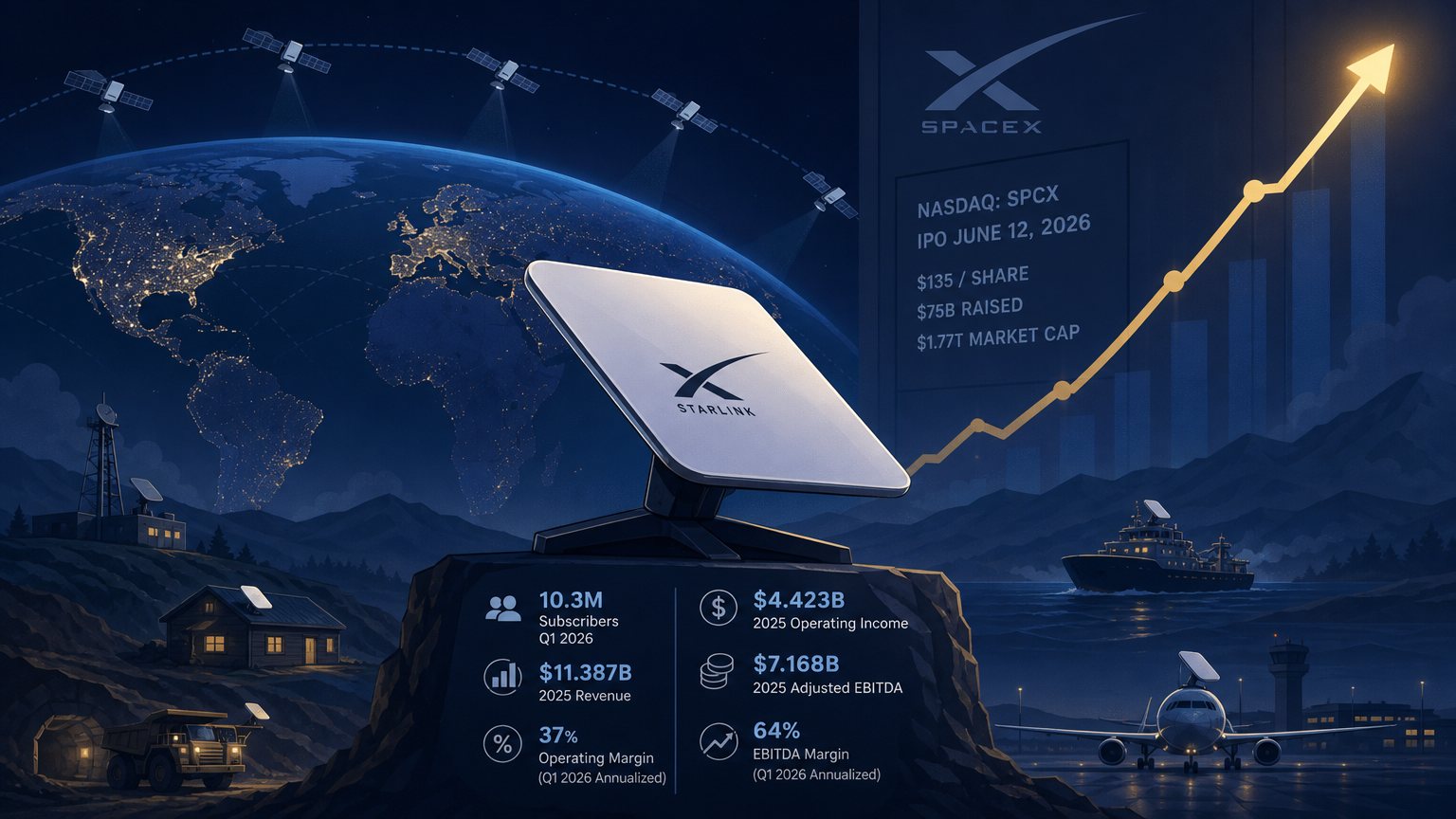
SpaceX priced its IPO at $135 per share on June 12, 2026, raising $75 billion and debuting on Nasdaq under SPCX at a $1.77 trillion market capitalization. CNBC described it as the largest initial public offering in Wall Street history. Shares reached $161 on the first day, about 19% above the offer price.
For infrastructure teams evaluating Starlink, the more useful information was in the financial disclosures. SpaceX's Connectivity segment, which is primarily Starlink, reported $11.387 billion in revenue, $4.423 billion in operating income and $7.168 billion in adjusted EBITDA for 2025.
After 24 years as a private company, SpaceX has provided a much clearer view of the business behind the service. Those figures strengthen the case for treating Starlink as a long-term connectivity supplier. They still need to be read alongside its technical limits, contract terms and the demands on its parent company's capital.
What the Connectivity figures show
Connectivity revenue grew 49.8% in 2025. Operating income rose 120.4%, and EBITDA grew 86.2%. Profit grew substantially faster than revenue, indicating that the segment became more profitable as it expanded.
In the first quarter of 2026, the segment generated $3.257 billion in revenue, $1.188 billion in operating income and $2.087 billion in adjusted EBITDA. Annualizing that quarter produces roughly $13 billion in revenue, with an operating margin near 37% and an adjusted EBITDA margin near 64%. That is a run-rate calculation, not a full-year forecast.
Those revenue and profit figures support a comparison with software subscription businesses. Starlink collects recurring payments on top of a large infrastructure investment: more than 9,600 satellites, ground stations and customer terminals. The S-1 filing disclosed on May 20 makes that relationship easier to examine.
The economic argument is that, once capacity is in place, another subscriber can bring in recurring revenue at a low incremental cost. In that respect, the margins invite a comparison with Salesforce rather than a conventional network operator such as Lumen Technologies. The comparison has limits, though. SpaceX still has to manufacture satellites, launch them and replenish the constellation.
Starlink served 10.3 million subscribers as of the first quarter of 2026, up from 2.3 million two years earlier. That is about a 4.5-fold increase in 24 months. Subscriber growth has begun to flatten slightly. Saturation among early adopters in higher-income markets is one possible explanation, while continued margin expansion suggests the business still has room to grow profitably.
The parent company's finances are less straightforward. SpaceX has accumulated $41.3 billion in total losses since its founding in 2002. Connectivity is profitable, but the Space and AI segments continue to consume capital. A supplier assessment has to account for both the recurring subscription business and the capital-intensive operations that share its corporate structure.
Lower revenue per subscriber needs context
Average revenue per user, or ARPU, fell from $99 per subscriber per month in 2023 to $66 by the first quarter of 2026. That decline deserves attention, but it isn't enough on its own to show that the business is weakening.
The explanation offered for the decline is a shift in geography and plan mix. Early subscribers were concentrated in the United States and Western Europe, often on premium residential and business plans. Later growth has included Latin America, Southeast Asia and Africa, along with maritime and aviation customers. Lower-priced offerings and some government subsidies for rural connectivity are part of that expansion.
Revenue and operating income have continued to rise rapidly despite the lower average monthly payment. That supports the judgment that lower ARPU can coexist with healthy economics as Starlink reaches more markets and makes fuller use of installed capacity.
The strongest version of this argument assumes that terminals ship at hardware cost and that the marginal cost of another subscriber approaches zero because bandwidth is already provisioned. That is an assumption about how the network scales, rather than something segment-level revenue and earnings can establish by themselves. The disclosed figures show a profitable segment; they don't provide a complete cost breakdown for each additional customer.
Where Starlink fits in enterprise infrastructure
The financial disclosures make it easier to assess the supplier. The choice of connection still depends on performance and service requirements.
Independent performance testing in 2026 reported latency of 20 to 40 milliseconds on Business plans. That is a substantial improvement over legacy geostationary VSAT connections at 600 milliseconds or more, and it is acceptable for many enterprise workloads.
Fiber remains the better choice where tight latency and consistent throughput are essential. Requirements such as sub-20-millisecond database replication, real-time financial transaction routing and synchronous VoIP at scale need closer scrutiny than a typical remote office or backup connection.
Several uses make a stronger case for Starlink:
- Backup WAN circuits. At an edge site exposed to fiber cuts, a Starlink Business connection costing $250 to $500 per month can be a reasonable cold standby. It provides an alternative access path, and Connectivity's profitability gives procurement teams more evidence about the business supporting it. Earnings alone don't establish service continuity.
- Remote and rural compute. Industrial edge sites, resource extraction operations and remote sensing deployments may have few practical choices where fiber doesn't reach. Starlink is a commercially mature option, with more financial visibility now that its operator is public.
- Maritime and aviation. Starlink Maritime and Aviation have commercial operating histories rather than being beta products. The S-1 treats them as significant contributors to the Connectivity segment.
- Disaster recovery and emergency operations. Low Earth orbit satellite connectivity offers a path that is less dependent on local terrestrial access networks. That separation is useful when planning for fiber cuts, floods and power-grid failures, though it should not be read as a guarantee that an entire satellite connection is immune to those events.
As of June 13, 2026, Starlink Business does not offer a financially backed service-level agreement with downtime penalty credits comparable to an enterprise MPLS circuit or major fiber provider. The service provides priority bandwidth allocation and SpaceX's operating track record, rather than the same contractual uptime protection.
That distinction should shape failover design. Starlink should be treated as high-quality best-effort connectivity, with recovery plans built around the possibility that it can also become unavailable.
xAI adds uncertainty at the parent company
SpaceX acquired xAI in February 2026, bringing Grok, its data centers and the social network X into the company. The S-1 lists three segments: Connectivity, primarily Starlink; Space, covering launch services; and AI, covering xAI and associated assets.
The implications for Starlink remain unclear. One plausible benefit is using AI to improve beam scheduling, interference management and spectrum optimization. Those are specific engineering problems where better scheduling and analysis could improve network operations.
A more speculative possibility is that Starlink terminals develop into edge-computing nodes for AI. A geographically distributed base of more than ten million endpoints could provide a distribution channel and, in that scenario, a potential source of training data. This is a possible direction, not an established product plan.
The risk is more immediate organizational complexity. Model infrastructure, data centers, social network operations and regulatory obligations bring demands of their own. Space already operates at negative margins. Adding an AI division increases execution risk at a time when SpaceX also has to meet public-market expectations.
Those possibilities deserve monitoring without allowing an uncertain AI roadmap to dominate a connectivity decision. Starlink's performance, availability and contract terms remain the relevant measures for an infrastructure deployment.
Public reporting helps, but doesn't guarantee investment
Public-company reporting gives infrastructure teams a recurring way to assess the supplier. Quarterly 10-Q filings and annual 10-K reports provide financial disclosures under SEC oversight, including audited annual financial statements. Earnings calls also give analysts an opportunity to question management about margins and investment.
That visibility helps teams track whether Connectivity remains profitable and whether SpaceX continues funding the network. It provides a more useful basis for assessing financial health than was available while the company was private, much as cloud customers examine the public financial disclosures covering AWS or Azure.
There is a tradeoff. Public markets put pressure on quarterly earnings, while satellite manufacturing, launch capacity and constellation replenishment require investment over much longer periods. Future filings should help show whether shareholder demands affect that spending.
Connectivity's $7.168 billion in annual adjusted EBITDA suggests substantial capacity to support investment. EBITDA is earnings before interest, taxes, depreciation and amortization, with further adjustments in this measure. It is not the same as cash available after capital spending. The figure supports confidence in the operating business without proving that every future network investment can be funded internally.
A stronger case for selected deployments
The May 20 S-1 and June 12 IPO reduced an important source of uncertainty for infrastructure buyers. The offering was reported as oversubscribed by institutional investors, but demand for the shares is less useful for network planning than the underlying segment results.
Connectivity is growing at roughly 50% annually, producing more than $7 billion in annual adjusted EBITDA and serving 10.3 million subscribers across a constellation of more than 9,600 satellites. That is substantial evidence of an established operating business, rather than an experimental service.
Those results support putting Starlink Business on approved vendor lists for backup WAN links, remote and rural edge deployments, maritime operations and disaster recovery connectivity. They don't justify moving latency-sensitive primary workloads away from fiber or overlooking the lack of comparable uptime guarantees.
Match the service to the site and test the failover arrangement. As new financial reports become available, review the supplier's investment record.