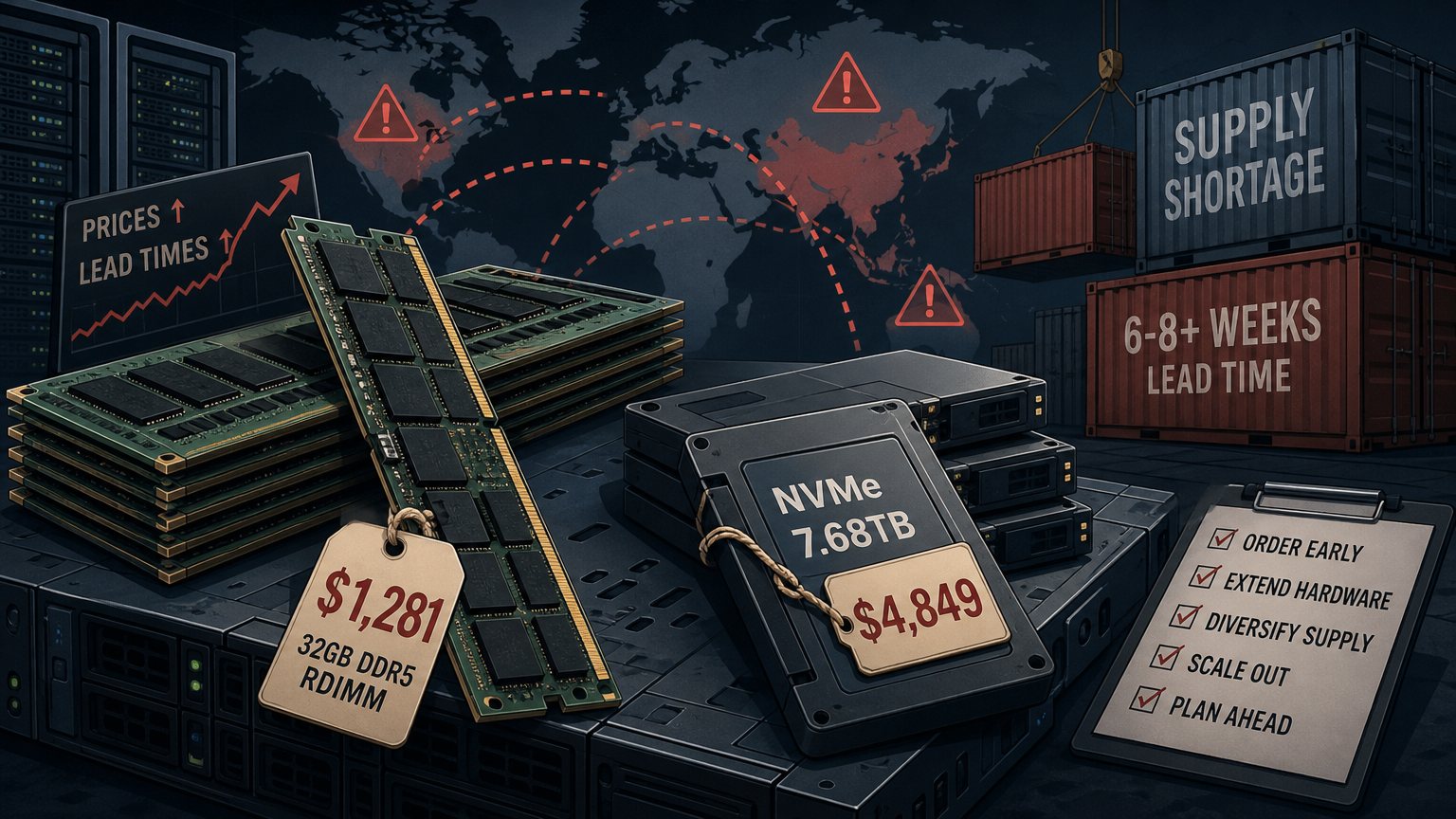
Enterprise memory and storage costs are making server replacements harder to fund in March 2026. Listed prices for 32GB DDR5 RDIMMs range from $998 to $1,424, while some 64GB modules exceed $2,400. In one dual-socket configuration, memory alone costs $20,496 before CPUs, storage or software licensing.
Delivery times add another constraint. Standard Dell and Lenovo configurations are listed at 6-8 weeks, while custom builds with particular memory requirements can take 20-26 weeks or longer. For infrastructure teams with fixed deployment dates, the configuration available soon enough may matter as much as the preferred specification.
The figures and forecasts below reflect conditions reported as of March 18, 2026. Industry forecasts point to shortages lasting into Q4 2027 and potentially beyond, leaving buyers to weigh new purchases against upgrades and temporary capacity.
March 2026 memory and storage prices
Enterprise memory uses registered DIMMs, or RDIMMs, which are a different product category from ordinary desktop memory. The following enterprise prices are attributed to memory.net.
| Memory module | Listed price |
|---|---|
| 32GB DDR5-4800 RDIMM | $998 |
| 32GB DDR5-5600 RDIMM | $1,281 |
| 32GB DDR5-6400 RDIMM | $1,424 |
| 64GB DDR5-4800 RDIMM | $2,408 |
| 64GB DDR5-6400 RDIMM | $2,498 |
| 32GB DDR4-3200 RDIMM | $460 |
Consider a dual-socket server with 16 DIMM slots, all populated with 32GB modules. That provides 512GB of memory. At $1,281 per DDR5-5600 module, the memory bill is $20,496. The same capacity using 16 of the listed DDR4 modules costs $7,360 on a compatible DDR4 platform.
Those are memory-only comparisons. They exclude CPUs, drives and licensing, and DDR4 and DDR5 configurations require compatible server platforms.
Enterprise SSD costs
The March 2026 storage examples also show substantial costs, though they cover different capacities and interfaces rather than directly equivalent drives.
| Drive | Listed price | Approximate cost per TB |
|---|---|---|
| Dell 15.36TB PCIe Gen 4 NVMe | $5,000.50 | $325 |
| Solidigm 7.68TB Enterprise SSD | $4,849.00 | $631 |
| Solidigm 1.92TB SATA SSD | $1,228.74 | $640 |
Four 7.68TB drives provide 30.72TB of raw capacity and cost $19,396 at the listed Solidigm price. Combined with the $20,496 memory configuration, RAM and storage come to roughly $40,000 for a single server.
The corresponding Q1 2026 hardware estimate is:
- Memory: 16 × 32GB DDR5, $20,496.
- Storage: 4 × 7.68TB drives, $19,396.
- CPUs, motherboard and power supply: $8,000-12,000.
- Total hardware: approximately $48,000-52,000+, excluding licensing, networking and installation.
Further price increases are forecast
Broader estimates put memory price increases over the past year at 50-60%, with forecasts for another 30-40% increase. More specific industry forecasts call for 20-30% quarterly increases through Q2 2026. These are forecasts, rather than settled purchase prices.
Dell, Lenovo, HP and HPE are reportedly implementing server-line price increases of approximately 15-25%, described as additional to component cost increases already reflected in pricing. Procurement budgets therefore need to account for both component quotes and the final system quote.
What is constraining supply
AI infrastructure demand is consuming server-grade RAM and NVMe storage. Memory manufacturers have shifted production capacity away from mainstream DDR4 and consumer DDR5 toward higher-margin server DDR5 and high-bandwidth memory, or HBM, used in AI accelerators. That shift reduces the capacity available for mainstream components even as demand for enterprise parts remains high.
Reported average DRAM inventories fell to 8 weeks of supply in late 2025, down from 31 weeks in early 2023. Described as the lowest buffer in more than a decade, that leaves suppliers with much less room to absorb demand changes or production disruptions.
Geopolitical tensions involving chip-producing regions and export controls on advanced semiconductors are also cited as supply constraints. Production consolidation and the preference for higher-margin products make access more difficult for mid-market buyers.
New factories cannot resolve the shortage quickly. Semiconductor fabs typically take 3-5 years to come online. Micron's Idaho facility and SK Hynix's Yongin cluster are expected to add capacity, but the forecast discussed here does not expect a meaningful market effect before late 2027.
Related coverage includes IPC2U's discussion of 2026 RAM prices and IT purchasing strategies and IDC's analysis of the global memory shortage and its potential effects on smartphone and PC markets. Tom's Hardware's RAM price index provides additional DDR4 and DDR5 price tracking, separate from the enterprise RDIMM examples above.
Server delivery estimates
The March 2026 estimates differ by vendor. Supermicro's standard configurations have shorter reported delivery times than those of Dell, Lenovo and HPE.
| Vendor | March 2026 lead time | Year-ago lead time | Reported change |
|---|---|---|---|
| Supermicro | 2-4 weeks | 1-2 weeks | +100% |
| Dell | 6-8 weeks | 2-3 weeks | +200% |
| Lenovo | 6-8 weeks | 2-3 weeks | +200% |
| HPE | 6-8 weeks, estimated | 2-3 weeks | +200% |
These estimates apply to standard configurations. Custom systems with specific memory requirements frequently face quoted waits of 20-26 weeks or longer, approaching or exceeding six months. A standard-system estimate is therefore a poor basis for scheduling a heavily customized deployment.
The supply outlook through 2028
WCCFtech reports forecasts of memory shortages lasting until at least Q4 2027. The broader planning outlook is:
- Q2-Q4 2026: acute shortages, with a forecast of continued 20-30% quarterly price increases.
- 2027: elevated pricing, with gradual improvement expected toward the end of the year.
- Late 2027: partial supply normalization as new manufacturing capacity becomes available.
- 2028 and later: a possible return to more normal pricing, though still forecast at 40-60% above pre-2024 levels.
The reasoning is tied to manufacturing schedules. Capacity decisions made in 2024-2025 take years to become volume production in 2027-2028. On that outlook, buyers should plan for at least another 18 months of constrained supply rather than assume that a short purchasing delay will bring lower prices.
Extend existing servers where the economics work
A functioning server can be a cheaper source of additional capacity than a replacement carrying a $20,000-plus memory bill. Systems that are 5-7 years old may already be paid off, have familiar failure patterns and still meet workload requirements. Those advantages support a targeted upgrade, provided support and reliability remain acceptable.
Memory expansion is the clearest example. A compatible 2016-2019-era server with spare DIMM slots could gain capacity from four DDR4 RDIMMs at $460 each, a total of $1,840. That is much less than the $15,000-plus new-system comparison used for this upgrade scenario. The broader cited range of $460-$1,400 per DIMM still makes selective upgrades worth evaluating against a complete replacement.
Storage upgrades can help when mechanical drives are the performance constraint. Moving to enterprise NVMe can substantially improve performance on systems that support it, although the current drive prices need to be included in the comparison. Firmware updates may also provide performance improvements at little or no cost.
Age alone is not enough to justify an extension. Unsupported systems create security risks, older chassis can have thermal or component-compatibility limits, and systems more than seven years old may face rising mechanical failure risk. A machine that still runs its workload can still be a poor candidate for further investment.
Place committed orders earlier
For projects requiring new servers in Q3 2026 or later, the purchasing recommendation is to place orders early enough to secure current pricing and an allocation. Waiting until the deployment quarter could leave too little time for delivery.
The cited early-order estimates suggest 25-35% faster fulfillment. The illustrative difference between ordering in Q1 and Q3 2026 is an 8-week wait versus 16-20 weeks or longer, with later pricing potentially 20-30% higher.
Configuration choices can also affect availability:
- Prefer standard, off-the-shelf builds where they meet the workload's needs.
- Consider single-socket systems instead of high-demand dual-socket configurations.
- Use standard memory configurations rather than the highest-capacity DIMMs where capacity requirements allow.
Major OEM allocation programs are another option for larger buyers. Annual purchasing volume of $500,000 or more, or a multi-year commitment, may provide negotiating room for priority access. The cited potential benefit is a reduction of 6-8 weeks in delivery time, though that depends on the vendor's allocation agreement.
Keep alternative suppliers and capacity options available
A second supplier is useful when the preferred vendor cannot meet a deployment date. A practical arrangement is a primary partner such as Dell or Supermicro, a second major OEM such as HPE, Lenovo or Cisco, and a system integrator or regional provider as another option.
Late-model refurbished enterprise hardware is also worth considering. Reported discounts of 20-40% compared with new systems can make it suitable for development and testing, or for temporary capacity that absorbs growth while new equipment is on order.
Smaller systems and cloud overflow
Where the workload supports it, several smaller single-socket servers can substitute for a large dual-socket system. Individual systems may arrive sooner, capacity can be matched more closely to demand, and one failure affects a smaller share of the cluster. This is an architecture choice, so its suitability depends on whether the workload can be distributed.
Cloud capacity can cover a temporary shortfall. For constrained workloads, it may cost less than waiting six months or more for on-premises equipment, leaving other infrastructure idle during the wait, or buying excess hardware solely to compensate for uncertain delivery times.
Matching the purchase to the constraint
| Situation | Recommended approach |
|---|---|
| Approved budget and a defined roadmap | Place committed orders in Q2 2026 and seek firm pricing and delivery terms. |
| Functional hardware aged 5-7 years | Use targeted memory or SSD upgrades where support and compatibility allow; consider deferring replacement to Q3-Q4 2026. |
| Capacity needed within 8-12 weeks | Prioritize upgrades to existing systems rather than depend on long-lead OEM orders. |
| Flexible architecture | Evaluate several smaller systems instead of one larger server. |
| Limited capital budget | Extend suitable existing hardware and compare secondary-market options. |
Deferring a replacement to Q3-Q4 2026 should be treated as a way to preserve cash or gain time, not as an expectation of cheaper hardware that quarter. The price outlook still points upward through 2026. For each project, the useful comparison is the cost and risk of keeping supported equipment running against the quoted price and delivery date of a replacement.