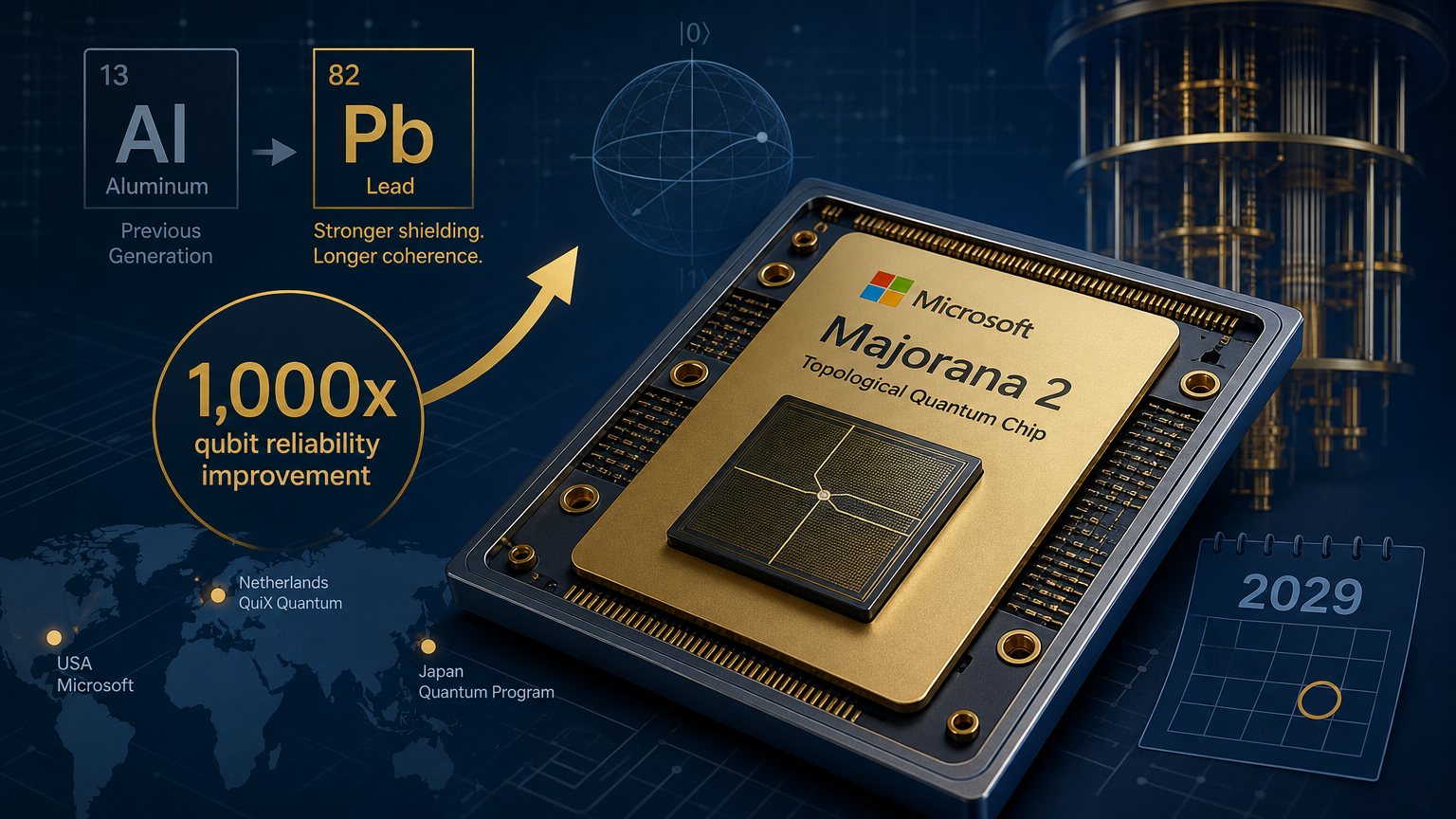
Microsoft unveiled Majorana 2 on June 2, 2026, reporting a 1,000-fold improvement in qubit reliability over its previous generation of topological quantum chips. The company also brought its target for a commercially viable, scalable quantum computer forward to 2029, roughly half its previously cited timeline.
That gives infrastructure teams a date to track, though it doesn't justify rebuilding a technology roadmap around hardware that isn't commercially available. As of June 12, the useful distinction is between the reported experimental results and Microsoft's forecast for turning them into a service. The results deserve attention. The forecast still depends on substantial engineering work and independent validation.
A longer-lived qubit, with fabrication tradeoffs
The central result is a reported mean qubit lifetime of 20 seconds, with peak instances lasting as long as one minute. Microsoft's previous generation operated in the millisecond range. For quantum operations that take microseconds, a longer lifetime could leave much more room to perform useful work before the quantum state is lost.
Microsoft presents the improvement as a 1,000-fold gain in reliability. That is a substantial claim, although qubit lifetime alone doesn't establish that a complete computer can perform reliable, error-corrected calculations at commercial scale.
The reported hardware change was a substitution of lead for aluminum in the chip's superconducting layer. The explanation accompanying the result credits lead with better protection against low-energy cosmic radiation and ambient vibration that can disturb quantum states. It also points to lead's higher superconducting critical temperature and magnetic properties suited to topological qubits.
A material substitution can sound simple after it works. Making it reproducible is a different problem. Lead introduced fabrication tradeoffs that reportedly took years to resolve before the lifetime gains could be achieved in a manufacturable chip.
Majorana 2 is described as about one-hundredth of a millimeter across. It still requires cryogenic temperatures near absolute zero and extreme electromagnetic shielding. Those operating conditions are far removed from ordinary server rooms or GPU clusters. If the chips become commercially useful, their effect on computing could eventually be comparable to the expansion of GPU use after 2012, but that remains a forecast rather than a consequence already demonstrated by this device.
Where Microsoft's AI agents helped
Microsoft says it used its Discovery agentic AI platform throughout Majorana 2's design and testing. The useful part of that account is the work assigned to the agents.
Quantum chip development involves repeated fabrication and measurement. Researchers build a device, collect thousands of measurements, adjust hundreds of parameters and repeat the process. Many interactions between those parameters aren't well understood in advance, so exploring the possible combinations takes considerable time.
According to Microsoft, measurement cycles previously consumed weeks of researcher time. Its agents automated portions of parameter optimization and helped identify qubit states in noisy measurement data. They also combined knowledge from research teams across multiple facilities and flagged fabrication anomalies before those anomalies developed into systematic failures.
Researchers retained final authority over conclusions, an arrangement Microsoft calls “scientist in the loop.” This is a sensible use of agentic AI: handling repetitive analysis and coordination so researchers can examine more experiments without handing over scientific judgment.
Microsoft's account is that the team covered more of the experimental search space in less time, contributing to a better chip. The reported lifetime result is a measurable output, which makes this claim more concrete than a general promise of AI-assisted discovery. It doesn't, by itself, establish how much of the improvement came from the agents rather than the materials work or other changes to the experimental process.
What the 2029 target would mean
A commercially useful quantum computer wouldn't replace a data center. The target is a machine that can solve particular classes of problems with a meaningful advantage over classical hardware.
Potential applications include breaking certain encryption schemes, simulating molecular dynamics for drug discovery and tackling optimization problems with large numbers of possible combinations. These are different workloads with different requirements. Reaching commercial usefulness in one wouldn't establish usefulness in all of them.
Early systems are likely to have narrow applications and expensive access. Broader availability by 2034 is a possible scenario if the technology follows a sustained exponential improvement curve, but Majorana 2 doesn't establish that trajectory. The reported gains suggest faster progress may be possible than forecasts from two years earlier assumed.
There is also a reason to keep independent validation close to the discussion. Neowin's coverage describes an earlier setback, saying that an original Majorana 1 announcement in 2023 included scientific claims that were later walked back after peer review identified problems in the underlying data.
The reported 20-second lifetime should therefore be treated as a result to examine, rather than as proof that Microsoft's commercial schedule will hold. A company announcement isn't a peer-reviewed paper. Independent scrutiny over the coming months will matter both for the measurement and for the claims about how well the architecture can scale.
Fault tolerance is the more useful comparison
Raw qubit counts have dominated quantum computing announcements for years. A large count is of limited use if errors prevent those qubits from completing a calculation. Fault tolerance means keeping a computation reliable despite errors, usually through error detection and correction.
A June 6 TechTimes analysis describes Microsoft, QuiX Quantum in the Netherlands and Japan's national quantum computing program as explicitly prioritizing fault tolerance over qubit count. That is a more useful basis for assessing progress toward practical machines than the number of physical qubits alone.
On June 3, QuiX reportedly installed a Feed-Forward Control Unit with 150 nanoseconds of latency for photonic quantum operations. These systems use light to carry quantum information. Feed-forward control uses a measurement result to determine a subsequent operation, so the time needed for detection and reconfiguration is a practical constraint. The coverage describes that full cycle as a window in which light travels about 30 meters.
IBM's Relay-BP decoder addresses another part of the problem: interpreting error-correction data. It is reported to reduce error-correction resource requirements by five to ten times compared with competing methods while running on standard field-programmable gate arrays, or FPGAs. These are configurable chips used for specialized processing. Keeping that classical processing overhead manageable matters because quantum hardware still needs conventional electronics to support its operation.
These efforts address different architectures, but each focuses on completing reliable calculations rather than simply adding qubits. Their appearance in the same week's coverage shows where much of the engineering attention is going.
Microsoft's topological approach is intended to make qubits inherently more stable than the superconducting qubits used by IBM and Google. If that advantage holds under independent testing and at larger scale, it could reduce the error-correction overhead needed for fault tolerance. That would strengthen the case for Microsoft's 2029 target. A longer-lived device is an encouraging component of that case, not a demonstration of the whole system.
Preparation that doesn't depend on the deadline holding
There are useful steps available without assuming that a scalable quantum computer will arrive in 2029.
- Inventory cryptographic dependencies. Quantum computing's most direct security concern for production systems is its potential to break current public-key encryption schemes. NIST finalized its post-quantum cryptography standards in 2024. Organizations handling long-lived sensitive data, including financial records, health information and regulated government data, should identify where vulnerable cryptography is used and map migration paths. Three years is a short planning window for changes spread across applications, vendors and infrastructure.
- Follow the Azure Quantum roadmap. The Next Web reports that Microsoft intends Majorana 2 to feed directly into Azure Quantum availability. For organizations with existing Azure commitments, an early-access route may come through that commercial relationship. Understanding the roadmap would make it easier to assess access programs when they open, without committing to an unproven delivery date.
- Identify candidate workloads. Architecture teams can examine optimization, molecular or financial simulation, combinatorial search and logistics scheduling for problems where quantum speedups are theoretically meaningful. That inventory should distinguish a plausible application from a demonstrated advantage. Operations teams don't need to change production systems today, but having candidate workloads ready could avoid a lengthy evaluation process once useful hardware becomes accessible.
Majorana 2's reported lifetime gains and the wider focus on fault tolerance make quantum computing worth including in long-range infrastructure planning. The appropriate commitment is limited: prepare cryptographic migrations, track independent results and identify workloads worth testing. Those steps remain useful if Microsoft's 2029 target slips.