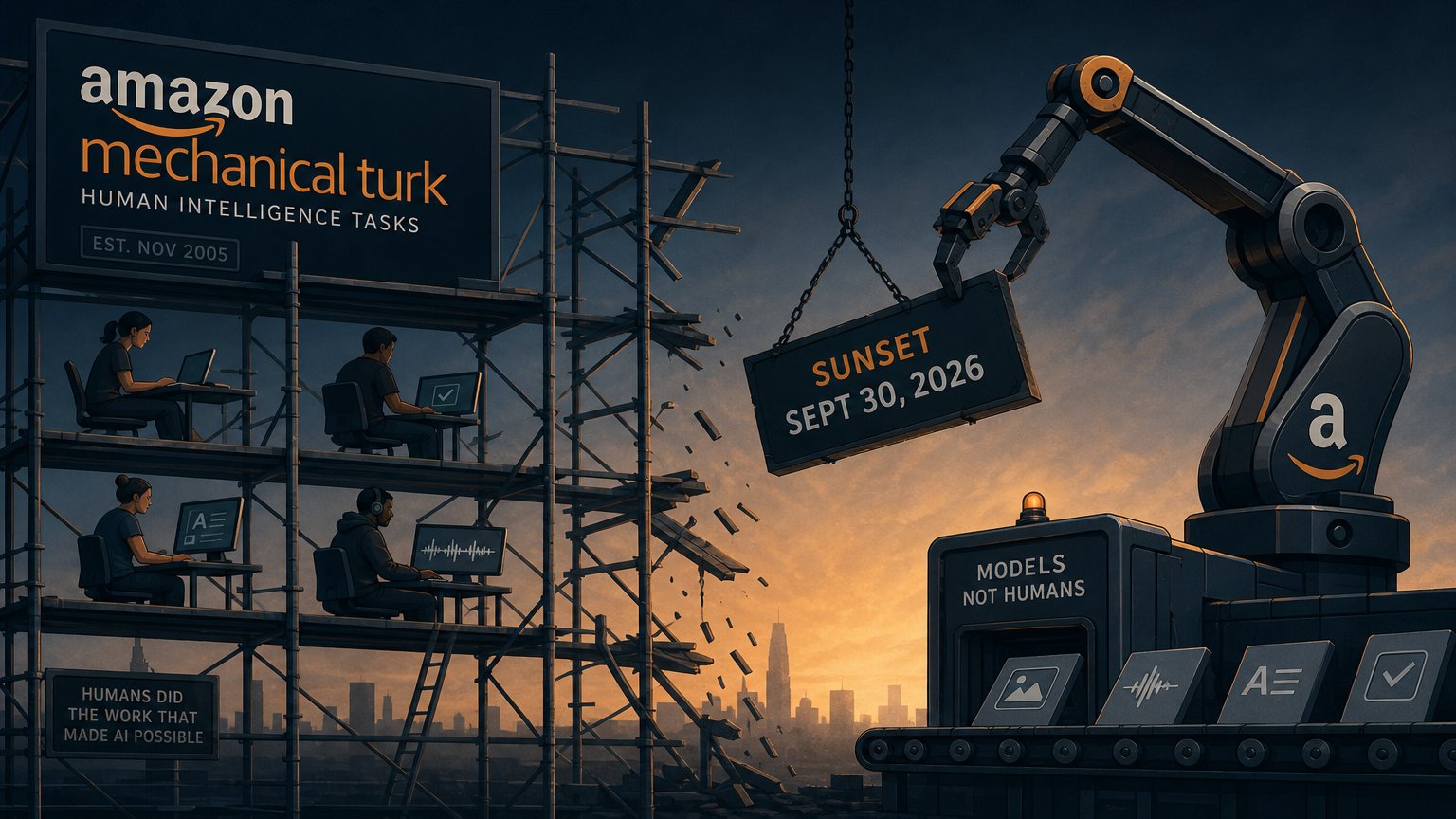
Amazon plans to close Mechanical Turk on September 30, 2026, leaving existing customers about five weeks to move their workflows. The marketplace launched in November 2005 to let developers send tasks that computers couldn't reliably handle to people instead. Jeff Bezos called it “artificial artificial intelligence.” Human work sat behind an API, a software interface that made it available to applications.
Over its 21-year run, Mechanical Turk became a source of training data for machine learning. Workers labeled images, transcribed audio, and classified text. Models can now perform many of those tasks, although Amazon hasn't publicly given that as the reason for the shutdown. Its explanation, as reported by CNBC, was that the decision followed “an assessment of programs and services.”
Amazon is also closing SageMaker Ground Truth and Amazon Augmented AI on the same date. Taken together, the closures suggest a broad retreat from services built around human data collection and review. They don't, on their own, establish that models can replace all the work those services supported.
The work behind the marketplace
Mechanical Turk called its jobs Human Intelligence Tasks, usually shortened to HITs. A requester posted a task, and a worker completed it for a small payment. The work included labeling images for computer vision, transcribing speech, categorizing sentiment for natural language processing, checking business listings, flagging policy violations, and answering academic surveys.
These tasks were often small individually but useful in large numbers. A text classifier needed examples of text paired with the right category. A speech recognition system needed recordings paired with transcripts. Mechanical Turk gave developers and researchers a way to buy those examples without hiring an annotation team.
The low price came with substantial costs for workers. Tasks paid anywhere from a few cents to a dollar, with no employment protections, health benefits, or minimum wage guarantee in most jurisdictions. Research on the workforce consistently put effective hourly earnings for most workers between $2 and $6. The marketplace attracted both workers in countries with lower living costs and people in more expensive countries seeking supplemental income. At its peak, more than 500,000 workers and requesters were active on the platform.
Cheap task results also needed quality control. Rejection rules, agreement checks across multiple workers, and questions with known answers could help identify unreliable responses or attempts to game a task. Those checks added work and cost beyond the posted price of each label.
How the market moved beyond MTurk
Mechanical Turk helped produce data for early computer vision models, speech recognition systems, and text classifiers. As those systems improved, demand grew for larger and better-controlled datasets. More specialized providers, including Scale AI, Mercor, and Prolific, offered more structured ways to obtain human work than an open task marketplace.
Models then became capable of doing some of the labeling themselves. That creates a connection between the labor Mechanical Turk supplied and the automation now competing with it. It isn't a simple causal chain in which one platform trained its own replacement. Specialized services, quality requirements, and changes in model capabilities all contributed to the pressure on the marketplace.
By 2023, researchers had documented that a significant fraction of MTurk workers were using AI tools to complete tasks intended for AI training. That complicates the value of buying human responses. If a task is meant to capture human judgment, an undisclosed model-generated answer may not provide the evidence the requester needs.
The economic argument for the shutdown is plausible even without a detailed explanation from Amazon. Mechanical Turk served a gap between inexpensive human cognition and machine capabilities that were either costly or unavailable. As models became cheaper and more capable, that gap narrowed quickly relative to the lifespan of a production data pipeline. A marketplace built around low-cost human tasks had less room to compete.
What existing customers need to move
As of August 27, September 30 is roughly five weeks away. Teams using Mechanical Turk for annotation, content review, or human-in-the-loop validation need to decide which work still requires people and where it should go. A human-in-the-loop system sends some decisions or outputs to a person for review rather than relying entirely on automation.
The TechCrunch coverage says the platform stopped accepting new customers on July 30. Existing requesters and workers have until September 30 to wind down operations, verify payment settings, and retrieve needed data.
There are several options for replacing the work, with different costs and limits:
- Synthetic training data. For many classification tasks, foundation models can generate labeled examples directly. These are broadly trained models that can be adapted or prompted for different tasks. Their labels may work well for structured problems and less well for nuanced judgments. Synthetic examples are worth testing for an initial dataset before committing to paid human annotation, but their quality shouldn't be assumed to match human labels.
- Specialized annotation providers. Scale AI, Prolific, Surge HQ, and Labelbox offer more structured workflows, including quality assurance and different worker compensation models. Their prices per label are higher, but the cost can be competitive after accounting for usable results and review effort. That structure is particularly valuable for safety, moderation, and other high-stakes classification work. Compensation and quality claims still need checking for the particular service and contract.
- Internal labeling tools. For modest volumes of internal work, a lightweight annotation workflow may be enough. Examples include evaluating model outputs, reviewing generated content, and validating retrieval-augmented generation responses, where a model answers using retrieved material. Argilla, LabelStudio, and Prodigy support language-model-assisted pre-labeling, which can reduce the amount of work left for human reviewers.
- Removing steps that no longer need people. A migration is a useful time to audit the existing pipeline. Some tasks that required human review in 2015 may be suitable for a well-prompted foundation model in 2026. The decision should turn on the task's error rate and consequences, rather than an assumption that every old review step needs a new annotation vendor.
Human review is likely to become more specialized
The broader risk extends to businesses built around tasks that AI currently performs poorly. Their advantage can shrink when model capabilities improve. That doesn't mean every such business will disappear, but it does make a service based only on inexpensive cognitive work vulnerable to substitution.
Human participation in AI systems is likely to shift toward harder cases. Ambiguous examples, unfamiliar situations outside a model's training experience, and adversarial inputs designed to fool automated review can still require careful judgment. Those tasks need different workers, instructions, and quality checks from a high-volume marketplace paying a few cents per response.
A reasonable forecast is that human-in-the-loop work will place more emphasis on expertise and on covering rare, difficult cases. That could mean higher wages, harder tasks, and lower volumes. It could be a better arrangement for the people doing the work, provided enough demand exists to support them. It isn't a guarantee that displaced crowdworkers will gain access to those jobs.
The workers' share of the outcome
Mechanical Turk's labor model deserves scrutiny alongside its technical contribution. Its use of independent contractors allowed requesters to buy work without the wage guarantees and protections associated with employment. Workers could also lose payment when requesters rejected their submissions, with little recourse against unfair decisions. The criticism is that the platform made it easy to obtain useful labor while leaving much of the risk with the person performing it.
The workers who helped build modern AI's training data generally received payment for individual tasks, not a share of the later value of the models. The people labeling images for ImageNet classifiers at three cents per image in 2011 aren't receiving a share of the returns that work helped generate. That remains part of the history even if a service that paid poorly doesn't deserve nostalgia.
The Register framed the closure as a case in which even AI couldn't save a platform that helped build AI. The practical deadline is less abstract. By September 30, requesters need replacement workflows and their data, and workers need to finish outstanding work and check their payment arrangements. Higher-paid expert annotation may grow, but it doesn't settle what happens to the people whose low-paid work supported the earlier systems.