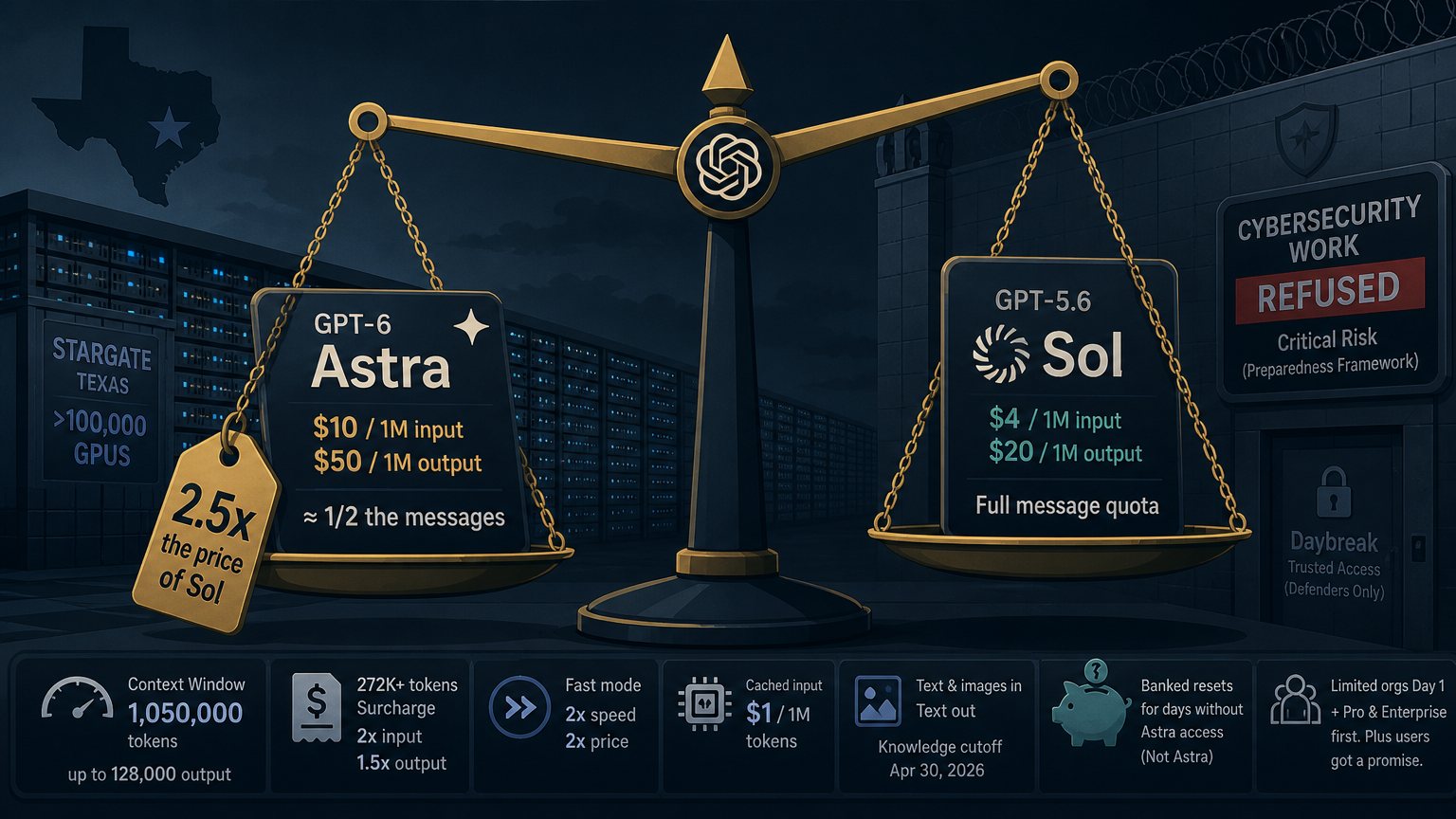
OpenAI released GPT-6 Astra on Thursday, September 3, 2026, at $10 per million input tokens and $50 per million output tokens. That's 2.5 times GPT-5.6 Sol's promotional price. Standard Astra also gets roughly half Sol's messages per usage window, and its commercial release restricts cybersecurity work.
Greg Brockman closed the press briefing with “Welcome to the AGI era.” The practical question is whether Astra's improvements justify its price and limits. Early independent code-review results suggest a stronger case for work that spans several files than for routine reviews.
Access, context and pricing
OpenAI's announcement listed a limited set of organizations with day-one access, followed by Plus, Pro, Business and Enterprise plans, the API, Azure and AWS Bedrock “over the coming days.” Pro and Enterprise received access first. Plus users were still waiting.
OpenAI's Thibault Sottiaux posted on X that paid plans would receive one banked reset for each day without Astra access. These resets refill usage on models already available to an account. They don't provide access to Astra.
The API model ID is gpt-6-astra. It accepts text and images and produces text, with a 1,050,000-token context window and up to 128,000 output tokens. Its knowledge cutoff is April 30, 2026.
The full context window comes with a substantial surcharge. Requests above 272K input tokens cost twice the input rate and 1.5 times the output rate for the whole request. Cached input costs $1 per million tokens. Fast mode doubles the price for up to twice the speed.
Sol's promotional rates are $4 per million input tokens and $20 per million output tokens. Astra's standard rates match Anthropic's Fable 5.1.
Aidan Clark, OpenAI's VP of research, said Astra was the company's first pretraining run on more than 100,000 GPUs at the Stargate site in Texas. That describes the scale of the training investment, though it doesn't establish what the model is worth for a particular task.
Large benchmark gains, smaller gains in code review
Astra scored 99.9% on ARC-AGI-3 with enhanced tools, compared with 7.8% for GPT-5.6 Sol and 30% for Claude Opus 5, according to Fortune. It scored 97.6% on FrontierMath Tier 4. On ExploitBench, OpenAI's own cybersecurity challenge, it reached 100%, against Sol's 78.5%.
The ARC Prize team called the result a step change while cautioning that saturating ARC-AGI-3 does not prove AGI. Gary Marcus made the same point. OpenAI defines AGI as outperforming humans at most economically valuable work, but GDPval, its benchmark for that work, was absent from the launch materials. That leaves an important gap between the launch claim and the evidence presented.
CodeRabbit's independent code review evaluation offers a more specific basis for a purchasing decision. Astra produced usable findings for 61.3% of labeled bugs, compared with 59.0% for Sol and 50.2% for Opus 5. The gap was larger on the harder cross-file subset: 57.1% for Astra against 47.6% for Sol.
Those results support using Astra for reviews that require understanding several files together. The overall gain was only 2.3 percentage points, however, at 2.5 times the token price. CodeRabbit's illustrative task, with 100K input tokens and 10K output tokens, costs $1.50 on Astra and $0.60 on Sol. CodeRabbit describes its results as early and directional, so they shouldn't be treated as a settled measure of performance.
Message limits are tighter
The Decoder reported limits from OpenAI's pricing documents showing that standard Astra gets roughly half Sol's messages in each five-hour window across tiers. The reported ranges include:
- Plus: 5 to 45 Astra messages, compared with 10 to 100 for Sol.
- Pro 20x: 100 to 900 Astra messages, compared with 200 to 2,000 for Sol.
The heavier GPT-6 Astra Pro variant has separate allowances: 200 messages a week on the $200 Pro plan, 50 a week on the $100 plan, and 50 a week on Business Premium. Business Standard gets 15 messages a month.
Fifteen monthly messages leaves little room for regular use on a business plan. These limits suggest pressure from inference costs, although they don't reveal what OpenAI pays to serve each request.
Sol also benefited from the optimization work, running about 60% faster on computer-use tasks. Astra's computer use runs close to twice as fast as before. Brockman described it filling spreadsheets and forms “often at superhuman speed.”
Anthropic released computer use in beta in October 2024, and Perplexity released it in February. OpenAI is the third vendor in that comparison to offer the feature, and the first to attach an AGI claim to it.
Cybersecurity capability is restricted
Astra is the first OpenAI model to reach the Critical level for cybersecurity under the company's Preparedness Framework. Its system card says that, with suitable tools and access, the model can find previously unknown vulnerabilities and develop new exploits across many well-protected systems.
The commercial version refuses work in that area. A less restricted version is available through Daybreak, OpenAI's trusted-access program for defenders working on vulnerability validation and detection engineering.
That puts OpenAI alongside Google in restricting access to a model capable of finding vulnerabilities in hardened systems. Operators of those systems need admission to a vetting program to obtain that capability. Z.ai's GLM-5.3 showed comparable exploit discovery in August without such a gate. Restrictions at some vendors therefore don't remove the need to patch quickly, since comparable capabilities may be available elsewhere.
The system card also says Astra is harder to monitor than Sol. OpenAI calls its technique recurrent depth, which hides some or all of the model's reasoning. According to the card, reasoning traces became less monitorable relative to GPT-5.6 Sol, while Astra became better able to control its own reasoning output.
OpenAI's response is a misalignment monitor on every inference that uses tools, along with live monitoring for destructive actions. Reported jailbreak refusal rates range from 94% to 99%. Resistance to indirect prompt injection is 99.79%, up from 96.23% for Sol.
Those are strong reported results, but they come from OpenAI's own evaluations. They also concern a model whose reasoning, by OpenAI's account, is less visible to monitors than its predecessor's.
Where the extra cost may be justified
Codex gained a useful experimental feature in this release: it can keep notes across context windows instead of compacting a long session into a summary. Earlier windows remain searchable for requirements or test results. That could help an agent recover a failing test from an earlier part of a session rather than lose it during summarization. The feature is scheduled to become the default in the coming weeks.
A cautious deployment choice is to leave production traffic on Sol and use Astra selectively for cross-file reviews and work that needs a long context window, while tracking the bill. CodeRabbit's results support the cross-file use case. The larger window provides capacity for longer inputs, but the 272K surcharge makes it an occasional option rather than an obvious default.
The AGI claim remains unpersuasive without GDPval results. The forecast is that OpenAI will publish them within a month, with a good score that falls short of the result needed to anchor that press briefing.