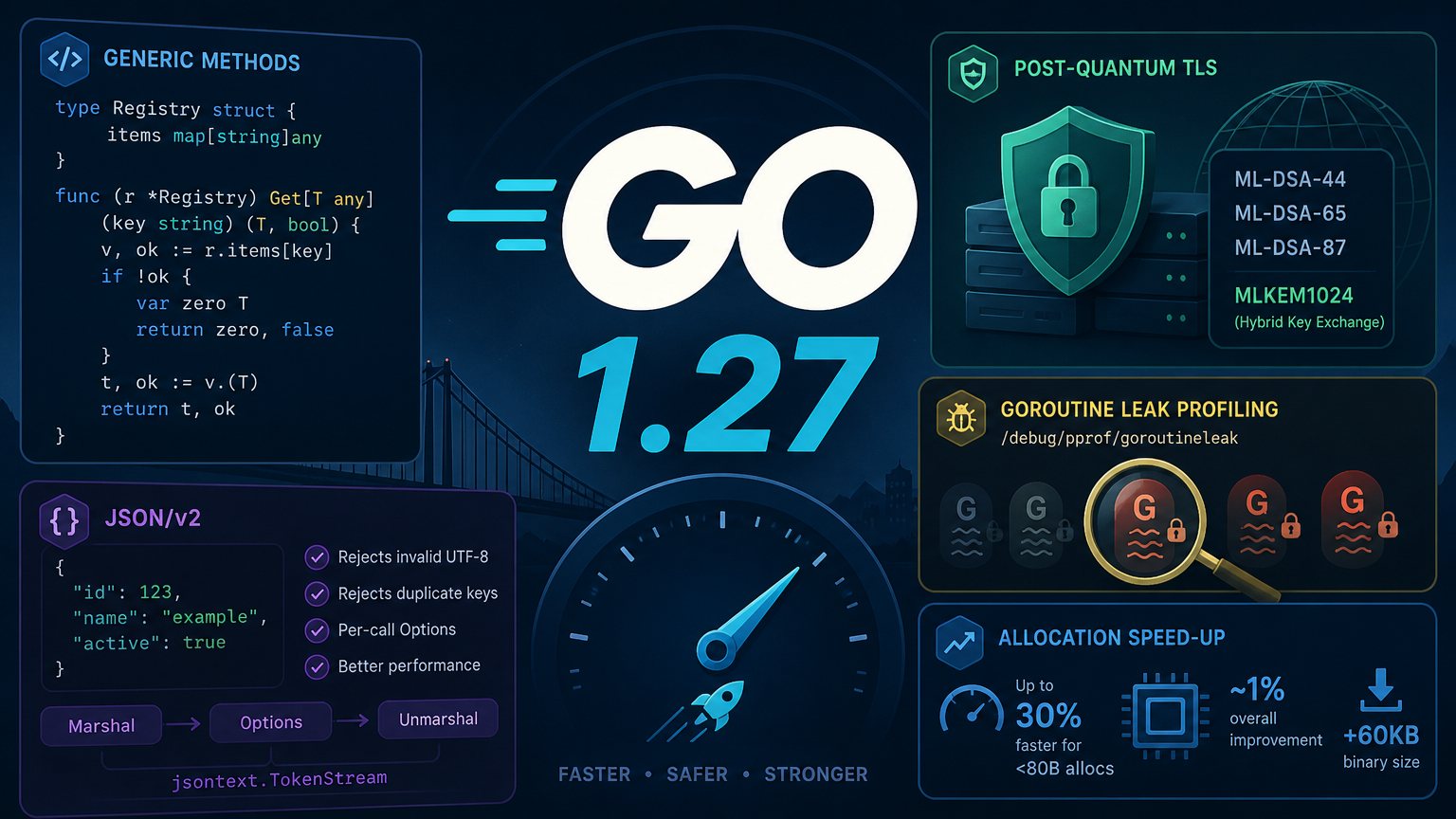
Go 1.27 shipped on August 2, 2026, with changes to several parts of production Go development. Methods can declare their own type parameters, the standard library adds post-quantum cryptography support, and a new encoding/json/v2 package offers stricter parsing and more flexible configuration. The release also adds goroutine leak profiling and reduces the cost of small allocations.
Some benefits arrive with a toolchain upgrade. Others need testing and explicit adoption, particularly stricter JSON handling and post-quantum TLS configuration.
Methods get their own type parameters
Go 1.18 introduced generics in 2022, but methods couldn't declare type parameters of their own. A receiver type could be generic, yet a method couldn't introduce an independent type parameter. That left developers using package-level generic functions, helper types, or implementations based on interface{} and reflection.
Go 1.27 allows a method to declare type parameters independently of its receiver. A typed lookup on a registry is one example:
type Registry struct {
    items map[string]any
}

func (r *Registry) Get[T any](key string) (T, bool) {
    v, ok := r.items[key]
    if !ok {
        var zero T
        return zero, false
    }
    t, ok := v.(T)
    return t, ok
}
The interface restriction remains. Interface methods cannot declare type parameters, so these generic methods cannot satisfy interface contracts. Code that needs polymorphism through interfaces still needs the existing patterns.
The release also applies function type inference in more assignment contexts. The compiler can work out type arguments in more places, reducing the need to write them explicitly.
Generic methods are useful where the previous restriction distorted an API. Typed registries and fluent builders are good candidates, as are APIs that passed functions around mainly to work around that restriction. Their availability isn't a reason to make every method generic. The interface limitation still needs to fit the design.
Post-quantum signatures and TLS support
The new crypto/mldsa package implements ML-DSA, the post-quantum digital signature scheme standardized in NIST FIPS 204. It supports ML-DSA-44, ML-DSA-65, and ML-DSA-87, with corresponding new SignatureScheme values in crypto/tls.
There are related changes across the standard library. TLS 1.3 support in crypto/tls now includes MLKEM1024 key exchange alongside ML-DSA signatures. Post-quantum hybrid key exchanges can be configured through Config.CurvePreferences. The crypto/x509 package can parse and generate certificates using ML-DSA keys and signatures.
For publicly accessible services, this calls for a migration plan rather than an immediate production configuration change. Current quantum computers cannot break TLS. The concern for encrypted traffic is harvest-now-decrypt-later: an adversary can collect traffic today and retain it in the hope that future hardware will make decryption possible. Key exchange is the relevant part of that confidentiality problem; digital signatures serve a separate authentication purpose.
The case for moving promptly also depends on forecasts that the arrival of cryptographically relevant quantum computers has moved closer over the past two years. The timing remains uncertain, but sensitive data may need protection for many years. NIST finalized its first three post-quantum cryptography standards in 2024. Standard-library support in Go as of August 2026 makes migration planning easier by reducing the need to introduce a separate cryptography library and take it through security review.
A practical rollout starts with Go 1.27 in a test environment. Enable ML-KEM hybrid key exchange, test against the clients that use the service, and check for failures during key exchange negotiation. A production rollout over the next quarter is a reasonable target if those tests succeed. Client compatibility still has to be established before broad deployment.
json/v2 changes defaults without forcing a full migration
The original encoding/json package accepts duplicate object names and doesn't reject invalid UTF-8. Those behaviors can hide input problems. Its handling of deeply nested structures has also become a performance concern, while the API makes some per-call configuration awkward.
Go 1.27 introduces encoding/json/v2 as an opt-in standard-library package with stricter defaults. It rejects invalid UTF-8 in JSON strings and duplicate names within JSON objects. Applications adopting those defaults may discover inputs that the older API accepted without complaint.
The API also changes how configuration works. Marshal, Unmarshal, and the streaming variants MarshalEncode and UnmarshalDecode accept variadic Options arguments. Behavior can be configured at the call site without changing global state. For custom parsing, the lower-level encoding/json/jsontext package provides direct access to the token stream.
Performance improves, particularly during unmarshaling. The original encoding/json package now uses the v2 implementation underneath while preserving the v1 API. Existing applications can therefore receive some performance benefit from upgrading the toolchain without changing their imports. The stricter defaults require explicit adoption of json/v2.
That separation gives services room to migrate gradually. An API receiving duplicate keys or malformed UTF-8 from clients outside its control can retain the v1 API while individual handlers move to v2. Changing parser behavior across every endpoint at once could otherwise turn previously accepted requests into failures.
If the v2 implementation behind the v1 API causes problems, building with GOEXPERIMENT=nojsonv2 restores the previous implementation. The Go team has flagged that escape hatch for removal in a future release, so it shouldn't become a long-term dependency.
For new code, encoding/json/v2 is the recommended starting point. For existing services, run JSON round-trip tests against the stricter parser and inspect the failures. Malformed input needs attention even when compatibility requirements prevent an immediate rejection policy.
Finding goroutines that cannot make progress
Go 1.27 adds a goroutineleak profile through runtime/pprof. Applications using net/http/pprof can access it at /debug/pprof/goroutineleak. The profile identifies goroutines blocked on concurrency primitives that can never be unblocked.
These leaks can accumulate quietly in concurrent services. A goroutine may wait on a channel that will never receive another send. Another may remain blocked on a mutex whose holder panicked without releasing it. The visible symptoms can arrive much later: growing memory use, a slower scheduler, or a goroutine dump containing ten thousand goroutines where ten were expected.
Without targeted tooling, diagnosis often means reading stacks and tracing dependencies by hand. The new profile provides a structured starting point within existing pprof tooling.
Its detection scope is important. A goroutine blocked on a reachable primitive may not appear if a potential sender still exists, even when the application will never arrange for that send to happen. The profile can identify some permanent waits, but it doesn't establish that every goroutine outside the report is healthy.
Faster small allocations
The Go 1.27 compiler generates size-specialized allocation routines. For allocations under 80 bytes, allocation cost drops by up to 30%. The overall improvement for allocation-heavy programs is roughly 1%, with a binary-size increase of about 60 KB.
Those figures describe different things. A substantial reduction in the cost of a small allocation produces a smaller improvement across a whole program, which also spends time doing other work. The tradeoff should be reasonable for most production deployments.
JSON deserialization, HTTP middleware chains, and gRPC message handling commonly involve small allocations. Services spending meaningful time in the allocator are good candidates for measuring the benefit. The optimization requires no source changes.
Planning the upgrade
The Go 1.27 release documentation covers the changes in detail. The compatibility guarantees remain in place, with code that compiled under Go 1.26 expected to compile under Go 1.27. Compatibility doesn't remove the need to test application behavior.
- Update the toolchain to Go 1.27 and run the full test suite.
- Enable
/debug/pprof/goroutineleakin staging and leave it running through a normal workload cycle. - Test existing JSON handling against
encoding/json/v2, paying particular attention to malformed UTF-8 and duplicate object names. - For customer-facing services handling sensitive data, put post-quantum TLS testing on the Q3 or Q4 roadmap and validate negotiation with real clients before rollout.
The upgrade is worth testing promptly. Allocation improvements and the JSON implementation changes can benefit existing code, while generic methods, stricter parsing, and post-quantum TLS support can be adopted where their constraints fit the application.