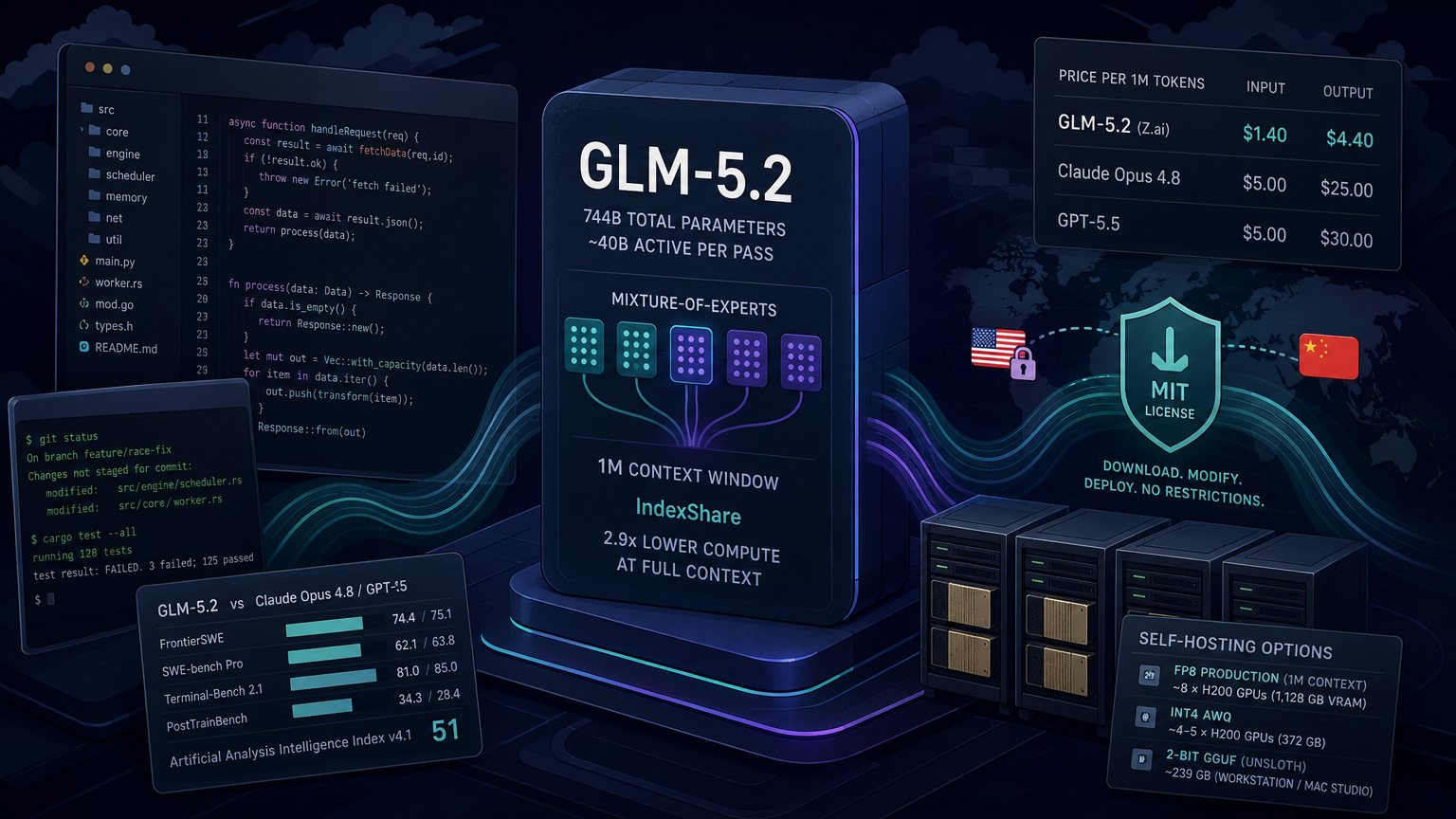
Z.ai's GLM-5.2 gives infrastructure teams a reason to test an open-weight model against the closed models handling their coding workloads. Its reported benchmark scores are close to Claude Opus 4.8 on some engineering tasks, while its API prices are substantially lower. The downloadable weights also offer a deployment option that API-only models don't.
Z.ai, the Beijing-based company formerly known as ZhipuAI, launched the API on June 13, 2026, and released the weights under an MIT license on June 16. By July 10, GLM-5.2 was the top story on Hacker News, with engineers reporting that it held up in coding workflows where earlier open models had struggled.
As of July 11, the case for evaluating it is strong. The harder question is whether its performance and deployment costs fit a particular production workload.
The model and its million-token context
GLM-5.2 is a Mixture-of-Experts model with 744 billion total parameters and roughly 40 billion active per forward pass. That design uses only part of the model for each inference step, reducing computation compared with activating every parameter. It doesn't remove the need to store the full model's weights.
The context window is 1 million tokens. Z.ai describes the model as built for large-scale implementation, automated research, performance optimization, and complex debugging. Those tasks can require substantial context, such as navigating a 200,000-line codebase or following a debugging process across multiple tool calls and retries.
Z.ai attributes much of the long-context efficiency to a component called IndexShare. In its description, standard sparse attention computes an index component independently at every layer. IndexShare reuses that component across several layers, reducing per-token compute at full context length by a reported factor of 2.9.
That reduction could make longer contexts more practical. If a million-token request approaches the cost of a much shorter request, a team may choose to pass more source material directly rather than build an elaborate retrieval pipeline. The compute figure alone, however, doesn't establish that a 1M-token window costs roughly the same as a 128K-token window.
The weights are available at zai-org/GLM-5.2 on Hugging Face. The MIT license permits downloading, modifying, fine-tuning, and commercial deployment without a separate commercial agreement or model-specific usage restrictions.
How close are the coding scores?
Benchmarks are useful when they resemble the work a model will perform. They become less useful when gains reflect overfitting to popular evaluations or changes in evaluation methods. For GLM-5.2, the most relevant results are those involving code changes, terminal work, and multi-step engineering tasks.
| Evaluation | GLM-5.2 score | Comparison |
|---|---|---|
| FrontierSWE | 74.4 | Claude Opus 4.8: 75.1 |
| SWE-bench Pro | 62.1 | No comparison given |
| Terminal-Bench 2.1 | 81.0 | Claude Opus 4.8: 85.0 |
| PostTrainBench | 34.3 | GPT-5.5: 28.4 |
FrontierSWE uses real GitHub issues requiring code changes. The 0.7-point gap between GLM-5.2 and Opus 4.8 is small enough to justify a direct workload comparison, though the scores alone don't establish that the difference is statistically insignificant. Terminal-Bench 2.1 measures terminal-based engineering tasks, where Opus retains a four-point lead. GLM-5.2 leads GPT-5.5 on PostTrainBench, described as one of the harder reasoning evaluations.
The reported result on the independent Artificial Analysis Intelligence Index v4.1 is 51, the highest score recorded for an open-weight model at launch.
Analyst Nathan Lambert at Interconnects described GLM-5.2 as the first open model that feels suitable as a general agent in coding harnesses. That's a judgment about how the model behaves inside software that manages its tools and execution, rather than just its answers on a test. Earlier open models could perform well on structured evaluations and still struggle with less structured agentic work.
API pricing and the cost of completed work
Z.ai's listed API prices are $1.40 per million input tokens and $4.40 per million output tokens. The comparison prices are:
| Model | Input per million tokens | Output per million tokens |
|---|---|---|
| GLM-5.2 | $1.40 | $4.40 |
| GPT-5.5 | $5.00 | $30.00 |
| Claude Opus 4.8 | Approximately $5.00 | Approximately $25.00 |
The estimate for a median coding workload is roughly one-sixth of GPT-5.5's API cost, assuming comparable task completion. That ratio depends on the input-to-output mix. Input tokens are about 3.6 times cheaper, while output tokens are about 6.8 times cheaper, so one-sixth isn't a universal discount.
For a deployment processing tens of millions of tokens each day, those prices can materially affect a quarterly budget. But the useful comparison is the cost of completed work. A cheaper model that needs more retries or produces changes requiring more correction can lose some of its token-price advantage.
The reported scores make that comparison worth running. They don't establish comparable completion rates across every coding workflow.
Self-hosting still needs substantial hardware
Open weights don't make GLM-5.2 a lightweight production model. Running the FP8 checkpoint with support for the full 1M-token context is estimated to require approximately 8 × H200 GPUs. That provides roughly 1,128 GB of VRAM, with about 750 GB needed for weights and the remaining capacity providing room for the KV cache, which stores attention data during inference.
A cloud deployment at that size also needs engineering support for the inference cluster. The annual compute commitment has been estimated in the eight figures, before that engineering overhead, but no cloud rate or fleet-size calculation accompanies the estimate. It shouldn't be treated as a quoted cost for one eight-GPU instance.
Smaller versions reduce the memory requirement:
- INT4 AWQ quantization: approximately 372 GB for weights, with a suggested configuration of four to five H200 nodes for teams that don't need the full context length.
- Unsloth's 2-bit dynamic GGUF: approximately 239 GB, making local development possible on a suitably configured multi-GPU workstation or a high-memory Mac Studio.
Those smaller configurations are relevant to privacy-sensitive development and teams seeking local control without cloud egress concerns. Fitting the weights into memory, however, is a different requirement from providing production throughput with a million-token context.
For most teams, the API is the more practical starting point. Self-hosting becomes more attractive when sustained volume supports the hardware costs, data-governance rules prohibit third-party APIs, or the work requires fine-tuning on proprietary code or domain knowledge.
Open weights change the dependency risk
GLM-5.2 arrived roughly two months after reported U.S. export restrictions on Claude Fable 5, described as Anthropic's most capable model, limited access for certain international deployments. That reported restriction illustrates a risk for infrastructure planning: access to an API-hosted model can depend on a provider's decisions and the regulations governing it.
GLM-5.2's Chinese origin brings its own political and compliance considerations. Whether it is suitable depends on the deployment's threat model and applicable rules. Downloadable weights don't remove legal obligations, including any export restrictions that apply.
They do provide more operational control. A self-hosted deployment is less directly exposed to the model provider changing API prices, discontinuing service, or suffering an outage during incident response. It still depends on hardware, hosting, and the team's ability to operate the inference stack.
For complex coding work, GLM-5.2 makes an open-weight fallback more credible. Whether it can serve as a peer to a closed model, rather than a reduced-capability backup, needs to be established on the tasks the fallback would handle.
What to test before changing production routing
There's no need to remove existing Claude or GPT-5.5 integrations solely because of these results. Proprietary models retain advantages in some multimodal tasks, reasoning evaluations, and established tooling ecosystems. Running an inference stack also creates work that an API customer doesn't have to take on.
Two decisions deserve another look. First, complex coding tasks routed to a closed model should have a GLM-5.2 comparison before the higher cost is accepted. That comparison should cover task completion, retries, tool use, and the corrections required after a run.
Second, fallback plans should test whether GLM-5.2 can carry meaningful engineering workloads when the primary provider is unavailable. A model that scores well but fails inside the existing coding harness isn't ready for that role.
If those tests hold up, lower API spending and the option to control the weights may outweigh a small capability difference. The remaining work is to determine where that tradeoff holds, and where the closed model still earns its higher price.